Famous Movies and TV Shows Filmed in Berlin
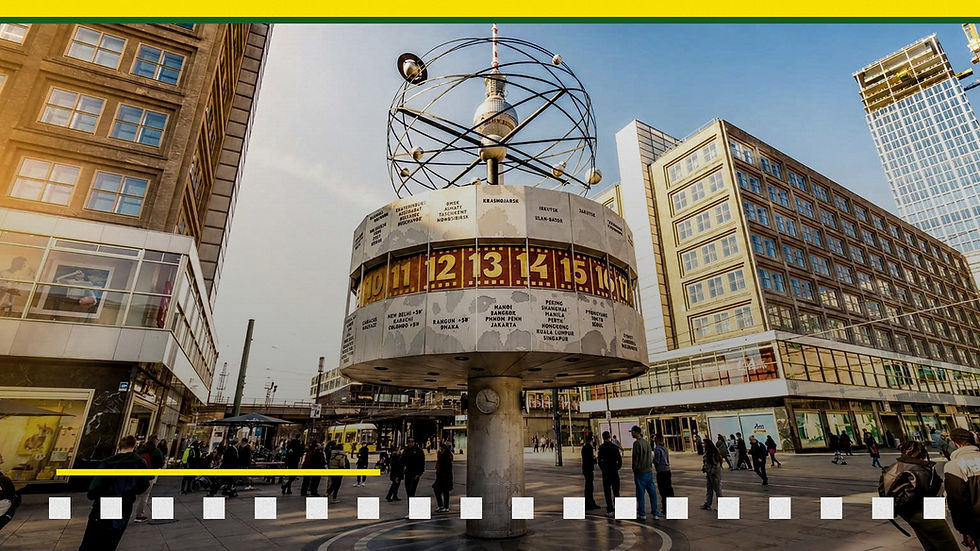
The World Time Clock at Alexanderplatz: meeting point for my walking tours, and a film location in its own right.
I start my walking tours at the World Time Clock on Alexanderplatz, and almost every week a guest looks around and says the square feels strangely familiar. Usually it is not a history book they are remembering. It is a screen. Jason Bourne met his contact exactly here. Babylon Berlin staged its Weimar chaos a few steps away. The fake TV news in Good Bye, Lenin! was set against these same buildings.
Berlin has always looked like a movie set, but not in the polished, postcard sense. The city carries layers: imperial avenues, socialist boulevards, Cold War borders, techno basements, empty lots, and streets that still feel like they have seen too much. Filmmakers keep coming back for exactly that.
This guide collects the famous movies and TV shows filmed in Berlin, tells you which locations you can actually stand at, and is honest about the ones you cannot. My advice before you start: do not build your Berlin trip as a checklist of exact camera positions. I have watched guests try that, and it turns a good city into a scavenger hunt. Pick one or two screen moods, walk the streets that carry them, and let the rest find you.
Quick Answer: Famous Movies and TV Shows Filmed in Berlin
Famous movies filmed in Berlin include Run Lola Run, Wings of Desire, Christiane F., Good Bye, Lenin!, The Lives of Others, Victoria, The Bourne Supremacy, Bridge of Spies, The Hunger Games: Mockingjay - Part 2, The Ballad of Songbirds and Snakes, Tár, and John Wick: Chapter 4.
Famous TV shows connected to Berlin include Babylon Berlin, Kleo, Dark, Homeland Season 5, Berlin Station, Sense8, Deutschland 83, The Queen's Gambit, Unorthodox, and Berlin ER.
Not all of these are simple "go to this exact street corner" cases. Berlin is used in three different ways on screen:
Berlin as itself: the story is set here and the city is part of the plot.
Berlin as history: the city plays a specific era, especially divided Berlin, the GDR, or the Weimar years.
Berlin as a stand-in: Berlin locations double for Moscow, Las Vegas, New York, or fictional worlds.
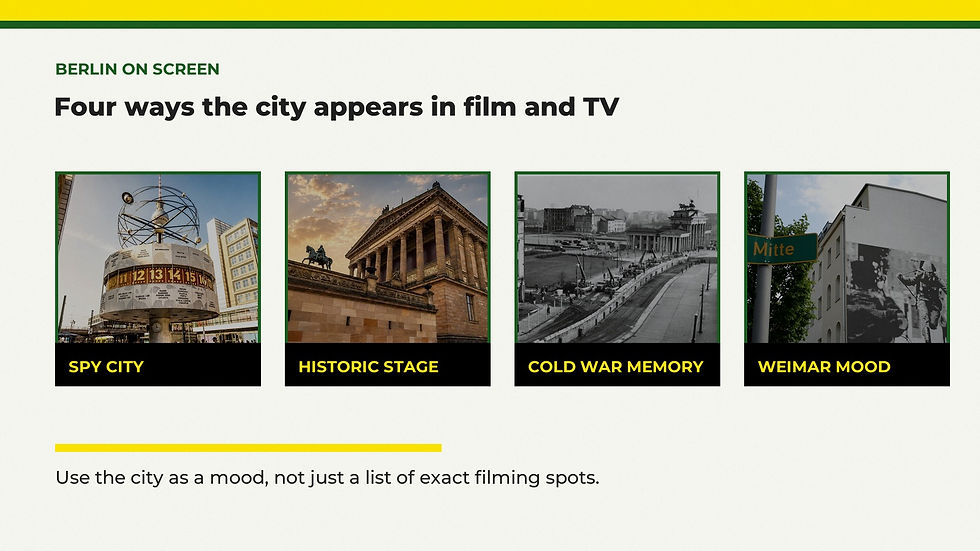
Four ways the city shows up on screen. Knowing which one a story uses tells you where to walk.
Why Berlin Is So Cinematic
Berlin gives filmmakers a rare mix of real history and visual flexibility. Few cities can move so quickly from grand boulevards to concrete modernism, from lakeside calm to underground nightlife, from Cold War geometry to chaotic street energy.
It is also a serious production hub. Studio Babelsberg in Potsdam is one of the oldest large film studios in the world, and a Medienboard Berlin-Brandenburg study published by visitBerlin back in 2014 already found that films inspire roughly one in ten visitors to come to Berlin. Walk through Mitte on a normal weekday and there is a decent chance you will pass a closed street, a camera crane, or a catering truck. I treat it as a small Berlin ritual: someone is always filming something here.
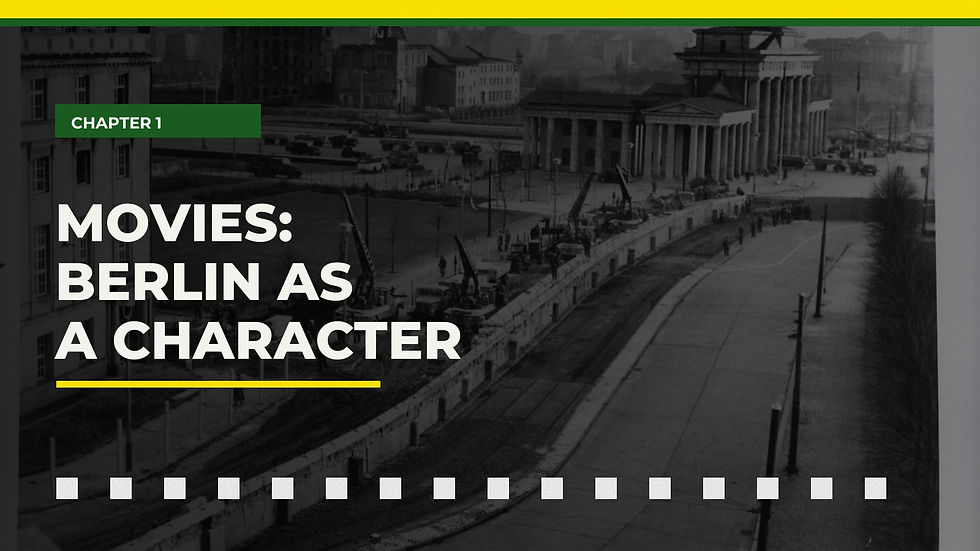
Chapter one: the movies that made Berlin a screen character.
Movies Filmed in Berlin
Run Lola Run (1998)
If one film turned Berlin into pure motion, it is Run Lola Run. Tom Tykwer's cult thriller sends Lola sprinting through the city again and again, but the geography is deliberately scrambled. Berlin is not presented as a realistic route. It is a rhythm machine.
The most recognizable location is Oberbaumbrücke, the red-brick bridge between Kreuzberg and Friedrichshain. Lola's apartment is placed around Albrechtstraße 13-14 in Mitte, behind the Berliner Ensemble, and other cuts use Friedrichstraße, Unter den Linden, Bebelplatz, and the Gendarmenmarkt area.
One honest warning: do not try to walk Lola's route in order. It does not exist. The film jumps across the city in seconds, which is exactly the point. Cross Oberbaumbrücke on foot instead, ideally in late light, and you get the film's energy in one real place.
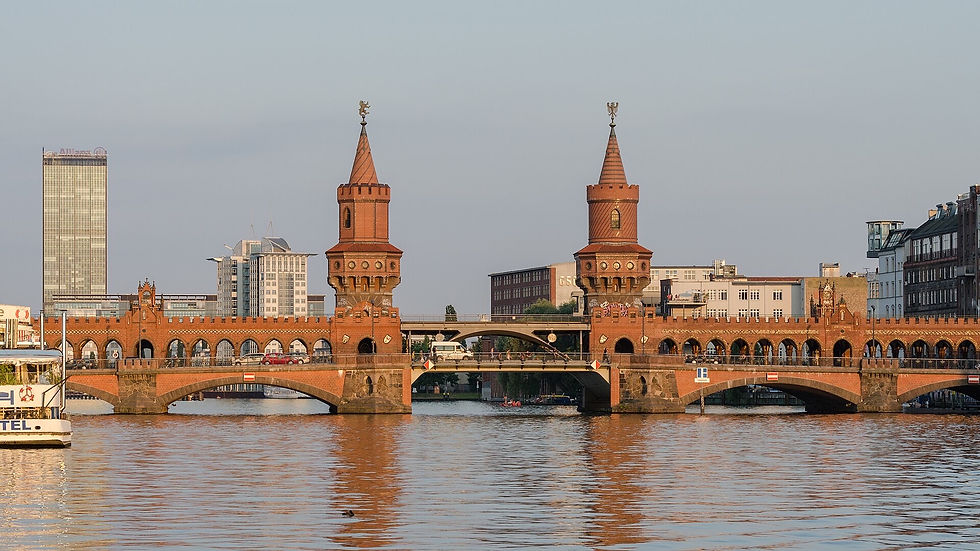
Oberbaumbrücke, the bridge Lola crosses at full speed. In real life it rewards a slow walk.
Berlin mood: kinetic, chaotic, 1990s, post-Wall.
Good to visit: Oberbaumbrücke, Bebelplatz, Friedrichstraße, Unter den Linden.
Wings of Desire (1987)
Wings of Desire captures West Berlin before reunification as a place of longing: libraries, empty lots, walls, and skies watched by angels. Wim Wenders filmed a city that no longer exists in the same form, which is exactly why the film still matters.
The strongest real locations are the Siegessäule in Tiergarten, where the angels perch, the Staatsbibliothek at Potsdamer Straße with its famous reading-room scenes, and the ruin of Anhalter Bahnhof. Location guides such as Movie-Locations are useful here because so much of the film's Berlin has been rebuilt or absorbed into the new city.
My tip: go up to the Siegessäule viewing platform and look toward Potsdamer Platz. In the film that direction was wasteland along the Wall. Today it is glass towers. That single view explains more about Berlin than most museums.
Berlin mood: poetic, divided, melancholic, timeless.
Good to visit: Siegessäule, Staatsbibliothek Potsdamer Straße, Potsdamer Platz, Anhalter Bahnhof.
Christiane F. (1981)
Christiane F. is one of the darkest films connected to West Berlin. Based on the autobiographical book about teenage addiction, it became inseparable from Bahnhof Zoologischer Garten and the hard-edged West Berlin of the late 1970s. visitBerlin lists Zoo Station as a filming location, and Christiane's home high-rises in Gropiusstadt were real shooting environments too.
This is not a glamorous film stop, and I would not treat it as one. The station area has changed enormously. Treat it as cultural memory: stand in front of Bahnhof Zoo, look toward the Kaiser Wilhelm Memorial Church, and you are looking at the old center of West Berlin, with all its weight.
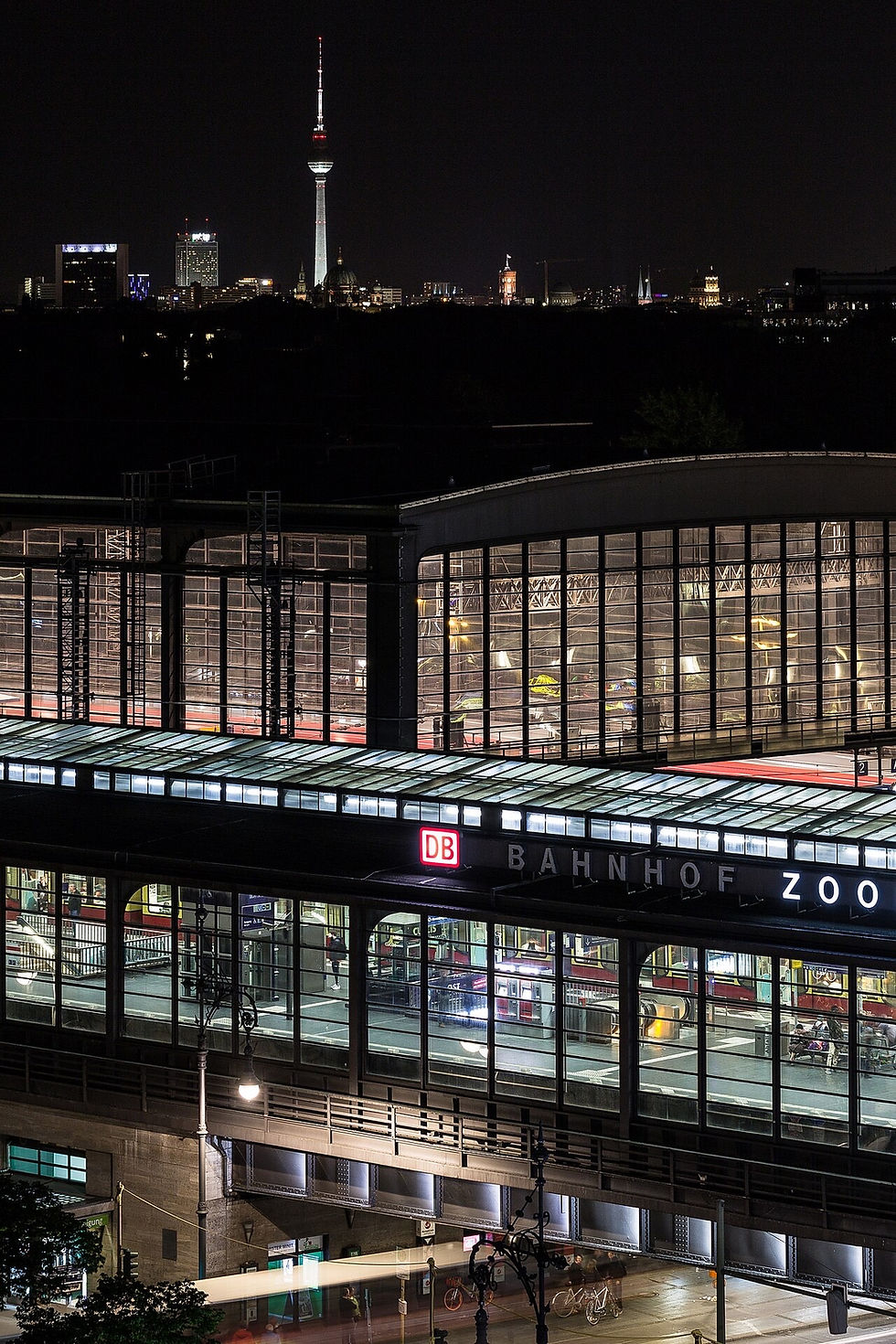
Bahnhof Zoo at night, with the TV Tower far on the horizon. The film's world is gone, but the station still anchors the old West Berlin center.
Berlin mood: raw, nocturnal, West Berlin, social realism.
Good to visit: Bahnhof Zoologischer Garten, Hardenbergstraße, Kaiser Wilhelm Memorial Church area.
Good Bye, Lenin! (2003)
Good Bye, Lenin! is still the best film for understanding how strange reunification felt at street level: a son rebuilds East Germany inside one apartment so his mother will not learn that her country disappeared while she was in a coma.
The film lives in East Berlin's architecture. Karl-Marx-Allee, Strausberger Platz, and Alexanderplatz carry its visual language, and the World Clock appears as the backdrop of the famous fake news bulletin. If you want the full story of the square itself, I wrote a separate guide to Alexanderplatz then and now.
The most rewarding real visit is Karl-Marx-Allee. Walk it from Strausberger Platz toward Frankfurter Tor and the film's world opens up immediately: monumental socialist facades on both sides, built as a showcase boulevard for the GDR.
Berlin mood: post-Wall, bittersweet, nostalgic, changing fast.
Good to visit: Karl-Marx-Allee, Strausberger Platz, Alexanderplatz.
The Lives of Others (2006)
The Lives of Others is not about landmarks. It is about rooms, listening devices, and the fear of being watched in East Berlin. That is why it pairs so well with the real places that survived: the Stasi Museum in the former Stasi headquarters on Normannenstraße, and the former Stasi prison memorial at Berlin-Hohenschönhausen.
If you watch one film before visiting Berlin's Cold War sites, make it this one. Then choose the Stasi Museum first; the offices of Stasi chief Erich Mielke are preserved there almost untouched. I put both sites in my guide to Cold War Berlin in 5 key locations if you want a full route.
Berlin mood: controlled, tense, intimate, East Berlin.
Good to visit: Stasi Museum on Normannenstraße, Berlin-Hohenschönhausen Memorial.
Victoria (2015)
Victoria feels like Berlin at 5 a.m.: beautiful, risky, half-awake, and slightly out of control. The whole film is one single continuous take, shot on the third attempt between roughly 4:30 and 7:00 in the morning of 27 April 2014, moving through about 22 locations in Kreuzberg and Mitte.
That is not a technical footnote. It is the reason the film captures Berlin nightlife better than any montage could: the city becomes a real-time maze of side streets, rooftops, and bad decisions.
There is no tidy location list worth chasing here. Instead, walk the corridor between late-night Kreuzberg and central Mitte and you are inside the film's geography. If you are actually planning a club night rather than a film pilgrimage, my guide on what to wear to Berlin clubs is the practical version.
Berlin mood: nocturnal, modern, restless, intimate.
Good to visit: Kreuzberg nightlife streets, Mitte side streets around Friedrichstraße.
The Bourne Supremacy (2004)
Berlin is perfect for spy thrillers because the city already carries layers of secrecy. In The Bourne Supremacy, Bourne meets Nicky Parsons at the World Time Clock on Alexanderplatz and disappears into a crowd of demonstrators. The film also used the Tiergarten Tunnel for its chase scene in 2003, before the tunnel opened to normal traffic in 2006, with the final crash staged at the Potsdamer Platz exit.
That World Clock is where my own tours begin, and I never get tired of the coincidence. I explain the object itself, a GDR design from 1969, in my guide to the Weltzeituhr at Alexanderplatz.
For a visitor, the cleanest version is simple: stand at the World Clock, then walk Friedrichstraße. You have covered the film's two best moods, crowd and transit, in under an hour.
Berlin mood: spy-city, transit, pressure, anonymity.
Good to visit: Alexanderplatz World Clock, Friedrichstraße, Zoo Station.
Bridge of Spies (2015)
Steven Spielberg did something rare here: he filmed the story where it actually happened. The prisoner exchange in Bridge of Spies was shot on the real Glienicke Bridge between Berlin and Potsdam, the same bridge where the CIA and KGB swapped Rudolf Abel and Gary Powers in 1962. The bridge closed for filming in November 2014, and even Angela Merkel visited the set.
The production also used Tempelhof Airport for the arrival scenes and the former Stasi prison at Hohenschönhausen for interrogation scenes. visitBerlin's Glienicke Bridge page has the background.
The bridge is an easy half-day trip: S-Bahn S7 toward Potsdam, then a short bus ride or a pleasant walk. Stand in the middle and you are standing on the exact line where East met West. Few film locations anywhere deliver that much real history per square meter.
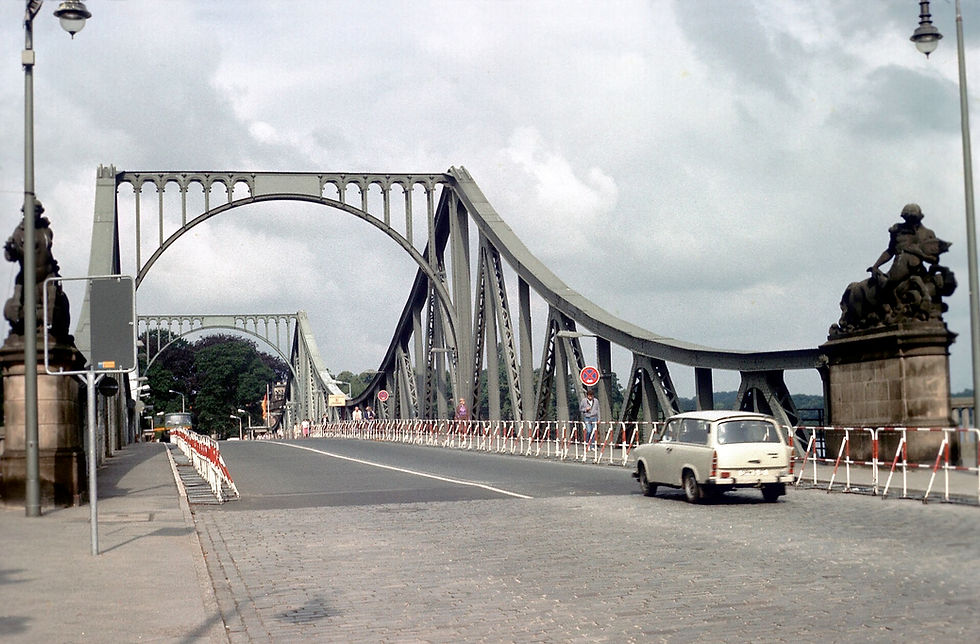
Glienicke Bridge in June 1990, border barriers still standing. Spielberg restaged the 1962 exchange on this exact bridge.
Berlin mood: Cold War, diplomatic, wintry, historic.
Good to visit: Glienicke Bridge, Tempelhof Airport, Berlin-Hohenschönhausen Memorial.
The Hunger Games: Mockingjay - Part 2 (2015)
Parts of Mockingjay - Part 2 were filmed in the Berlin region, and this is a good example of Berlin not playing Berlin. The most important real locations are Tempelhof Airport, whose monumental entrance became the District 2 base, and the parking level under the ICC at Messedamm, which plays the Capitol's orange-tiled underground. The flooded tunnel scenes were studio sets, so do not go looking for those.
These are large, hard-edged spaces, and that is the lesson: Berlin's architecture of power converts very easily into dystopia.
Berlin mood: dystopian, monumental, concrete.
Good to visit: Tempelhof Airport, ICC / Messedamm area, Studio Babelsberg in Potsdam.
The Hunger Games: The Ballad of Songbirds and Snakes (2023)
The franchise came back to Berlin for the prequel, and this time the locations are right in the tourist center. The Capitol's Academy borrows the pillared facade of the Altes Museum on Museum Island, and the prize ceremony hall is the Bärensaal inside the Altes Stadthaus on Klosterstraße. The Games arena exterior is the Olympiastadion, extended with digital effects, and Capitol street views use Strausberger Platz on Karl-Marx-Allee.
I like this one because guests can test it immediately. My tour route passes the Altes Museum, and once you know it played the Capitol, you cannot unsee it: Schinkel's colonnade was designed to project power, and Hollywood simply agreed.
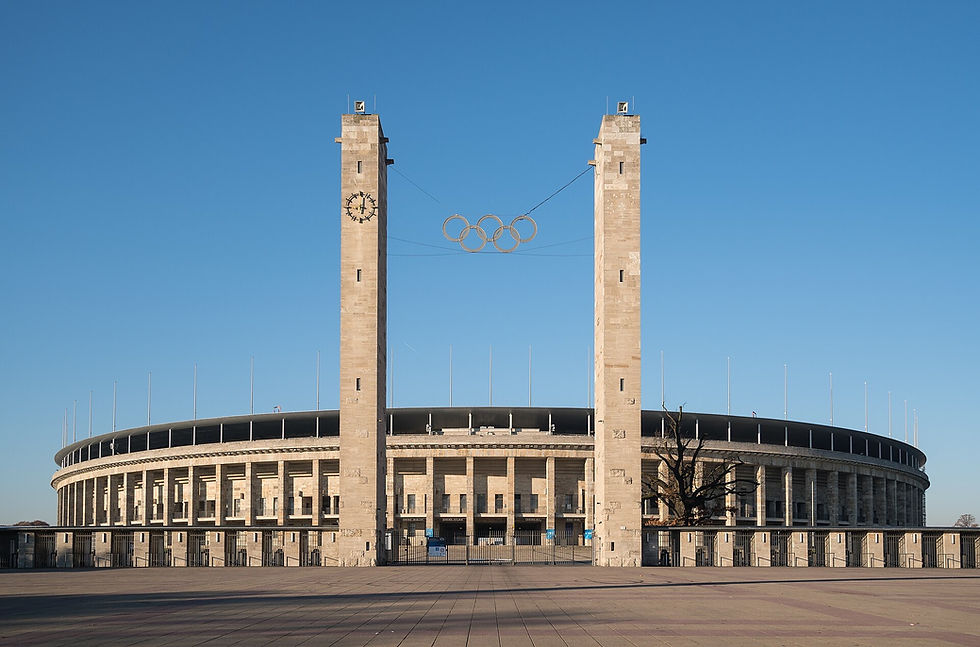
The Olympiastadion played the Games arena exterior. The real building needs no set dressing to feel monumental.
Berlin mood: monumental, imperial, unsettling.
Good to visit: Altes Museum, Olympiastadion, Strausberger Platz, Altes Stadthaus.
Tár (2022)
Tár gave Berlin its most prestigious recent screen role: the daily life of a world-famous conductor, played by Cate Blanchett, set in the city's cultural machine. Most of the film was shot in Berlin, and its best visitable location is hiding in plain sight: Lydia Tár's brutalist penthouse sits on top of the Boros Collection bunker on Reinhardtstraße, a WWII air-raid bunker turned private art gallery that you can visit with a booked tour.
One honest correction you will not find in most listicles: the orchestra scenes were not filmed at the Berliner Philharmonie. They were shot in the Kulturpalast in Dresden. So skip the Philharmonie pilgrimage for this film and book the Boros bunker instead; the building's history, from bunker to banana warehouse to techno club to art space, is one of the best short versions of Berlin's whole story.
Berlin mood: controlled, cultured, cold elegance.
Good to visit: Boros Collection bunker on Reinhardtstraße, Staatsbibliothek Potsdamer Straße.
John Wick: Chapter 4 (2023)
The Berlin chapter of John Wick 4 is built almost entirely on real Berlin architecture. The nightclub with the cascading water walls is the interior of Kraftwerk Berlin, the decommissioned power station on Köpenicker Straße that normally hosts techno nights and art installations. The waterfalls were built for the film, so the real hall looks rawer, which honestly suits it.
The club's exterior is a Berlin in-joke: it is the Alte Nationalgalerie on Museum Island, a neoclassical temple of 19th-century art playing a criminal hideout. The Ruska Roma church scenes were filmed at Herz-Jesu-Kirche in Prenzlauer Berg, and the Brandenburg Gate appears in establishing shots.
If you walk my tour route across Museum Island, you will pass the Alte Nationalgalerie without any effort. Kraftwerk is a short walk from Ostbahnhof, and worth checking for events if you want to stand inside the film's hall for real.

Inside Kraftwerk Berlin during an event. This concrete hall became the John Wick club, minus the Hollywood waterfalls.
Berlin mood: industrial, stylized, night-city.
Good to visit: Alte Nationalgalerie, Kraftwerk Berlin, Brandenburg Gate.
Chapter two: the series that turned Berlin into whole worlds.
TV Shows Filmed in Berlin or Around Berlin
Babylon Berlin
No modern series has done more to turn Berlin's past into a cinematic universe than Babylon Berlin. Set in the late Weimar Republic, it builds a world of police politics, nightlife, poverty, and approaching catastrophe.
The series is anchored at Studio Babelsberg, where the enormous "Neue Berliner Straße" backlot stands, but it also filmed at real places you can visit: the Rotes Rathaus staircases play the police headquarters known as the Rote Burg, with exteriors at Alexanderplatz; interiors were shot at Rathaus Schöneberg; the 1920s Hermannplatz U-Bahn station plays itself; and the Moka Efti club interior is the beautiful silent-film-era Theater im Delphi in Weissensee. visitBerlin's Babylon Berlin page collects the highlights.
A useful update for 2026: the fifth and final season is now confirmed for September 2026 on Das Erste and ARD Mediathek. It moves into February 1933, when the Nazis took power. The production also shot period street scenes on Museum Island and Unter den Linden. If the series brought you to Berlin, this is the year to return.
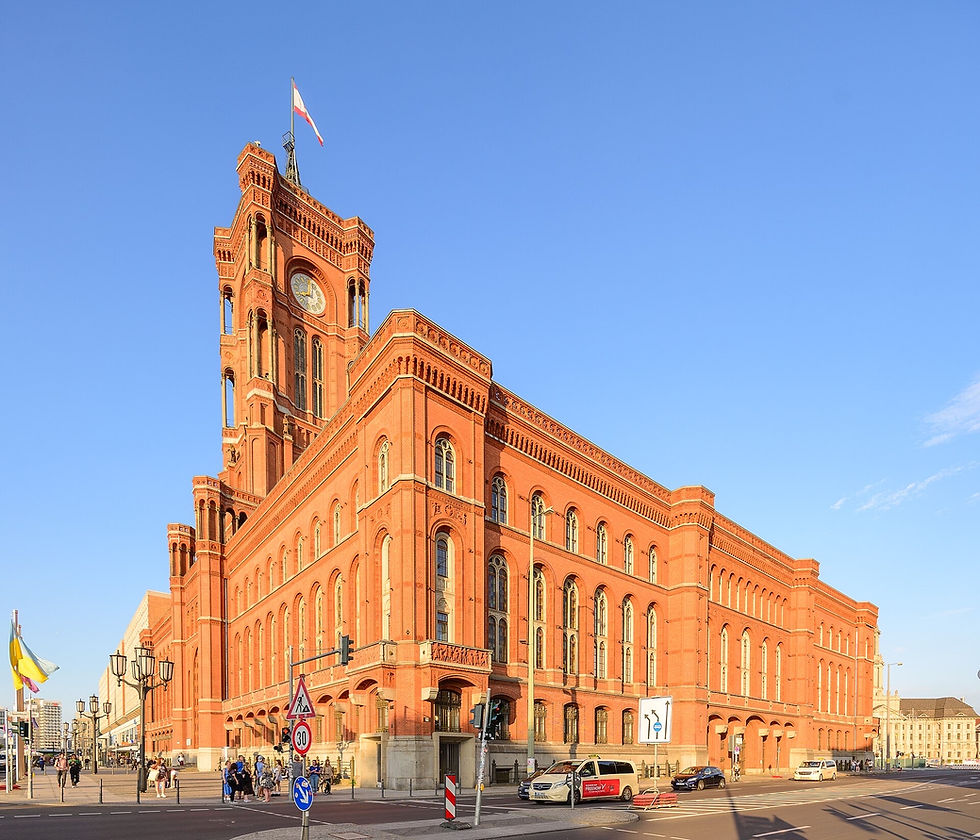
Rotes Rathaus, the series' Rote Burg. My tour passes it; the TV Tower stands directly behind.
Berlin mood: Weimar noir, cabaret, crime, political tension.
Good to visit: Alexanderplatz, Rotes Rathaus, Hermannplatz U-Bahn station, Theater im Delphi.
Kleo
Kleo is the most Berlin-proud thing Netflix has made in years: a former Stasi assassin hunts her old handlers through the collapsing GDR, with wild costumes and real East Berlin locations. The best one is Kino International on Karl-Marx-Allee, the GDR's premiere cinema from 1963, whose upstairs bar plays the series' Café International. The timing is good too: the cinema reopened on 26 February 2026 after an 18-month renovation, so you can buy a ticket and stand inside a restored GDR landmark.
The series also borrows the legend of Big Eden, the real Kurfürstendamm club that gave the first episode its name; the club closed in 2006, so treat that one as a story, not a stop. If you only do one thing, walk Karl-Marx-Allee at golden hour and end at Kino International. It is the series' whole aesthetic in one street.
Berlin mood: GDR pop, revenge, neon-on-concrete.
Good to visit: Kino International, Karl-Marx-Allee, Strausberger Platz.
Dark
Dark is not a Berlin city series. Its fictional town of Winden is built from the region's forests, institutional buildings, and quiet edges. The school exterior is the Reinfelder Schule in Charlottenburg-Wilmersdorf, and the unforgettable church is the cemetery chapel at Südwestkirchhof Stahnsdorf, a vast woodland cemetery just outside the city.
For a visitor, Dark works best as a reminder that Berlin is surrounded by very filmable Brandenburg landscape. If the show's mood is what you want, take one of the day trips from Berlin into the forests and lakes, and it will find you.
Berlin mood: eerie, suburban, forested, metaphysical.
Good to visit: Südwestkirchhof Stahnsdorf, Brandenburg forests, Reinfelder Schule surroundings.
Homeland, Season 5
Season 5 moved Carrie Mathison to Berlin and turned the city into a contemporary spy stage, with Studio Babelsberg supporting production and central Berlin playing the world of embassies, media, and intelligence work.
This is not postcard Berlin. The best real-world fit is the Government Quarter, Potsdamer Platz, and the office streets of Mitte. Walk the Spree bend past the Reichstag at dusk and you have the season's exact texture.
Berlin mood: contemporary espionage, diplomatic, institutional.
Good to visit: Government Quarter, Potsdamer Platz, modern Mitte.
Berlin Station
Berlin Station is one of the clearest examples of Berlin playing itself in a modern spy drama. The production filmed largely in the capital and leaned into real geography: transit, embassies, nightlife, and the sense that everyone might be watching someone else.
The most useful locations are Alexanderplatz station, central Mitte, and nightlife streets in Kreuzberg. This one is less about a single landmark and more about moving through the same infrastructure the show uses: platforms, office streets, late bars.
Berlin mood: CIA thriller, contemporary, location-heavy.
Good to visit: Alexanderplatz station, Mitte, Kreuzberg.
Sense8
Sense8 used Berlin as one node in a global network, and its Berlin identity is club culture, chosen family, and reinvention. I would be careful with exact-location claims here; the Berlin material is more scene than checklist.
For a real-world mood match, use Kreuzberg, Friedrichshain, and the club corridor along the Spree: RAW-Gelände, Warschauer Straße, and the riverside between them.
Berlin mood: global, queer, club-driven, connected.
Good to visit: Kreuzberg, Friedrichshain, Warschauer Straße, RAW-Gelände.
Deutschland 83
Deutschland 83 sends an East German agent into the West, and it pairs perfectly with Berlin's real Cold War sites: the Stasi Museum, the Berlin Wall Memorial at Bernauer Straße, and the Tränenpalast, the former border crossing hall at Friedrichstraße where East and West said goodbye.
The series does not reward chasing scenes. It is about systems: propaganda, surveillance, and the strange intimacy of a divided country. If you want the physical version, my guide to where the Berlin Wall stood maps what is actually left.
Berlin mood: Cold War, 1980s, divided Germany.
Good to visit: Stasi Museum, Berlin Wall Memorial, Tränenpalast.
The Queen's Gambit
The Queen's Gambit is the best example of Berlin pretending to be everywhere else. The series is set in America, Paris, and Moscow, but it was mostly filmed in and around Berlin. Karl-Marx-Allee became Moscow: the Stalinist blocks play Soviet hotel facades, and the upstairs bar of Kino International plays the Moscow hotel restaurant.
The fun part is how specific the doubling gets. The Friedrichstadt-Palast foyer plays a hotel in Mexico City. The Palais am Funkturm plays a Las Vegas hotel lobby. Three continents, one S-Bahn network.
Visit Karl-Marx-Allee and Frankfurter Tor first; the long boulevard and monumental towers make the Moscow illusion click instantly.
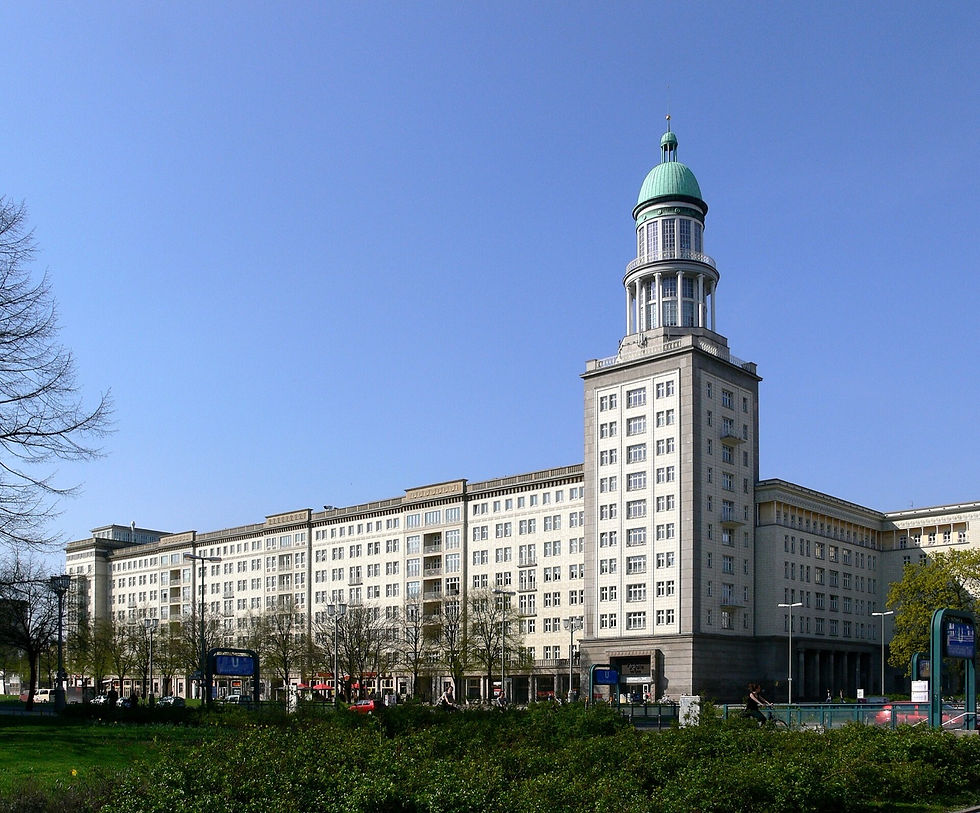
Frankfurter Tor on Karl-Marx-Allee. The monumental architecture explains why Netflix cast this boulevard as Moscow.
Berlin mood: elegant, retro, disguised, architectural.
Good to visit: Karl-Marx-Allee, Frankfurter Tor, Kino International, Friedrichstadt-Palast.
Unorthodox
Unorthodox uses Berlin as a place of reinvention: Esty leaves an ultra-Orthodox community in New York and comes here to imagine a different life. The series' emotional center is Strandbad Wannsee, the historic lakeside lido where she wades into the water and removes her wig. The music school scenes were filmed at the Musikinstrumentenmuseum near the Kulturforum.
The contrast is the point. Wannsee gives the story air and water; the Kulturforum gives it music and a possible future. Both are easy to visit, and Strandbad Wannsee is a genuinely great summer afternoon even without the series: S-Bahn S1 or S7 to Nikolassee, then a short walk.
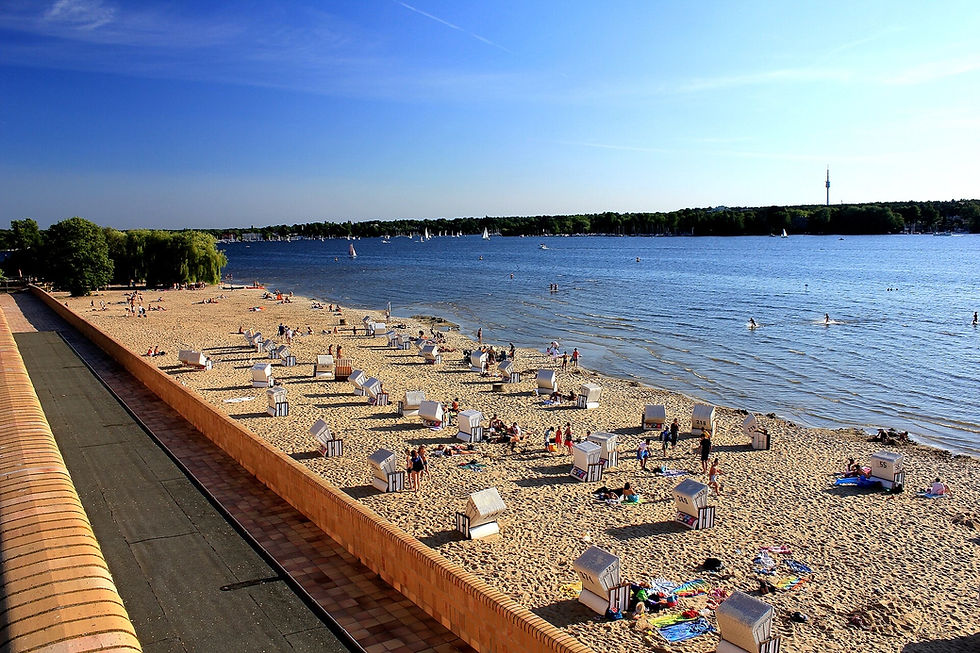
Strandbad Wannsee, the 1920s lakeside lido where Unorthodox stages its most famous scene.
Berlin mood: emotional, liberating, reflective.
Good to visit: Strandbad Wannsee, Musikinstrumentenmuseum, Kulturforum.
Berlin ER
The newest entry carries Berlin in its title: Berlin ER, originally KRANK Berlin, follows an emergency room in the city's roughest corner. The hospital itself was built inside the SEZ, the abandoned GDR sport and leisure complex on Landsberger Allee, with street scenes shot around Kreuzberg and Neukölln.
Here is the very Berlin twist: the SEZ is still caught between preservation arguments and a redevelopment plan. The borough stopped preliminary demolition work in November 2025, while WBM still presents the site as a future housing quarter. The series may become the building's last major screen appearance, but the exact on-site state can change. If you pass Landsberger Allee, view it from the public pavement rather than treating the closed complex as a film set you can enter.
Berlin mood: frantic, raw, contemporary, tender underneath.
Good to visit: Landsberger Allee tram corridor, Kreuzberg and Neukölln streets.
Watch the Berlin Mood Before You Fly
Trailers are the fastest way to test which Berlin you want. Three that show completely different cities, all of them real:
Weimar glamour on the edge of catastrophe, 1990s post-Wall adrenaline, and GDR revenge pop. Same city, three different planets. That range is exactly why productions keep landing here.
Best Berlin Screen Locations to Visit
If you want to plan a screen-inspired Berlin day, think in clusters rather than chasing every exact scene.
Alexanderplatz and Rotes Rathaus
The square appears again and again because it is visually loud and historically layered: The Bourne Supremacy, Babylon Berlin, Good Bye, Lenin!. If you are visiting in real life, my guide to 5 mistakes tourists make at Alexanderplatz will save you some annoyance.
Karl-Marx-Allee
The single most cinematic street in Berlin. It plays East Berlin in Good Bye, Lenin!, Moscow in The Queen's Gambit, the GDR's dream of itself in Kleo, and the Capitol in the new Hunger Games. Walk Strausberger Platz to Frankfurter Tor and finish at Kino International.
Museum Island
Schinkel's museums have quietly become Hollywood's favorite Berlin facades: the Altes Museum in The Ballad of Songbirds and Snakes, the Alte Nationalgalerie in John Wick 4. My walking tour crosses the island, and the film connection makes guests look at the colonnades differently.
Oberbaumbrücke and the Spree corridor
Run Lola Run, Sense8, and every music video ever. Cross the bridge on foot, then decide between Kreuzberg and Friedrichshain for the evening.
Bahnhof Zoo and the old West
Christiane F. territory, and the memory core of West Berlin. Pair it with the Kaiser Wilhelm Memorial Church.
Wannsee and Glienicke Bridge
The lake district delivers two completely different stories twenty minutes apart: Unorthodox at Strandbad Wannsee and Bridge of Spies at Glienicke Bridge. Both reachable on the S7; together they make one of the best half-day trips Berlin offers.
Potsdam-Babelsberg
Studio Babelsberg connects almost everything on this list, from Babylon Berlin to Hollywood productions. The Filmpark next door is the visitor-facing version.
Find Your Berlin Screen Mood
Different films, different Berlins. If you are not sure which one is yours, try the mood finder: pick a mood, see which films and shows match it, and get real places to notice in the city.
A Note on Exact Locations
Film-location hunting can be tricky in Berlin. Some scenes are shot on real streets, some in studios, some use one Berlin location to represent another city, and some are edited together from places nowhere near each other. If you want a deeper database after this guide, Shot in Berlin is good for browsing more titles.
That is why I avoid claiming every scene can be visited exactly. The better question for a walk is: what version of Berlin is this story using? The divided city? The spy city? The nightlife city? The city of escape?
That question leads to a much richer day than standing where a camera once stood.
Want to See the Real Berlin Behind the Screen?
Not every famous scene sits on one route, but the reason Berlin works so well on screen is the same reason it works on foot: every street has layers. On my Berlin walking tour, I cross the same ground many of these productions used, from the World Clock where Bourne vanished to the museum facades John Wick borrowed, and connect them to the real history underneath.
If you want to understand why Berlin looks the way it does on screen, come walk it with me.
Photo attribution is available from the compact Image credits disclosure inside the Screen Mood Finder above.