eSIM, SIM & Free WiFi in Berlin 2026: What Actually Works
- Yusuf Ucuz

- May 20
- 8 min read
Updated: Jun 30
The phone problem is one of the first things tourists actually have to solve in Berlin. Not the most romantic part of the trip, but real. You land at BER, your phone is in airplane mode, you want Google Maps, the U-Bahn timetable, the booking confirmation for your hotel, the address of where you are meeting me, the photo your friend just sent you of which currywurst place to go to. Then you see the SIM kiosk in the arrival hall and you wonder if you should pay 30 euros for a SIM right now, or if you can just rely on WiFi, or if eSIM is finally the answer.
This is the guide I wish my guests had read before their flight. It is honest about what each option is good for, what it costs, and where each one quietly falls apart.
For broader context, pair this with my realistic Berlin daily budget guide and with the Berlin public transport guide for tourists, where having mobile data genuinely changes the experience.

The Honest Answer
You have three real ways to get online in Berlin in 2026:
A travel eSIM bought online before you arrive, from a provider like Airalo, Saily, Holafly, or Nomad.
A German prepaid SIM or eSIM from a supermarket brand like Aldi Talk, Lidl Connect, Vodafone CallYa, or Congstar.
Free WiFi only, mostly BVG-WiFi at U-Bahn stations, Freifunk in public spaces, and cafe and museum hotspots.
Match the option to the trip:
Weekend or short city break (1 to 5 days): travel eSIM. It installs in five minutes, you do not need a German address, you skip every kiosk queue, and 1 to 5 GB is usually plenty.
Longer stay (1 to 4+ weeks): German prepaid SIM. Cheaper per gigabyte, full EU roaming included, and you get a German number if anyone needs to call you about a booking or reservation.
Tight budget, mostly sightseeing in the centre, your phone can wait: WiFi only. Realistic in Berlin if you plan ahead.
Most visitors are in the first group and never need to think about a German prepaid plan. That is fine.
Option 1: Travel eSIM (Best for Most Tourists)
A travel eSIM is a digital SIM you install on your phone before you arrive. You scan a QR code, the plan activates when you land in Germany, and your phone starts working as soon as you take it off airplane mode.
The main providers used by Berlin visitors in 2026 are Airalo, Saily, Holafly, and Nomad. They all run on one of the German networks (Telekom, Vodafone, or O2). Coverage in central Berlin is excellent on all three networks, including 5G, which is live across the city.
Rough 2026 pricing for Germany-only data plans:
1 GB / 7 days: around 4 to 6 euros.
3 GB / 15 days: around 8 to 12 euros.
5 GB / 30 days: around 12 to 18 euros.
Unlimited plans (Holafly): around 6 to 9 euros per day, but no fair-use cap.
Most tourists I meet use somewhere between 500 MB and 1.5 GB per day, depending on how much they map, stream, and upload. For a 3 day Berlin trip, a 1 to 3 GB eSIM is usually enough.
Why eSIM is the easy answer:
Buy it from your sofa the night before the flight.
No SIM tray, no kiosk, no German paperwork.
You keep your home number active for SMS authentication (banks, two-factor codes).
Roughly half the price of an airport SIM, in many cases.
The catch:
Your phone must be eSIM-compatible. Almost every iPhone since the XS, Pixel 3 and newer, Samsung S20 and newer, and most modern flagships are. Older phones, budget Android, and dual-SIM travel routers may not be.
Most travel eSIMs are data only. You will not get a German phone number, and you cannot make traditional voice calls from this line. Use WhatsApp, Signal, or FaceTime for calls. This is fine for tourism but bad if you actually need a German number.
Set up the eSIM on your home WiFi the day before. Activating one in the middle of BER arrivals with no data is a stressful way to start the trip.
Option 2: German Prepaid SIM or eSIM (Best for Longer Stays)
If you are in Berlin for two weeks or more, or if you also need to call German phone numbers (a clinic, a landlord, a tour operator), a German prepaid plan is the better choice. EU rules mean any German prepaid SIM also works across the EU at the same domestic price, so it doubles as your travel SIM if you are doing a wider European trip.
The main supermarket and discount brands are:
Aldi Talk (runs on the O2 network). Often the best value for heavy data users. A typical 2026 plan: around 8 to 9 euros for 10 GB, 4 weeks, with 5G.
Lidl Connect (runs on the Vodafone network). Strong coverage, similar pricing, sold at every Lidl.
Vodafone CallYa (Vodafone's own prepaid). The CallYa Allnet Flat S in 2026 sits around 9 to 10 euros for 25 GB, 4 weeks, with 5G and EU roaming.
Congstar (runs on the Telekom network). Usually the best overall coverage in Germany, slightly more expensive.
Starter packs cost roughly 10 to 15 euros at the supermarket till and include a small amount of initial credit. You activate online, and identity verification is done by video call (PostIdent or video-ident in the app). Bring a passport.
Why a German SIM is worth the extra effort:
Cheapest per gigabyte in Berlin by a wide margin.
A real German phone number, useful for restaurant bookings, doctor visits, ride share apps, and Wix-Bookings confirmations.
EU roaming included by law.
Works seamlessly with 5G on every major Berlin network.
The catch:
Activation requires identity verification, which can take 15 to 60 minutes the first time.
Most supermarket brands have German-language apps. Not a disaster, but worth knowing if you do not read any German. See my 50 essential German phrases guide for the basics.
Not always available as eSIM. Lidl Connect, Aldi Talk, and CallYa now sell eSIMs in 2026, but the physical SIM is still the more reliable path.
Option 3: Free WiFi Only (Realistic in Berlin, with Planning)
Berlin is one of the easier major European cities to visit on WiFi alone, especially if you are sightseeing in the historic centre. You will not get seamless turn-by-turn navigation, but you can absolutely survive a 3 day trip without buying any kind of SIM.
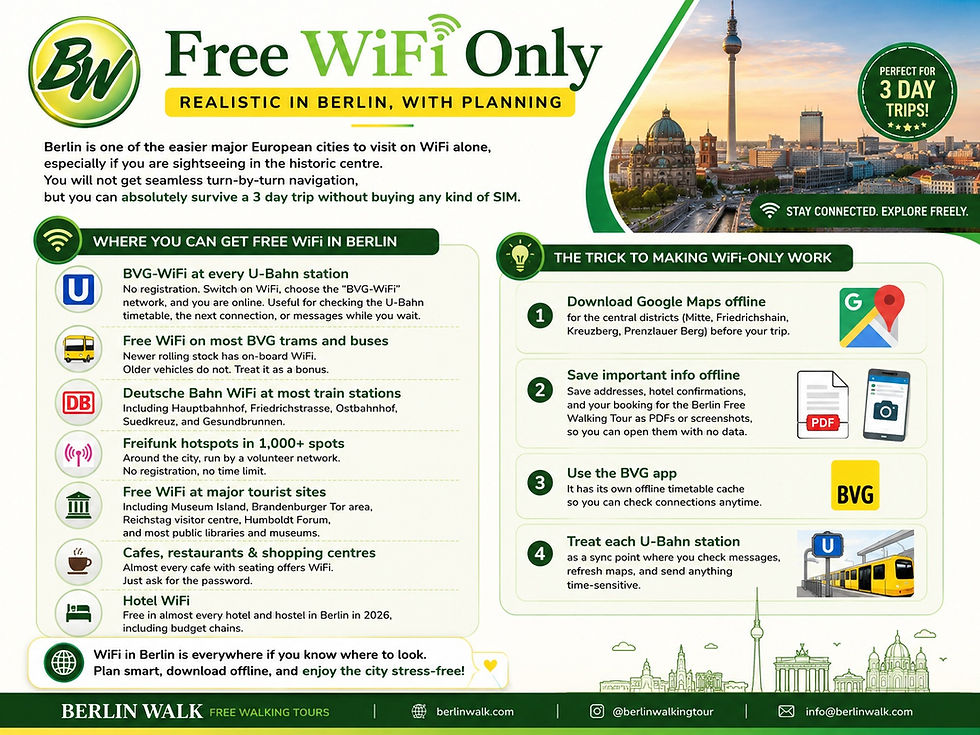
What is actually free in Berlin:
BVG-WiFi at every U-Bahn station. No registration. Switch on WiFi, choose the "BVG-WiFi" network, and you are online. Useful for checking the U-Bahn timetable, the next connection, or messages while you wait for a train.
Free WiFi on most BVG trams and buses. Newer rolling stock has on-board WiFi. Older vehicles do not. Treat it as a bonus.
Deutsche Bahn WiFi at most train stations, including Hauptbahnhof, Friedrichstrasse, Ostbahnhof, Suedkreuz, and Gesundbrunnen.
Freifunk hotspots in more than 1,000 spots around the city, run by a volunteer network. No registration, no time limit.
Free WiFi at major tourist sites including Museum Island, the Brandenburger Tor area, the Reichstag visitor centre, the Humboldt Forum, and most public libraries and museums.
Cafes, restaurants, and shopping centres. Almost every cafe with seating offers WiFi. Just ask for the password.
Hotel WiFi. Free in almost every hotel and hostel in Berlin in 2026, including budget chains.
The trick to making WiFi-only work in Berlin:
Download Google Maps offline for the central districts (Mitte, Friedrichshain, Kreuzberg, Prenzlauer Berg) before your trip.
Save addresses, hotel confirmations, and your booking for the Berlin Free Walking Tour as PDFs or screenshots, so you can open them with no data.
Use the BVG app, which has its own offline timetable cache.
Treat each U-Bahn station as a sync point where you check messages, refresh maps, and send anything time-sensitive.
It is not as smooth as having mobile data. But it works, especially for a 2 or 3 day trip in the historic centre.
The Airport SIM Question
Should you buy a SIM at BER airport when you land?
Honest answer: only if you forgot to set up an eSIM and you do not want to stop at a supermarket.
The kiosks at BER mostly sell physical SIMs at clear tourist prices. There are usually no airport eSIM kiosks. The same plans are often 30 to 50 percent cheaper either:
Bought online as an eSIM before the flight, or
Bought at any Aldi, Lidl, Saturn, MediaMarkt, or Vodafone shop in central Berlin.
If you are stuck and want to get a SIM the moment you land, fine, buy one. But it is usually not the best deal.
For airport logistics on the same day, see how to get from Berlin airport to Alexanderplatz the easy way.
What I Tell My Walking-Tour Guests
If you are arriving for a short Berlin trip and you ask me one question on the way to the meeting point, it is usually some version of "how do I get online?". The honest answer in 2026 is:
2 to 5 day trip: travel eSIM, set up at home, 1 to 5 GB.
2 to 4 week stay: German prepaid SIM from Aldi, Lidl, or Vodafone CallYa.
Tight budget weekend: WiFi only, with Google Maps offline. Berlin is generous enough with free WiFi that this is genuinely fine for sightseeing.
What I would not do in 2026 is buy a SIM at the airport without checking the eSIM options first.
A Sample "First Hours in Berlin" Plan
For a tourist landing at BER at 09:00 with no data yet:
The night before: install a 3 GB / 15 day travel eSIM (around 8 to 12 euros). Add the plan to your phone but leave it disabled.
On the plane: screenshot your hotel booking, BVG ticket, and tour meeting point.
At BER: take the phone off airplane mode, activate the travel eSIM, you are online before passport control.
In central Berlin: Google Maps and WhatsApp work the same as at home.
At 11:00: meet me bag-light at Alexanderplatz for the Berlin Free Walking Tour, with your phone already working.
You can also do this entirely on WiFi for free if you do not mind sync points and offline maps, but eSIM is the path of least resistance.
What to Avoid

Roaming on a non-EU phone plan without checking the price. US, UK, and most non-EU carriers can charge frightening per-megabyte rates in Germany. Check before you fly.
Buying an airport SIM as a default without comparing to eSIM.
Sketchy SIM stalls in tourist alleys or backstreet phone shops. Stick to known supermarket brands or recognised eSIM apps.
Sharing your eSIM QR code in public chats or screenshots. Each QR code can usually only be installed once, but it is still credentials.
Assuming all cafes have WiFi worth using. Most do, but some lock the network behind a key you only get with an order, and a few have meaningful time limits.
My Honest Advice
The simplest move for a Berlin tourist in 2026 is to spend 10 minutes the evening before the flight, install a travel eSIM, and land with your phone already working. For longer stays, a German prepaid SIM from a supermarket is cheaper and gives you a real German number. For tight budgets, Berlin is one of the more WiFi-friendly cities in Europe and it is genuinely possible to enjoy a short trip without a data plan at all.
Whichever route you pick, do not let the airport kiosk be your first move. It is almost never the best deal.
If you want a local to walk Berlin's historic centre with you on your first morning here, my Berlin Free Walking Tour starts at Alexanderplatz every day. Phone working, ticket on screen, Google Maps already pinned to the World Clock. That is the easiest possible Berlin morning.
For the next step, my practical Berlin guides to Berlin plug adapters and charging and lost property in Berlin can help with the next practical detail.