Berlin Museum Discounts: Who Actually Gets the Reduced Ticket
- Yusuf Ucuz

- 6 days ago
- 7 min read
You walk up to the counter at the Neues Museum, and there are two numbers on the board. Fourteen euros. Seven euros. Nobody explains which one is yours, and the queue behind you is not in the mood for a conversation about it. Most visitors read the smaller number, decide it is probably for children, and pay the larger one.
Some of them did not have to.
Berlin museum discounts are not hidden, but they are written in German, printed in small type, and they only work if the right piece of paper is in your pocket at the moment you reach the desk. That is the whole game. The rules are generous, the paperwork is strict, and nobody at the counter will talk you into the cheaper ticket.

The Bode-Museum at the tip of Museum Island. Like most of its neighbours it charges 14 euros, or 7 with the right card.
How Berlin museum discounts actually work
The German word is ermäßigt, and it means reduced. At the Staatliche Museen zu Berlin, the group that runs the Museum Island houses, the Gemäldegalerie and the Hamburger Bahnhof, the reduction is stated plainly on their own reductions page: the general reduction is 50 percent.
So the second number is almost never a children's price. It is the adult price halved for people who can prove they belong to one of a short list of groups.
The other half of the rule matters just as much. A free or reduced ticket is only valid together with the proof, and the museums ask you to show that proof at the entrance without being asked. In practice, the desk sells you the reduced ticket on trust and the person checking tickets at the gallery door checks the card. I have watched a visitor buy a 7 euro ticket in Berlin and then argue about it thirty seconds later at a rope. Bring the card, or buy the full ticket.
Who gets the reduced ticket at Berlin's state museums
The published list is short and specific. Half price at the Staatliche Museen zu Berlin, with proof:
Students, at any age, with a valid student card or enrolment certificate
Apprentices and trainees in a recognised programme
School pupils who are already 18 or over
People doing a recognised voluntary service year
Jobseekers receiving ALG I
Severely disabled visitors, with a degree of disability of 50 or more
The card matters more than the story. A student card with no validity dates printed on it gets refused often enough that it is worth checking yours before you leave the hotel. An international student card usually works when it clearly shows a name, a photo and a valid period.
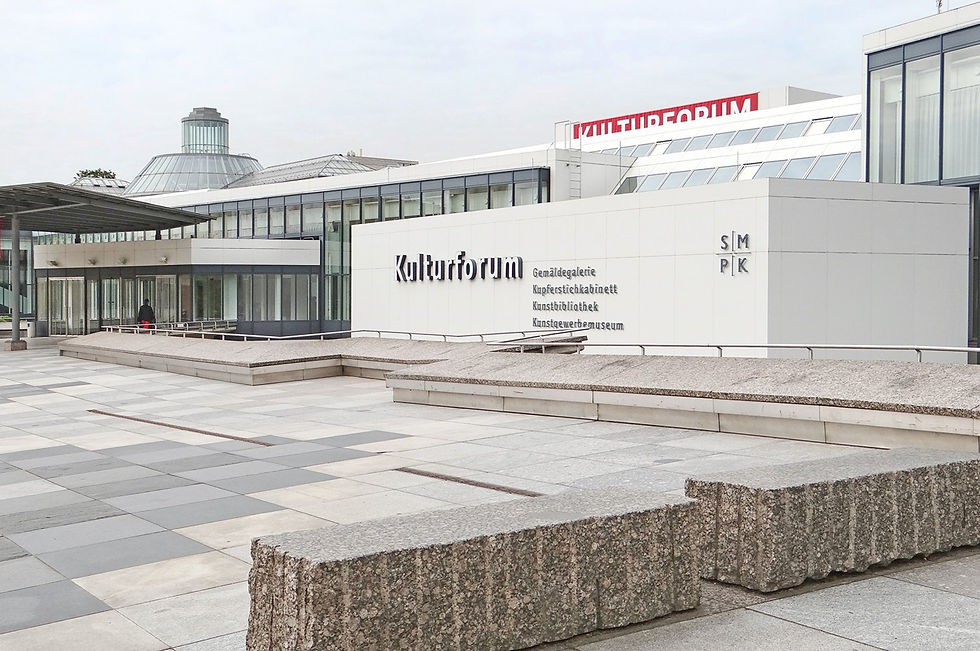
The Kulturforum entrance. The Gemäldegalerie charges the same 14 and 7 as Museum Island, and a day ticket for the whole Kulturforum is 22 or 11.
Who walks in free
This is the part that actually changes what a family pays, and it is the part almost nobody knows before they arrive.
Anyone under 18 gets in free at the state museums. Not half price. Free. A fifteen year old and a seventeen year old cost nothing at the Neues Museum, the Bode, the Altes Museum, the Gemäldegalerie and the rest of the group. Free entry also covers:
Members of ICOM and the Deutscher Museumsbund
Press card holders
People receiving Bürgergeld, Wohngeld, Grundsicherung or benefits under the asylum-seekers act
A companion of a severely disabled visitor, when the companion mark is in the disability card
School and university groups that registered in advance
One detail catches people out. Free does not mean walking past the desk. The museums ask free visitors to collect a zero-euro ticket at the counter or book it online, then show the matching ID at the entrance. Skipping that step is how a free visitor ends up stuck at the gallery door.
Who does not get a discount, however European that feels
Here is the line that surprises visitors from almost anywhere else in Europe: there is no pensioner or senior rate on the state museums' list. A 70 year old and a 40 year old pay the same 14 euros at the Neues Museum. Age helps you at one end of life in Berlin and not at the other.
The same goes for the ordinary adult who finished studying. If you are over 18, not enrolled anywhere, not registered disabled and not on benefits, the full price is simply your price. My advice: stop hunting for a card that does not exist, and put the energy into the free sights instead. Berlin has more of those than almost any capital in Europe.
What that looks like at the desk
The prices below were checked on the museums' own ticket pages on 22 August 2026. Build the group that will actually be standing at the counter and the tool prices it, tells each person what to carry, and shows the day pass next to the single tickets.
The pass trap: a special exhibition is a separate ticket
The 24 euro Museumsinsel-Ticket covers every open museum on the island for one day. The 32 euro Museumspass Berlin covers the permanent exhibitions of around 30 Berlin museums for three days. Both have a reduced version at exactly half, 12 and 16, on the same proof rules as above, and both let you walk straight in without queueing for a separate ticket.
What they do not cover is a big temporary show. The Alte Nationalgalerie is the live example right now. Until 27 September 2026 it sells only a combined ticket with its Paul Cassirer exhibition at 16 euros, or 8 reduced, and holders of the Museumsinsel-Ticket, the Museumspass and the Berlin WelcomeCard pay a surcharge of 6 euros, or 3 reduced, on top of the pass they already bought.
That is not a scandal, it is how German museums price special exhibitions. But it does mean a pass never buys you a guaranteed flat day. If a specific exhibition is the reason you came, check that exhibition's own page before you count on the pass. My full comparison of the passes against single tickets is in the Berlin museum pass guide, and the pass cost comparison tool does the arithmetic for a whole trip.

The Alte Nationalgalerie. The banner on the stairs is the tell: when a big temporary show is running, the pass in your pocket may not cover it.
Not every Berlin museum plays by the state rules
The 50 percent rule belongs to the Staatliche Museen zu Berlin. City museums, private museums and foundation museums each write their own list, and the numbers stop being tidy.
The Berlinische Galerie in Kreuzberg is a good example. Its day ticket is 12 euros and the reduced ticket is a flat 7, which is more than half. Under 18s are free there too. And it runs something the state museums do not: on the first Wednesday of every month, everyone pays 7 euros, with no card, no proof and no argument. That is the single easiest Berlin museum discount there is, and it exists because one museum decided to make one Wednesday cheap.
While we are clearing up museum myths: Museumssonntag, the free first Sunday of the month, ended in December 2024 and has not come back. Plenty of travel pages still promise it. If a Berlin guide tells you to plan your trip around the free Sunday, that guide has not been updated in two years.

The Berlinische Galerie in Kreuzberg, where the reduced ticket is a flat 7 euros and the first Wednesday of the month is 7 euros for everybody.
Where the discount does not matter, because entry is already free
Before you spend an afternoon optimising ticket prices, it is worth remembering how much of Berlin's best material has no ticket at all. The permanent exhibitions at the Humboldt Forum are free. So are the Topography of Terror, the Berlin Wall Memorial on Bernauer Straße, the East Side Gallery and the Reichstag dome, which needs a booking rather than a payment.
That changes the maths for an ordinary adult with no card to show. Two full-price museum tickets and a coffee is a 35 euro morning. A free morning at the Humboldt Forum and the Topography of Terror costs a transport ticket. I have written up the whole free list in which Berlin museums are free, and if you are choosing between the paid ones, the best museums for first-time visitors is the shortlist I actually give guests.
One more piece of planning: the Pergamonmuseum is shut and does not reopen until 4 June 2027, so no ticket, pass or discount gets you in. The details are in is the Pergamon Museum closed.

The Schlüterhof inside the Humboldt Forum. The permanent exhibitions here cost nothing, which beats any reduced ticket.
The move before you queue
The whole thing comes down to one small habit. Before you leave your accommodation on a museum day, put the proof in the bag you are actually carrying: the student card with dates on it, the passport or ID for anyone under 18, the disability certificate with its companion mark. It takes ten seconds and it is worth 7 euros a head at every state museum you enter that day.
Then buy the ticket that matches the group, not the ticket the queue is buying.
And when the ticket prices start to feel like the whole trip, remember that the walking part of Berlin is still free. My own free Berlin walking tour runs past the Museum Island desks you have just been reading about, from the World Clock at Alexanderplatz to Hackescher Markt in about 2 hours, and it is tip-based, so there is no counter and no card to show. It is a good way to see which museum you actually want to pay for before you pay for any of them.
Image credits
Source and licence details for the 5 photographs used in this article.
The Bode-Museum at the northern tip of Museum Island, seen from the Ebertbrücke: Bahnfrend, CC BY-SA 4.0, via Wikimedia Commons.
The entrance forecourt of the Gemäldegalerie at the Kulturforum in Berlin: Jean-Pierre Dalbéra, CC BY 2.0, via Wikimedia Commons.
The Alte Nationalgalerie on Museum Island with its exhibition banners: Beko, CC BY-SA 4.0, via Wikimedia Commons.
The yellow typographic forecourt outside the Berlinische Galerie in Kreuzberg: Gerd Eichmann, CC BY-SA 4.0, via Wikimedia Commons.
The Schlüterhof courtyard inside the Humboldt Forum in Berlin: Dosseman, CC BY-SA 4.0, via Wikimedia Commons.