Berlin Marathon 2026: What Closes, Where to Watch and How to Cross the City

Most people who get caught out by the Berlin Marathon never intended to watch it. They booked a Sunday in Berlin, walked out of the hotel at ten, and found a metal barrier where the road used to be, a stream of runners going past it, and no obvious way to the other side.
My advice: do not treat marathon Sunday as a day that got ruined. Treat it as a day with a line drawn through it. Find out which side of that line you are on, learn where you can get across, and the rest of the day becomes manageable. I have watched visitors lose two hours to a problem that a short train ride would have solved.

The last few hundred metres, looking east towards the Brandenburg Gate. On this one Sunday the middle of Berlin belongs to a field of tens of thousands.
Berlin Marathon 2026: the date, the start and what it actually does to the city
The Berlin Marathon 2026 runs on Sunday 27 September 2026. The handbike top field starts at 08:20, elite wheelchair racers at 08:26, and the remaining wheelchair and handbike field at 08:29. Runners leave Straße des 17. Juni in six waves: 08:45, 09:05, 09:33, 10:02, 10:12 and 10:27. The start and finish area is on the stretch between the Brandenburg Gate and the Kleiner Stern.
Those are the times on the organiser's current 2026 race-day schedule. The part that matters if you are a visitor is simpler: the course is a 42 kilometre loop through the middle of the city, and for much of the day its street barriers behave like a wall.
The route touches Tiergarten, Mitte, Friedrichshain, Kreuzberg, Neukölln, Schöneberg, Steglitz, Wilmersdorf and Zehlendorf. That is not a corner of Berlin you can avoid. That is Berlin.
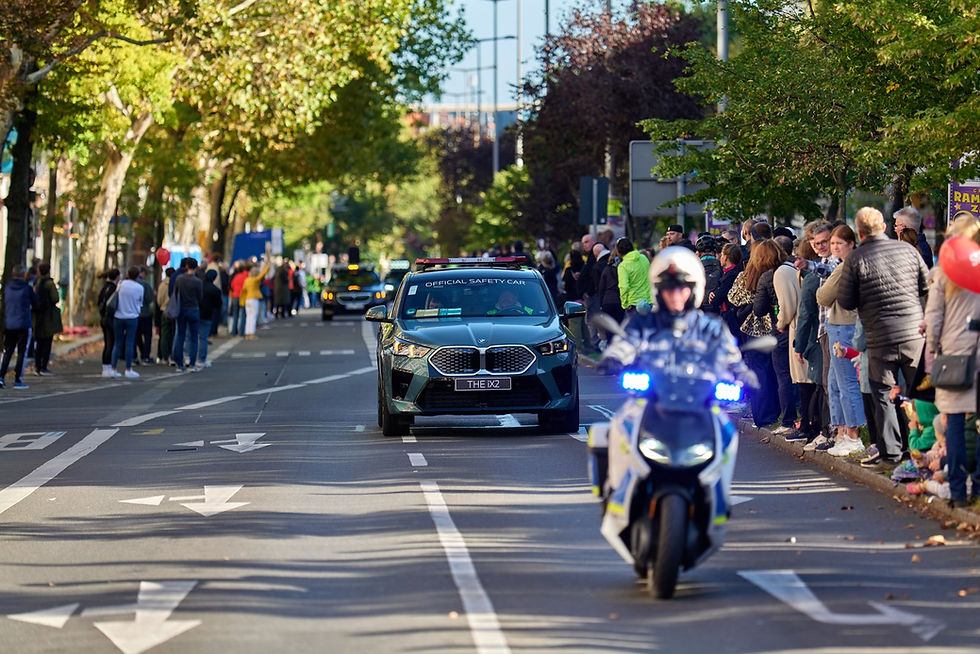
The lead vehicles on Rheinstraße in Friedenau. The road closes well before the first runner arrives, which is the part that catches people out.
The road closes long before anyone runs past it
This is the single most useful thing to understand. A street on the marathon route is not closed while runners are on it. It is closed from early morning until the last participant has gone through and the barriers have been cleared, and that can be seven or eight hours.
Working from the closure pattern Berlin's traffic centre published for the 2025 race, the day looks roughly like this. Unter den Linden between Pariser Platz and Friedrichstraße goes first, from about 06:00. Mitte and Charlottenburg-Wilmersdorf follow from around 07:45. Friedrichshain and Kreuzberg from 08:00. Tempelhof-Schöneberg from 08:15.
Then nothing reopens for hours, and it does not reopen in the order you would expect. The 2025 winning time was 2:02:16, so a comparable run from the 2026 elite start would finish at about 10:47. That changes nothing for the streets, because tens of thousands of people are still out on the course. In the 2025 traffic plan, Friedrichshain and Kreuzberg came back first, from about 14:00. The south followed around 16:30, Mitte and the west around 17:30, and Unter den Linden at about 19:00.
The exact 2026 windows will be published closer to the event by the organiser and the Berlin traffic information centre, and they can still change. Use the 2025 pattern above to plan the shape of the day, then check the official closure map in the week before you travel and again on race morning.
The tool below plays the whole day out so you can see it rather than read it.
Use the U-Bahn or S-Bahn to cross the course
The race barriers close streets, so rail is usually the most practical way past a blocked section. Do not build the day around every U-Bahn or S-Bahn service running normally, though. The S-Bahn is not entirely underground, live disruptions and crowd controls are possible, and no train line is a universal tunnel beneath the whole course.
The useful question is: which station is on my side, and which station gets me past this particular closure? A one or two stop journey, or a station underpass, can save a long walk to a barrier. Check BVG, VBB or S-Bahn live service before you leave.
There are also stewarded crossing points on the surface. In 2025 the marked Sunday crossings were at Kurfürstendamm and Tauentzienstraße just before Rankestraße, at Wittenbergplatz, at Potsdamer Platz by the U-Bahn station traffic light, at Leipziger Straße and Friedrichstraße, and at Französische Straße and Friedrichstraße. Treat that as last year's reference, not a promise for 2026. Around the start and finish area, the organiser's current spectator guidance directs people across at Pariser Platz only.
My advice: do not try to walk the long way round. The course is 42 kilometres and it loops. Walking around it is not a plan. Use my U-Bahn versus S-Bahn explainer and the wider Berlin public transport guide to choose a short rail crossing before you are standing at a barrier deciding.
One warning about buses and trams. Routes may be diverted, shortened or temporarily suspended, and those changes can move through the day as police release sections. Check the live journey planner rather than yesterday's route. Rail is usually the stronger first choice, but check it live too. The Tiergarten road tunnel was expected to remain open in the 2025 plan; wait for the 2026 traffic notice before relying on it.

Yorckstraße in Schöneberg. The railway bridges show why rail can be useful when the street below is closed, but race-day service still needs a live check.
Where to stand if you decide to watch
If you are in Berlin anyway, watching an hour of it is genuinely worth doing. This is a World Marathon Major and the course record, Eliud Kipchoge's 2:01:09 from 2022, was set on these streets.
The obvious spots are obvious for a reason, and they are crowded. The Reichstag sits at around km 6.5 and Friedrichstadtpalast at km 8, so both fill up early in the race when the field is still dense. The Brandenburg Gate finish at km 42 is the most photographed and the least pleasant, because everyone is there.
My advice: go west and go late. The Memorial Church is at about km 35 and Potsdamer Platz at km 38.5. These stretches are usually easier than the finish area, though they are still busy. You see people deep into their race instead of only watching the leaders go past in a blur.
If the race is your reason for the trip, book early. Late September fills up, and the whole city prices accordingly. My guide to what to book in advance in Berlin covers what genuinely needs reserving, and Berlin in September covers what else is happening that month.

The Kurfürstendamm at around km 35. Later in the race, further from the finish, and much easier to get a spot at the barrier.
Saturday is the part nobody warns you about
Almost everything written about this race is about Sunday. But the marathon weekend starts on Saturday 26 September, and Saturday can quietly collide with an ordinary sightseeing plan.
The Generali 5K starts at 10:00 and follows the final five kilometres from Potsdamer Platz. The inline skating event starts from 12:20 and uses a multi-lap city circuit, not the runners' full marathon route. There is also a mini marathon. In 2025 the skating event closed Straße des 17. Juni, Großer Stern, Ernst-Reuter-Platz, Otto-Suhr-Allee, Hofjägerallee, Reichpietschufer, Potsdamer Straße, Leipziger Straße, Jerusalemer Straße, Markgrafenstraße, Französische Straße, Glinkastraße and Unter den Linden through the middle of the afternoon.
Read that list again. That is Potsdamer Platz, Leipziger Straße and Unter den Linden, on a Saturday afternoon, in the exact area most visitors spend their first full day. Unter den Linden between Pariser Platz and Friedrichstraße was closed from 07:00 to 18:00.
If you have one Saturday in Berlin and it is that Saturday, do not build a midday plan that crosses the event circuit. Check the official Saturday map, choose one side, and leave the afternoon for a specific place east of Alexanderplatz such as Boxhagener Platz or the East Side Gallery.

The inline skating event on the Saturday. It uses a separate multi-lap city circuit and is one reason central Berlin is affected a day early.
The Tiergarten event build starts well before race day
This one surprises people who come in September for reasons that have nothing to do with running.
The start and finish area is not built in a morning. In 2025, Straße des 17. Juni between Yitzhak-Rabin-Straße and the Brandenburg Gate was closed from 13 September and did not reopen until 24 September, days after the race. Großer Stern and Yitzhak-Rabin-Straße joined from 17 September. The government quarter streets around Ebertstraße and Scheidemannstraße went from the Thursday evening before.
So if you visit Berlin in the second half of September, the Victory Column and the central axis through the Tiergarten may be affected by fencing, grandstands and trucks. The park is not automatically closed to pedestrians, but access and photographs can look different from an ordinary week. Check the 2026 build notice before you go.

Race infrastructure going up in front of the Reichstag. The event build can affect this area well before race day.
What I would actually do that weekend
If you are in Berlin on 27 September 2026 and you are not running, here is the plan I would give a friend.
Do not count on a normal city before 08:00. In the 2025 pattern, Altonaer Straße closed at 05:00, Unter den Linden at 06:00 and more central sections from 07:45. Before leaving the hotel, check the live map, choose one side of the course and stay there until a confirmed crossing or reopening works for you.
Many museums may keep their normal Sunday hours, but their entrances and the journey to them are not automatically unaffected. Pick one cluster, verify that venue's opening and access, and avoid stacking timed bookings on opposite sides of the course. The 2025 plan reopened Friedrichshain and Kreuzberg from around 14:00, but confirm the 2026 barriers and transit before moving. If you can reach a western viewing point without crossing the course, watch twenty minutes around midday. It is genuinely something to see.

The handbike top field starts at 08:20, before the runners. An empty Berlin main road is a strange and quite good thing to see.
My free walking tour starts at Alexanderplatz and covers the historic centre around Museum Island and Hackescher Markt. Marathon weekend can still affect how you reach that area, so check the closure map and live rail service before setting out. If you are planning a walk of your own, keep it on one side of the line. For the wider context around the month, start with Berlin in September.
The short version
The Berlin Marathon 2026 is on Sunday 27 September. Handbikes and wheelchair racers start from 08:20, then runners leave Straße des 17. Juni in six waves from 08:45 to 10:27. The race puts a closed 42 kilometre loop through the middle of Berlin for much of the day.
You are not going to beat it, and you do not need to. A short U-Bahn or S-Bahn journey is often the practical crossing, the 2025 plan reopened the eastern sections first, and the west gives you useful late-race viewing points. Check the official closure map and live transport before you go, decide which side of the line your Sunday lives on, and the marathon becomes a thing you saw rather than a thing that happened to you.
Image credits for the three licensed photographs are available from the closed Image credits button inside the marathon-day tool above.