Victory Column Berlin: View, Tickets and Climb Tips
- Yusuf Ucuz

- Jul 2
- 8 min read
Victory Column Berlin is one of those landmarks many visitors notice from a bus window, a park path or the long line of Straße des 17. Juni, then quietly wonder the same thing:
Is it actually worth stopping for, or is it just a golden statue in the middle of a busy roundabout?
My honest answer is yes, but with conditions. The Siegessäule is worth visiting if you want a classic Berlin viewpoint, if the weather is clear enough to make the view matter, and if a narrow 285-step spiral staircase sounds realistic rather than miserable.
It is not the first thing I would put into a short historic-centre day. For that, I would usually start around Alexanderplatz, Museum Island, Unter den Linden, Brandenburg Gate or the Berlin Wall route. But if you are staying near Tiergarten, planning a West Berlin loop, looking for a cheaper viewpoint than the TV Tower, or you simply want to understand why this golden figure ended up here, Victory Column Berlin can be a very good stop.
Victory Column Berlin: the honest answer

Caption: Victory Column Berlin is a strong viewpoint only when the weather, stairs and timing fit your day.
The Victory Column is best for three kinds of visitor.
First, it is good for people who like earned views. There is no lift, no easy escalator and no glassy observation deck feeling. You climb, you feel the old spiral staircase, and then Berlin opens out around Tiergarten.
Second, it is good for people who want a landmark that is not just pretty. The column began as a 19th-century Prussian victory monument, stood near the Reichstag for decades, was moved under Nazi plans for monumental Berlin, survived the Second World War, lost and later regained relief panels, and today has become a normal tourist viewpoint with a complicated past.
Third, it is good if you want a low-cost Berlin view. Berlin.de currently lists admission as EUR 4.50 for adults and EUR 3.50 reduced, cash only. Always recheck the official page before going, because opening hours, payment rules and prices can change.
If you want the easiest view, choose the Reichstag dome when you can get a free reservation, or a paid lift viewpoint when the weather is right. If you want a physical, old-school, windy Berlin viewpoint with a story, climb the Victory Column.
The view from the top
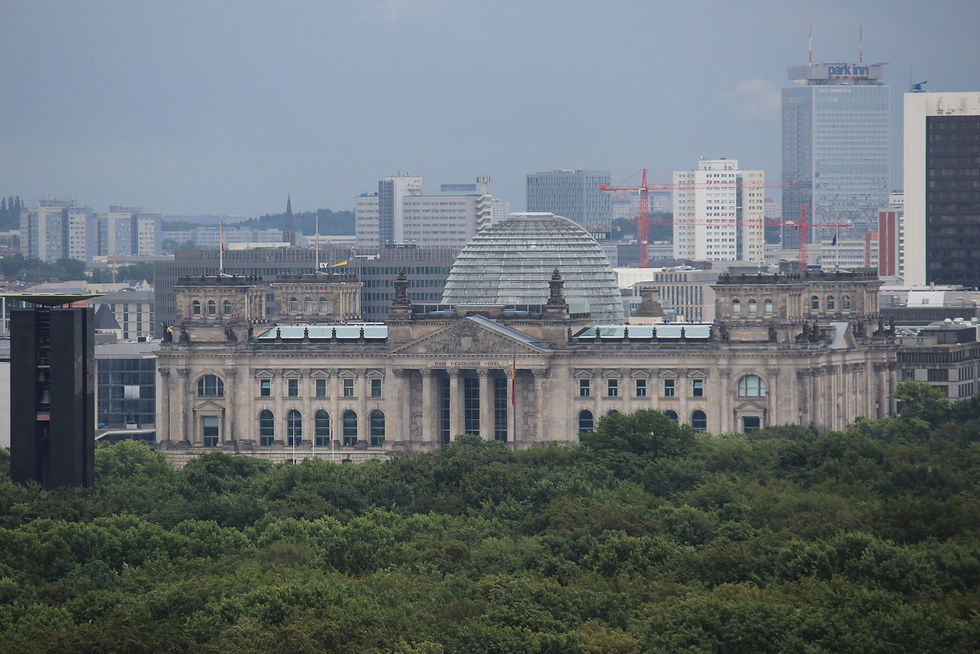
Caption: The climb is not about extreme height. It is about seeing Tiergarten, the government quarter and Berlin distance in one frame.
VisitBerlin describes the viewing platform as sitting directly below the golden Victoria statue, at the top of a 285-step spiral staircase. The platform is around 51 metres up, not skyscraper height, but the location is excellent.
From here, the view feels very Berlin because it is not only about height. You see the green mass of Tiergarten, the long axis toward Brandenburg Gate, the government quarter, Bellevue Palace, the Reichstag area and the flatness of the city beyond.
That matters. Berlin is not a city with mountains or a tight medieval skyline. Its drama often comes from distance, scars, open space and long sightlines. The Victory Column gives you that feeling better than many taller viewpoints.
The best conditions are simple:
Clear or partly clear weather: the view is the reason to climb.
Enough time to breathe: do not squeeze it between two timed museum entries.
Comfort with stairs and tight spaces: the staircase narrows and can feel slow when people pass.
Daylight or golden hour: Tiergarten is the main visual reward, so darkness weakens the stop.
If the day is grey, wet or windy in a bad way, I would usually save the climb for another time.
Use the Victory Column Climb Planner
Before you detour to Großer Stern, use the planner below. It gives you a practical verdict based on the conditions that actually change the visit: weather, stairs, time, mobility and what else you want from the day.
Tickets, opening hours and the 285-step climb
Berlin.de currently lists the Victory Column opening hours as 9:30 AM to 7:00 PM in summer, 9:30 AM to 5:30 PM in winter, and closed on 24 December. It also lists admission as EUR 4.50 for adults and EUR 3.50 reduced, cash only.
Do not treat those numbers as evergreen. This is a small attraction with practical operating rules, so check the official Berlin.de listing on the day you plan to go, especially if you are going late, travelling around holidays or depending on card payment.
The climb is the real filter. VisitBerlin says the staircase has 285 steps, and Berlin.de states clearly that the ascent is not wheelchair accessible and not suitable for people with limited mobility or weak constitution.
That is not a small footnote. It should decide whether you go up.
If you are travelling with a stroller, heavy luggage, knee pain, strong fear of tight spaces, vertigo or a mixed group where some people are tired, do the outside and base only. You can still see the monument, the tunnel approach, the mosaics and the Tiergarten setting without forcing the climb.
For accessibility-first Berlin planning, use my Berlin accessibility guide instead of building the day around the Siegessäule staircase.
How to reach the Victory Column safely
The column stands at Großer Stern, a large traffic circle in the middle of Tiergarten. It can look as if you are meant to cross the road at surface level.
Do not do that.
Use the pedestrian tunnels. They are the safe way into the centre of the roundabout and they are part of the visit. If you approach from Tiergarten, Straße des 17. Juni, Bellevue or the bus stop area, look for the tunnel entrances rather than trying to improvise through traffic.
For public transport, check BVG or VBB before you leave. Routes and disruptions change. The stop name you will often see is around Großer Stern, but the best option depends on whether you are coming from Brandenburg Gate, Zoo, Bellevue, Hauptbahnhof or another part of Tiergarten.
If you are already near Brandenburg Gate and like walking, you can also walk west along Straße des 17. Juni through Tiergarten. It is a long, straight, ceremonial route, not a cute side-street walk. That makes sense if you want the axis and the park. It makes less sense if you are short on time.
Why the Victory Column exists

Caption: The monument began as a 19th-century victory symbol, not as a neutral city decoration.
The Victory Column was designed by Johann Heinrich Strack, with the golden Victoria sculpture by Friedrich Drake. Berlin.de explains that it commemorates Prussian and German victories against Denmark, Austria and France between 1864 and 1871.
That is why the monument can feel uncomfortable if you only read it as triumph. It is beautiful, but it was not built as a neutral city decoration. It was a national victory monument, tied to Prussia, militarism and German unification.
The nickname Goldelse softens it a little in everyday Berlin speech. Visitors often hear the name and imagine a harmless golden mascot. But the statue, the gun barrels, the reliefs and the original purpose all belong to a harder 19th-century story.
You do not need to become a specialist before visiting. Just remember this: the column is not only a viewpoint. It is a monument that Berlin has repeatedly reinterpreted.
It did not always stand in Tiergarten
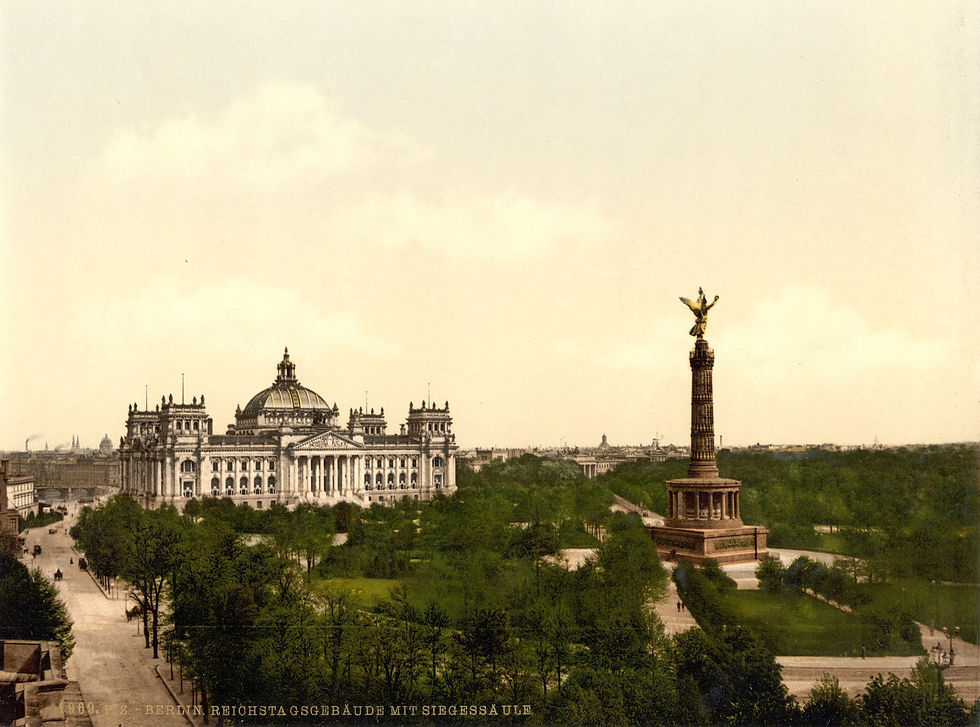
Caption: The Victory Column once stood much closer to the Reichstag, before it was moved west to Großer Stern.
This is the part many visitors miss. The Victory Column did not originally stand at Großer Stern.
VisitBerlin notes that it first stood on Königsplatz, today's Platz der Republik, in front of the Reichstag. In 1938 and 1939, under Hitler's plans to transform Berlin into the world capital Germania, the column was moved west to its present location and raised with an additional section.
That move changes how you should look at it.
The column is not just a landmark in a park. It is also evidence of how regimes try to rearrange cities to tell a story about power. The current placement gives it a grand axis through Tiergarten, but that placement is not innocent.
If you later visit Brandenburg Gate, the Reichstag or the government quarter, remember that the column once belonged much closer to that political space.
How to read the current location

Caption: The current location is part of the story. The monument was moved into a larger ceremonial axis in 1938 and 1939.
At Großer Stern, the Victory Column sits in the centre of roads that radiate through Tiergarten. That makes it dramatic from a distance and slightly awkward up close.
Stand outside the traffic circle first and take in the scale. Then use the tunnel and look up from the base. The golden Victoria is the obvious focal point, but spend a minute with the lower level too: columns, mosaics, reliefs, dark stone, gold accents and the almost stage-like relationship between monument and roundabout.
If you only climb, take the photo and leave, you miss the strange part. This monument was moved, lifted, surrounded by traffic and turned into a viewpoint. Berlin did not remove the old power symbol. It absorbed it into a new everyday city rhythm.
That is why I find it more interesting than a normal observation tower.
What to notice at the base

Caption: The base is where the old victory language of the monument is easiest to read.
The base is where the monument's older message is easiest to see. Look for the reliefs and decorative panels rather than rushing straight to the stairs.
Some images around the column show battle, state power and 19th-century symbolism. After the Second World War, parts of the monument's relief story became politically loaded and physically disrupted. Some reliefs were removed and later returned. If you have time, the base is worth a slower look before or after the climb.
This is also where the tourist experience becomes more honest. The view from the top is enjoyable. The base reminds you that the structure was not built simply to be enjoyable.
That tension is very Berlin.
Best time to visit
For most visitors, the best time is a clear late afternoon. The light is warmer, Tiergarten looks richer, and the long avenues make more sense visually.
Morning can also work if you want fewer people and a calmer climb. Midday is fine for a practical stop, but the light can be flat. Rainy days are usually not worth the climb unless you are nearby anyway and only want the history layer.
In winter, go earlier than you think. Berlin.de lists shorter winter opening hours, and the light disappears quickly. In summer, check whether the late opening window is actually useful for your date, then bring cash and do not arrive just before closing.
A simple first-visit plan
Use one of these three versions.
20 minutes: see the outside, use the tunnel, look at the base, skip the climb. This works if you are passing through Tiergarten or if stairs are not realistic.
45 minutes: climb the 285 steps, spend time on the platform, look at the base after you come down. This is the best normal version.
90 minutes: combine the climb with a Tiergarten walk, Bellevue Palace exterior, Café am Neuen See or a slow route toward Brandenburg Gate. This is better if you want the area to feel like part of the day rather than a photo stop.
If it is your first Berlin morning and you have not seen the historic centre yet, I would still start elsewhere. My own Berlin walking tour route focuses on the older centre, Museum Island, Alexanderplatz and the story layers you can connect in about 2 hours. The Victory Column is a good extra, not a replacement for that core.
What to pair with Victory Column Berlin
The best pairings depend on your day.
For a classic tourist route, pair it with Brandenburg Gate and Tiergarten. You can understand the long axis and then return toward the centre.
For views, pair it with my guide to the best views in Berlin you can find on foot. The Victory Column gives you one kind of view; the Reichstag dome, TV Tower and street-level viewpoints give you very different versions of the city.
For a broader first trip, pair it with Berlin in 3 days, not as a must-do stop, but as a flexible add-on when the weather is good.
For transport planning, use the current BVG or VBB route planner and compare it with my Berlin public transport guide. The route is easy when you choose the right approach, annoying when you drift there without checking.
Image Credits
Historical and detail images in this article include Wikimedia Commons public-domain and Creative Commons material, including Bundesarchiv, B 145 Bild-P016989 / CC BY-SA 3.0 DE, Dosseman / CC BY-SA 4.0, and Gary Todd / CC0.