BER Flight Delay Compensation: What You Are Owed and the Line That Decides It

There is a particular silence at BER when a flight goes wrong. The board flips from Boarding to Delayed with no new time, the gate staff disappear behind a door, and two hundred people stand in a pier that was designed to be walked through, not waited in. Everybody reaches for their phone and reads the same half-remembered thing about 600 euro.
Most of them will not get 600 euro. Some of them will get nothing, and will never know they were owed a hot meal and a hotel room anyway. The rules are not complicated, but almost every number people repeat about them is attached to the wrong flight.
I pulled the current BER route list and measured every destination the airport flies to, because the payout is decided by distance and by which side of an invisible line your city sits on.

Terminal 1 at BER. Every scheduled passenger flight from Berlin leaves from here or from Terminal 2 next door.
The only number that matters is three hours, and it is measured at the other end
This is the part people get wrong first. Compensation is not triggered by how long you sat at the gate in Berlin. It is triggered by how late you finally arrived at your destination.
A flight that pushes back four hours late but makes up an hour in the air and lands two hours and fifty minutes behind schedule pays nothing. A flight that leaves twenty minutes late, then sits on a taxiway in Palma for three and a half hours, pays in full. The European Court of Justice settled that the clock stops when a door of the aircraft is opened at the destination, not when the wheels touch down, and the European Commission's own passenger rights summary says the same.
So before anything else, note two times: the arrival time printed on your booking, and the actual time the doors opened. That gap is your claim.
Under three hours late: no compensation, whatever happened.
Three hours or more late: compensation is due, unless the airline can prove an extraordinary circumstance.
The delay is measured per booking, to your final destination. If you connect, it is the arrival at the last airport that counts, not the leg that went wrong.
That last point is worth more than it sounds. A Berlin to Frankfurt to Rio booking is not a 431 kilometre flight for these purposes. It is a Berlin to Rio flight, and it pays accordingly.

The departures level at Terminal 1. What happens here does not set the clock; what happens at the far end does.
BER flight delay compensation runs on distance, and the line falls in a strange place
Regulation 261/2004 sets three amounts: 250 euro up to 1,500 kilometres, 400 euro above that, and 600 euro only for long flights that leave the EU behind. The distance is the great circle distance from Berlin to your final destination, not the route the aircraft actually flew.
I measured all of it. On the route list I checked on 7 September 2026, BER serves 157 scheduled destinations. Sorted by that legal distance, they fall like this:
79 destinations pay 250 euro. Everything from Copenhagen at 366 kilometres out to Bordeaux.
69 destinations pay 400 euro, which is the biggest single band and the one most Berlin holidays sit in.
9 destinations pay 600 euro. Nine, out of 157.
Then there is the oddity. Nothing BER flies sits between 1,336 and 1,500 kilometres. Bordeaux, at 1,336 kilometres, is the longest route in the 250 euro band. The next destination up the list is Thessaloniki at 1,500.5 kilometres, which clears the line by five hundred metres and is worth 150 euro more. Corfu clears it by 1.4 kilometres. Barcelona clears it by 2.4.
If you are flying home from one of those three and an airline offers you 250 euro, that is the moment to check the number before you accept it. Half a kilometre on a 1,500 kilometre flight is inside the noise of how anyone measures an airport, and it is exactly the kind of thing a claims department settles rather than argues.
The Canary Islands trap: 3,669 kilometres that is still only 400 euro
Here is the rule almost nobody knows, and it costs people 200 euro a head.
The 600 euro band does not simply mean "a long flight". It means a long flight that is not inside the EU. Written properly: 400 euro covers all intra-EU flights over 1,500 kilometres, plus all other flights between 1,500 and 3,500 kilometres. Six hundred euro is what is left over, and only flights leaving the EU can land in it.
Tenerife South is 3,669 kilometres from Berlin. That is 800 kilometres further from Berlin than Cairo, and further than Marrakesh. The Canary Islands are Spanish, Spain is in the EU, and so a ruined Tenerife flight is a 400 euro claim, not a 600 euro one. The same goes for Gran Canaria, Fuerteventura, Lanzarote and Funchal.
The nine BER destinations that genuinely reach 600 euro are the ones that leave the union entirely:
Jeddah, 4,056 kilometres
Dubai and Abu Dhabi, around 4,600 kilometres
Montréal, New York, Newark and Toronto, between 6,000 and 6,500 kilometres
Beijing, 7,358 kilometres, the longest scheduled route out of Berlin
One more twist on that band. If the airline cancelled your flight and put you on a replacement that got you in only three to four hours late, a 600 euro claim can legally be halved to 300. That reduction exists for rerouting. If nobody rerouted you and the same aircraft simply arrived late, argue for the full amount.

The gate is where you learn something is wrong. It is rarely where anyone will tell you what you are owed.
What you are owed while you are still standing in the terminal
Compensation is the loud part. The quiet part is the right to care, and it works differently: it is owed even when the delay is the airline's fault in no way at all. Fog, a closed runway, an air traffic control failure. No compensation, but the airline still has to look after you.
The thresholds are set by the same distance bands, counted from your scheduled departure:
Two hours for flights up to 1,500 kilometres
Three hours for intra-EU flights over 1,500 kilometres and other flights up to 3,500 kilometres
Four hours for everything longer
Past that point the airline owes you meals and refreshments in proportion to the wait, and two phone calls or emails. If the new departure is the next day, it owes you a hotel and the transfer to it. And once a delay passes five hours, you can simply abandon the trip: you are entitled to a refund of the unused ticket, and a flight back to where you started if you have already connected somewhere.
In practice at BER, nobody will announce this. Ask at the airline desk on the departures level, and if there is no desk, keep every receipt and claim it back afterwards. A reasonable dinner and a bed near the airport is a normal reimbursement. A steak and a suite is not.

Check-in island 5. If your airline still has staff landside, this is where the care conversation actually happens.
What actually kills a claim
Airlines do not usually refuse outright. They refuse with a word, and the word is almost always the same one.
Extraordinary circumstances removes the compensation but never the care. It genuinely covers weather, air traffic control decisions, political instability and security risks, and the official EU list is narrower than airlines like to imply. It does not cover most technical faults, because the courts have decided that maintaining an aircraft is the airline's ordinary business. It also does not cover a strike by the airline's own staff, which is a point worth remembering in Germany, where cabin and ground crew strikes are a regular part of the calendar.
The other claim-killers are simpler:
A cancellation announced more than 14 days ahead pays nothing. Fourteen days is the whole test.
Giving up your seat voluntarily on an overbooked flight ends your rights. Take the voucher only if you genuinely value it more than the 250 to 600 euro you just waived.
Accepting a voucher as "compensation" does the same thing. You are entitled to cash, or to a bank transfer. A voucher is only binding if you agreed to it in writing.
That last one is the trap I would most like Berlin visitors to avoid. A polite person at a desk offering you a 200 euro flight voucher on a route that owes you 400 euro in cash is not making you an offer. They are making you a saving.
Going back into the city is usually the right move at BER
This is the Berlin-specific part, and it is the reason a delay here is less miserable than a delay at most airports.
The railway station sits directly underneath Terminal 1, on level U2, and Terminal 2 is a few minutes' walk from the same station. The Airport Express runs it in 22 minutes to Berlin Hauptbahnhof, and Alexanderplatz is about 32 minutes door to door with one change onto the U2. I checked both against live timetables while writing this. The S9 and S85 also serve the airport, and they are slower but useful late at night.
BER sits in fare zone C, so you need an ABC ticket: 5.00 euro for a single, 12.90 euro for 24 hours. That is the entire cost of turning four dead hours into an afternoon in the city.
My rule is simple. If the new departure time is at least four hours away and you have not yet dropped a bag, go into town. If you are already through security, staying put is usually right, because BER's security queues are unpredictable and you would be starting again. And if you have a long delay in daylight, my free walking tour of the historic centre is a two hour loop that starts a short walk from Alexanderplatz, which is about as neatly as a stranded afternoon can be spent.
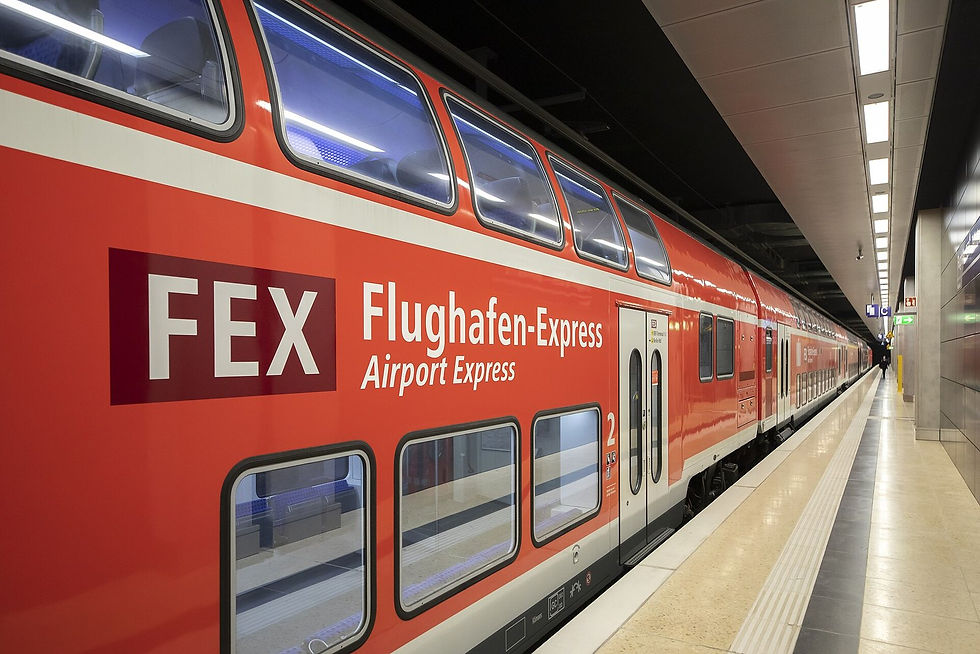
The Airport Express at BER. Twenty-two minutes to Hauptbahnhof, and the platform is directly under the terminal.
The rules changed in July 2026, and they do not apply to your flight
You will find headlines about new European passenger rights. They are real, and they are also not yet in force, which is a distinction worth being clear about.
The European Parliament approved the first full revision of Regulation 261/2004 on 7 July 2026, by 646 votes to 12, and the Council cleared it on 13 July 2026. The new text enters into force twenty days after publication in the Official Journal, and then countries and airlines get a further year to apply it. In practice that means the revised regime starts in 2027, not now.
Two things are worth knowing about what survived the rewrite:
The three hour threshold stayed. It was the most contested point in the whole negotiation and it did not move.
The 250, 400 and 600 euro amounts stayed too. The bands you can measure on the tool above are the ones that will still be in force after the change.
What does change from 2027 is mostly procedural and mostly good: airlines will have to tell you about your rights and how to claim without being asked, and they will no longer be able to cancel your return leg because you missed the outbound. Until then, a delay out of BER is judged under the same rules that have applied since 2004.
How to claim from Berlin, and how long you have
Claim it yourself first. The claim agencies advertising at airports are legitimate, but they take a cut of between a quarter and a third, and the first letter is not hard to write.
1. Write to the airline directly, by email or through its own claim form. Give the flight number, the date, the booking reference, the scheduled arrival time and the actual arrival time. Say the words "compensation under Regulation 261/2004" and name the amount. 2. Ask for a bank transfer, not a voucher, in the same message. 3. If the answer is a refusal or silence, take it to the free arbitration body. Germany's is the Schlichtungsstelle Reise & Verkehr, the organisation formerly known as söp, and it is based in Berlin. It costs the passenger nothing and it handles flights alongside rail, bus and ship complaints. 4. The Luftfahrt-Bundesamt is Germany's enforcement body for passenger rights. It supervises airlines and takes complaints, but it will not collect your money for you. Arbitration or a court does that.
You have longer than most people think. In Germany a claim expires three years after the end of the calendar year in which the flight took place, so a flight in September 2026 can still be claimed until the last day of 2029. There is no rush, but there is also no reason to wait: airlines answer faster when the flight is recent and the crew report is still on file.

The landside marketplace at Terminal 1, where most people spend the wait without ever asking what they are owed.
The one move I would make
If your flight out of Berlin is going badly, do this before you do anything else: screenshot the departure board showing the delay, and note the scheduled arrival time from your booking. That is thirty seconds of work and it is the evidence the whole claim rests on, because once you are home the board is gone and the airline's version is the only one left.
Then check the distance. A flight to Barcelona and a flight to Bordeaux feel like the same kind of trip and are worth 150 euro apart. Knowing which one you are on, before you talk to anyone at a desk, changes the conversation completely.
If Berlin has just handed you an unexpected afternoon, my guide to a Berlin last day has the version of this plan that works in reverse, and the BER departure guide covers the timing that stops most of these problems happening at all. For the train equivalent, Deutsche Bahn pays differently and far earlier than any airline does.
Image credits
Source and licence details for the 6 photographs used in this article.
Terminal 1 at Berlin Brandenburg Airport photographed from the forecourt at dusk: Arne Müseler / www.arne-mueseler.com, CC BY-SA 3.0 DE, via Wikimedia Commons.
The departures level at BER Terminal 1: Arne Müseler / www.arne-mueseler.com, CC BY-SA 3.0 DE, via Wikimedia Commons.
A gate area in the north pier at BER marked A33: Arne Müseler / www.arne-mueseler.com, CC BY-SA 3.0 DE, via Wikimedia Commons.
Check-in island 5 at BER Terminal 1: Arne Müseler / www.arne-mueseler.com, CC BY-SA 3.0 DE, via Wikimedia Commons.
A Flughafen-Express train at the underground platform at BER: Arne Müseler / www.arne-mueseler.com, CC BY-SA 3.0 DE, via Wikimedia Commons.
The landside marketplace level at BER Terminal 1: Arne Müseler / www.arne-mueseler.com, CC BY-SA 3.0 DE, via Wikimedia Commons.