Train Delay Compensation in Berlin: What You Actually Get Back

Updated: Aug 30
Berlin is a city where a late train can quietly eat a whole day of your trip. You go out to Potsdam or Dresden for the afternoon, you get to the platform for the ride back, and the board at Hauptbahnhof or Gesundbrunnen says +70. Everyone around you sighs and nobody moves, because almost nobody knows that at that exact number a rule switches on and the railway owes you money.
The rule is real, it is written into European law, and it is easier to use than it looks. What confuses visitors is that Berlin runs three different transport systems on the same map, and only one of them pays cash.
Which train you are standing on decides everything
Look at the front of the train before you look at the clock. That single detail decides what a delay is worth.
ICE, IC, EC, RE, RB and the airport regional trains run under EU rail passenger rights. These pay real money.
U-Bahn, tram and bus are run by BVG, the city operator. BVG has its own customer guarantee, and it pays in free tickets, not euros.
The Berlin S-Bahn sits on the railway side, but the fare is so small that the payout maths never gets off the ground. More on that below.
If you only remember one thing: the trains that take you out of Berlin are the ones worth claiming on. The trains inside Berlin are the ones worth walking away from.

ICE 677 from Karlsruhe at Berlin Hauptbahnhof in June 2026. Engineering work had closed the long-distance tracks on the elevated Stadtbahn line, so the train came in at the deep-level platforms instead. Berlin reroutes its trains more often than most visitors expect.
What 60 minutes is actually worth
Deutsche Bahn works to two thresholds, and they apply to the delay at your destination station, not the delay at departure. A train that leaves 40 minutes late and makes the time back owes you nothing.
60 to 119 minutes late: 25 percent of the fare you paid for that single journey.
120 minutes or more: 50 percent of the fare you paid for that single journey.
Two real Berlin examples:
A 29.90 euro saver fare to Hamburg arriving 70 minutes late pays back 7.48 euros.
The same ticket arriving 130 minutes late pays back 14.95 euros.
Then comes the catch that quietly kills most local claims. DB does not pay out anything under 4 euros. That threshold is written into the rules, and it is why a delayed S-Bahn or regional hop inside the city is not worth a form: 25 percent, or even 50 percent, of a single Berlin AB fare is nowhere near four euros. The number only starts working once you are on a proper intercity or long regional ticket.
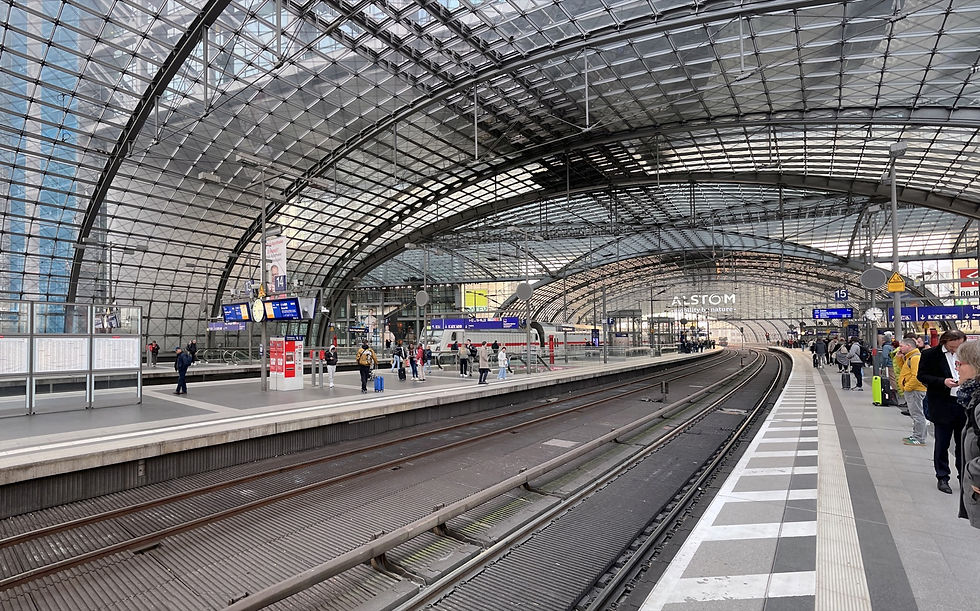
The upper Stadtbahn level of Berlin Hauptbahnhof. Long-distance trains east and west run through here, and a single closure on this stretch reshuffles departures across the whole city.
The 20-minute rule that saves the day, not the money
This is the rule I would want a visitor to know first, because it protects your evening, and it fires long before any money is involved.
Berlin day-trip tickets are usually cheap Sparpreis fares, and a Sparpreis is normally locked to one specific train. If your booked train is expected to arrive 20 minutes or more late at your destination, that lock comes off. You may take a different train, on the same route or another one, at no extra cost.
Twenty minutes is a low bar, and it triggers far more often than the compensation thresholds do. It means the correct move on a delayed Dresden or Leipzig return is not to stand and wait for your train. It is to open the DB Navigator, find the next departure that gets you back, and get on it.

An RE6 regional train at Berlin Gesundbrunnen. Regional trains carry the same passenger rights as an ICE, which surprises most visitors who assume the rules only cover long-distance travel.
When the sensible move is to give up and go home
At 60 minutes of expected delay, a second door opens: you can abandon the journey entirely and get the full fare refunded. If you have already travelled part of the route, you can get the unused part back, and if the trip has become pointless you can claim the used part too.
This matters for a Berlin day trip more than for a commute. If the 09:40 to Dresden is going to get you there at 13:00, the day is finished before it starts. Cancelling and taking the money back, then spending the day in Berlin instead, is usually the better trade. I have made the other choice before, sat on a platform for an hour to protect a plan that was already dead, and it is not a mistake worth repeating.
Stranded after midnight: the 120 euro rule
This is the clause worth carrying in your head, because it applies exactly when you are most stuck.
If your train is 60 minutes or more late, or cancelled, and it is the last scheduled connection of the day, and you can no longer reach your destination station by 24:00, then the cost of getting there another way is covered. Up to 120 euros for a taxi or a bus, on the condition that the railway offers you no replacement and you cannot reach anyone from the operator on the spot. The same applies to an arrival between 00:00 and 05:00.
There is a matching accommodation rule: if the delay or cancellation makes continuing the same day impossible or unreasonable and the railway does not arrange a room, your reasonable hotel cost is covered.
Two practical notes. Try the DB information desk or ticket office at the station first and note what happens, because the clause depends on the railway failing to help. And keep the receipt. No receipt, no reimbursement.
Berlin's own network: a free ticket, not a payment
Now the other system. If your U-Bahn, tram or bus is more than 20 minutes late through BVG's own fault, BVG sends you a free ticket. Not a refund, not a percentage, a ticket.
There is one genuinely useful clause underneath it. If it happens between 23:00 and 05:00 and you have to take a taxi because of it, BVG reimburses the fare up to 25 euros. That is the Berlin night-out version of the 120 euro railway rule, at a fifth of the value.
The deadline here is much tighter than the railway's: BVG asks for the completed guarantee certificate within 14 days. Leave it a month and you have lost it.

An old destination indicator on the U-Bahn platform at Alexanderplatz, kept for a line that was never built. BVG measures its own guarantee from 20 minutes late, and pays it in tickets.
If you are travelling on a Deutschlandticket
A growing number of visitors buy the monthly Deutschlandticket instead of single fares, and the compensation works completely differently, because there is no single-journey price to take a percentage of. DB pays a flat amount per delayed journey of 60 minutes or more:
Regional travel cards: 1.50 euros second class, 2.25 euros first class.
Long-distance travel cards: 5 euros second class, 7.50 euros first class.
Total compensation is capped at 25 percent of the card's value.
One and a half euros looks pointless next to the four euro payout floor, and on its own it is. But travel-card holders are allowed to collect several delays and submit them together, and they can count cases from 20 minutes upward once they are bundling. Three bad journeys in a month, submitted as one claim, clears the floor. One does not.
When they are allowed to pay you nothing
The compensation rules have one exemption, and it was tightened in 2023. A railway does not owe compensation when the delay came directly from extraordinary circumstances outside railway operations: extreme weather, a major natural disaster, a major public health crisis, where the operator could neither foresee nor avoid it.
The bar is genuinely high. An ordinary autumn storm or the usual seasonal flooding does not count. The event has to look like a real catastrophe. Normal German weather does not qualify. Signal failures, staff shortages, broken trains, engineering overruns and strikes are all on the railway's side of the line, and they all still pay.
How to claim, and how long you have
The process is short, and the part people miss is the first one.
1. Get the delay confirmed while you are still in the station. Ask a conductor or the service point to stamp a Fahrgastrechte form, or note the train number, the scheduled arrival and the real arrival. Evidence collected later is much harder. 2. File it. Online through your DB account or the order lookup on Deutsche Bahn's passenger rights pages, in the DB Navigator app, at a DB Reisezentrum, or by posting the paper form to DB Fernverkehr AG, Servicecenter Fahrgastrechte, 60647 Frankfurt am Main. 3. Choose money, not a voucher. DB offers both. Ask for the bank transfer. 4. Do not sit on it. The legal deadline is three months after the journey. DB says it is still accepting claims for up to twelve months as a transitional practice, but that is goodwill, not a right.
For BVG the equivalent is the guarantee certificate set out in the BVG customer guarantee, sent within 14 days to BVG Kundendialog, Fach 43431, 10096 Berlin, with the taxi receipt attached if you are claiming one.

Not every regional train out of Berlin is red. ODEG runs a large share of the Brandenburg network, and when your delay is on one of their trains the claim goes to them, not to Deutsche Bahn.
Work out what your delay is worth
The maths is simple in isolation and annoying in a station. The board below does it for you: pick the kind of ticket you had, drag the delay, and add each bad journey as its own case. The running total shows where you stand against the four euro payout floor, which is the number that decides whether a claim is worth filing at all.
What this changes about planning a Berlin day trip
Knowing the thresholds changes how you build the day, not just what you do when it breaks.
Book the early train, not the last one. The 120 euro clause exists because the last connection of the day is where people get properly stranded. If you are going to Dresden or Hamburg, leave yourself one later train as a spare.
Keep the ticket. Screenshot or paper, it does not matter, but a claim without the fare price is dead on arrival.
Do not fight the network inside Berlin. For a late U-Bahn the honest answer is that a free ticket is not worth your afternoon. Walk, take the tram, or take the bus.
Plan your inner-Berlin morning around walking. The historic centre is compact enough that a transport failure at Alexanderplatz is an inconvenience, not a lost day.
That last point is the one I lean on most. My own 2 hour walking tour covers 11 stops and 16 places on about 3 km through the medieval core, from the World Clock at Alexanderplatz to Hackescher Markt, and none of it depends on a train running on time. If a delayed morning has wrecked a day trip, a walk through the centre is the easiest way to rescue the rest of it. You can see how the route is built on the walking tour route page, and the meeting point is a two-minute walk from the Alexanderplatz platforms.
For the wider transport picture, the Berlin public transport guide explains how the U-Bahn, S-Bahn, tram and bus fit together, and if the disruption is a strike and not a delay, the Berlin transport strike guide is the one to read instead. Planning the trip out of the city in the first place is covered in best day trips from Berlin.
The move I would make
If the board says your train home is more than 20 minutes down, stop waiting and take the next train that works, because your saver ticket is no longer locked to that train. Photograph the departure board and your ticket while you are still standing there. Then, only if the delay at your destination crossed 60 minutes, file the claim later that evening and ask for the transfer rather than the voucher. Everything else is detail.
Rules and figures checked on 28 August 2026 against Deutsche Bahn's passenger rights pages and BVG's customer guarantee. Prices and thresholds can change, so confirm the current figures before you file.
Image credits
Source and licence details for the 5 photographs used in this article.
ICE 677 from Karlsruhe at a deep-level platform at Berlin Hauptbahnhof: NutzerAusBerlin, CC0 1.0, via Wikimedia Commons.
Platform 15 on the upper Stadtbahn level of Berlin Hauptbahnhof: Gunnar Klack, CC BY-SA 4.0, via Wikimedia Commons.
An RE6 regional train at Berlin Gesundbrunnen station: Lukas Beck, CC BY 4.0, via Wikimedia Commons.
An old destination indicator on the U-Bahn platform at Alexanderplatz: Falk2, CC BY-SA 4.0, via Wikimedia Commons.
An ODEG regional train at the platform at Berlin Alexanderplatz: Bahnfrend, CC BY-SA 4.0, via Wikimedia Commons.