Bauhaus in Berlin: Three Places That Make Modernism Easier to Read
- Yusuf Ucuz

- 4 days ago
- 4 min read
The word Bauhaus gets attached to almost every clean line, tubular chair and white facade in Berlin. That makes it easy to miss the useful part. Bauhaus in Berlin is not one neat museum stop. It is a way of noticing how a building holds a collection, a domestic room or a public hall together.
My advice is to choose one scale first. Start with the archive when you want the ideas and objects, move to Haus Lemke when you want to see modernism meet an ordinary garden, or stand under the roof of the Neue Nationalgalerie when you want to feel what a large public room can do. These are connected places, not a checklist of “Bauhaus buildings.”
Use the Berlin Bauhaus Lineage Map below to switch between the three places on one map. It is a way to read the connections, not a timed itinerary. Check each institution's own visitor page before you travel across the city.

The original Bauhaus-Archiv building has a roofline that makes its modernist language visible before you enter.
Start with the Bauhaus-Archiv when you want the ideas behind the look
The practical place to begin is the temporary Bauhaus-Archiv / Museum für Gestaltung at Knesebeckstraße 1 in Charlottenburg. The original museum building on Klingelhöferstraße is being renovated, so do not set off for an old address from a guidebook. The museum's own visitor information is the right final check for the current exhibition, entry and opening details.
This is the stop for someone who keeps asking, “What was the Bauhaus actually trying to change?” Look for the relationship between type, material and daily use rather than hunting for a single famous object. A chair, a typeface sample or a tea service becomes more useful when you ask what problem it was meant to solve.
If museums are a big part of your first visit, my guide to choosing the best Berlin museums for first-time visitors can help you avoid building a day around too many interiors.
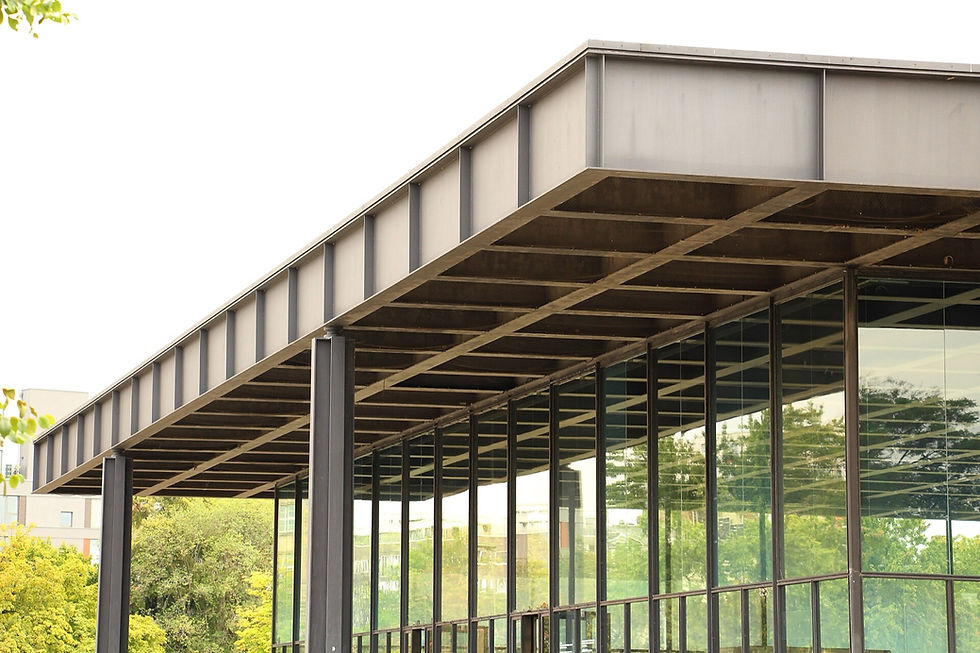
At the Neue Nationalgalerie, the roof and the glass walls make the space feel open before the collection begins.
Use Haus Lemke to see modernism at domestic scale
For a quieter counterpoint, go to the Mies van der Rohe Haus at Oberseestraße 60 in Alt-Hohenschönhausen. Haus Lemke was designed by Ludwig Mies van der Rohe in 1932–33 and is now an exhibition venue. It is not on the usual central sightseeing loop, which is exactly why it can clarify the subject: the brick, glass and garden are read at the size of a lived-in house.
Do not go expecting a grand survey museum. Go to notice a threshold, a corner, a view through glass and the way the house meets the outside. The venue's visit and registration page is especially worth checking if you are travelling as a group.
Haus Lemke also gives a useful answer to a common Berlin problem: not every good architectural stop has to sit beside Brandenburg Gate. Give the eastern side of the city its own reason for the trip instead of forcing it into an already crowded Mitte day.

Haus Lemke makes the connection between brick, glass and garden easier to notice at the scale of one home.
Read the Neue Nationalgalerie as the public-scale connection
The Neue Nationalgalerie at Kulturforum is not a Bauhaus school building, and it should not be labelled as one. It belongs in this Berlin modernism thread because Mies van der Rohe designed it in the 1960s, taking the question of structure and open space into a much larger civic setting. The building was completed in 1968; the museum's own building history gives the fuller context.
Stand outside first. The thin roof plane, the columns and the glass let you see how little of the structure is hidden. Then go inside if the current exhibition fits your day. I like this stop after Haus Lemke because the contrast is direct: one architect, but a house and a national gallery asking completely different things of a visitor.
If you are already around Kulturforum, my Potsdamer Platz guide is a useful way to see how the surrounding area shifted from a divided-city edge into a new district.

The Neue Nationalgalerie is a 1960s public building, not a Bauhaus school site; its connection is Mies van der Rohe's later work.
How I would choose between the three places
Choose the Bauhaus-Archiv when you want context, objects and a clearer idea of the movement itself. Its temporary Charlottenburg location makes it easy to combine with a different west-Berlin day, such as Charlottenburg Palace.
Choose Haus Lemke when a house, garden and small-scale detail will teach you more than another large gallery. It deserves its own journey to Alt-Hohenschönhausen.
Choose the Neue Nationalgalerie when you want to feel structure and openness in a major public building, then decide whether the current exhibition is worth the extra time.
You can visit all three, but only if the subject genuinely interests you. The useful move is not to claim a “Bauhaus day” because you checked three names off a list. Pick the place that answers the question you brought with you, then let the other two stay as possible second chapters.
If you are visiting Berlin as a group and want to discuss a day with architecture as one sensible thread, you can ask me about a private Berlin tour. It is an enquiry, not a pre-set Bauhaus itinerary.
Image credits
Source and licence details for the 4 photographs used in this article.
The curved roofline of the Bauhaus-Archiv in Berlin: Billie Grace Ward, CC BY 2.0, via Wikimedia Commons.
The glass and roof plane of the Neue Nationalgalerie in Berlin: Fred Romero, CC BY 2.0, via Wikimedia Commons.
A view from inside Haus Lemke towards its garden: Manfred Brückels, CC BY-SA 3.0, via Wikimedia Commons.
The roofline of the Neue Nationalgalerie seen across the Kulturforum forecourt: Tim Rademacher, CC BY-SA 4.0, via Wikimedia Commons.