Tropical Islands from Berlin: A Rainforest Day Trip Inside a Giant Airship Hangar

Updated: 1 day ago
Berlin keeps a strange answer to a broken weather forecast about an hour south of the city: a tropical beach held at 26 degrees, a real rainforest with around 50,000 plants and a 200 metre stretch of sand, all inside one of the largest free-standing halls in the world. On a grey morning you can spot exactly who is going there. Families with beach bags and pool noodles gather on the regional platforms at Ostkreuz, looking far too optimistic for the weather outside.
Tropical Islands is easy to dismiss as a theme park and just as easy to overrate as a paradise. It is neither. It is a very German piece of engineering optimism that failed as an airship factory and succeeded as a swimming pool. Whether it deserves one of your Berlin days depends mostly on your group, the season and how you handle the tickets. Here is how I would decide, and how the money and the trains actually work.

The Aerium near Krausnick: 360 metres long, 210 metres wide, 107 metres high. Airships were supposed to be built here.
What Tropical Islands actually is
Tropical Islands is an indoor tropical resort inside the Aerium, a hangar so large that the Eiffel Tower would fit inside it lying down. The hall is 360 metres long, 210 metres wide and 107 metres high, and it holds a permanent 26 degree climate with about 64 percent humidity. Under the roof you get the Tropical Sea, a 140 metre pool edged by a 200 metre sandy beach, the warmer Bali Lagoon with currents and whirlpools, a 27 metre waterslide tower, a tropical village and an indoor rainforest with around 600 plant species and its own walking trail.
In summer the ticket also covers AMAZONIA, an outdoor water area of more than 35,000 square metres with pools and sports courts, which quietly solves the obvious July objection that you did not come to Brandenburg to sit inside. A day ticket runs from 08:00 to 23:30, so the day is as long as your group can survive it.

The Tropical Sea, the rainforest and the village under one roof. The white dot on the horizon is the hall's own balloon.
How to get to Tropical Islands from Berlin in 2026
The resort has its own railway station, Brand Tropical Islands, on the line toward Cottbus. The RE2 and RB24 regional trains run there about hourly, and the ride from Berlin Ostkreuz takes roughly 45 minutes. A free shuttle bus waits at the station and is timed to the trains, though it does not wait for a badly delayed one. The dome is three minutes away across the old airfield.
One thing is different this year, and it catches people who last did this trip in 2025. The Stadtbahn, the east-west viaduct through Hauptbahnhof, Friedrichstraße and Alexanderplatz, is closed to regional trains from 14 June to 12 December 2026, so the RE2 runs via Gesundbrunnen, Ostkreuz and Schöneweide instead. Board at Ostkreuz, which every central S-Bahn line reaches, and check the VBB app on the morning itself. I explain the whole 2026 station situation in my guide to leaving Berlin by train.
For tickets, three options cover almost everyone:
Deutschlandticket: the 63 euro monthly subscription covers the entire ride, S-Bahn and regional train included. If you already have it, the transport cost of this day trip is zero. My Deutschlandticket guide for tourists explains whether one month is worth buying for your trip.
Brandenburg-Berlin-Ticket: 36.50 euros flat for up to five people on one ticket, valid on weekdays from 09:00. For a family or a group of three or more, this is usually the cheapest way without a subscription.
Single VBB tickets: Brand lies beyond Berlin's ABC zones, so a normal Berlin day ticket is not enough. The route stays inside the VBB network, so check the exact single fare in the VBB app before assuming the group ticket wins.
Driving works too: the resort sits just off the A13 at the Staakow exit, about 50 minutes from the southern edge of Berlin, and parking costs 6 to 8 euros for the day. But the train plus shuttle is genuinely the low-stress version of this trip.
What a day costs, and the one ticket habit that matters
The pricing is date-based, which means one simple rule saves more money than any other trick: book ahead on the official ticket page. An adult day ticket starts around 34.90 euros online and costs 55.90 euros or more at the door. For a family of four, deciding at the counter can cost 60 to 80 euros extra for exactly the same day.
The age bands: adults are 18 and over, teens 13 to 17, children 4 to 12, and children up to three enter free. Teens and children start around 29.90 euros online. Two more layers sit on top of the basic day:
Sauna & Spa: Europe's largest tropical sauna landscape is a separate area and costs extra, from about 39.90 euros as a combined online day ticket. Fair warning before you wander in: like almost every German sauna, it is textile-free. Swimwear stays outside.
Evening ticket: entry from 18:00 costs from about 29.90 euros for adults. Paired with a late train back, it makes a realistic half-day for people whose Berlin schedule is full.
There is also a Family ticket from 129.90 euros for two adults and three children, which beats single tickets for exactly that constellation. The planner below does the maths for your own group, including the train options, before you commit a whole day to it.
What it is like inside, honestly
The first ten minutes are genuinely surreal. You walk out of a Brandenburg pine forest, through a revolving door, and into humid tropical air with palm trees and the sound of water. The rainforest is not a decoration: it is a real planted forest with a proper trail through it, and walking it at a slow pace takes twenty minutes.

The rainforest trail: around 50,000 plants from 600 species, kept warm by the same roof that keeps the rain out.
The Tropical Sea is calm, shallow and clearly built for families rather than swimmers. The Bali Lagoon is warmer and busier, and the 27 metre slide tower is where teenagers disappear for the day. On summer days the AMAZONIA outdoor pools take the pressure off the indoor water, and on rainy autumn weekends the reverse happens and the dome fills up. Weekends and Berlin-Brandenburg school holidays are the crowded dates. If you can go on a weekday outside the holidays, the whole place breathes easier.

The 27 metre slide tower in the evening, when day-ticket holders still have hours left on the clock.
Food and drink inside are resort-priced. Purchases are recorded on an electronic chip wristband and settled on the way out, so budget for it the way you would budget for an airport day.

The tropical village borrows its architecture from Bali, Borneo, Thailand and Samoa. Kitsch, yes, but committed kitsch.
The airship story behind the hall
The building is the best part of the story. In the late 1990s a company called CargoLifter raised hundreds of millions to build giant airships that would carry factory turbines across continents, and in 2000 it finished one of the world's largest free-standing halls on a former Soviet military airfield to build them in. The airships never came. CargoLifter went insolvent in 2002 with little more than a test balloon to show, and the empty hall stood in the forest like a beached whale.

2002: the hall in its first life, with a CargoLifter test airship looking lost in the space. Two years later the palm trees arrived.
A Malaysian group bought the hangar for a fraction of its build cost and opened Tropical Islands on 19 December 2004. Since the end of 2018 it has belonged to Parques Reunidos, the Spanish leisure group. Berlin has a habit of giving failed infrastructure a stranger second life, and this is the region's biggest example: the same story family as Tempelhof airport becoming a park, except this one you can swim in.
Day trip or overnight
Door to door, Tropical Islands from Berlin is a nine to ten hour commitment for the standard visit. That is the honest cost of it, and it is exactly why I would not spend a rare sunny Berlin day here. With sun, a Berlin lake gives you more for less money and less travel.
The resort also runs overnight options, from proper rooms and lodges to tents pitched inside the hall, and the dome at night with the day crowds gone has its own atmosphere. For most Berlin visitors I think that is one commitment too far, but for families on a longer trip it can replace a hotel night and a whole day of planning.
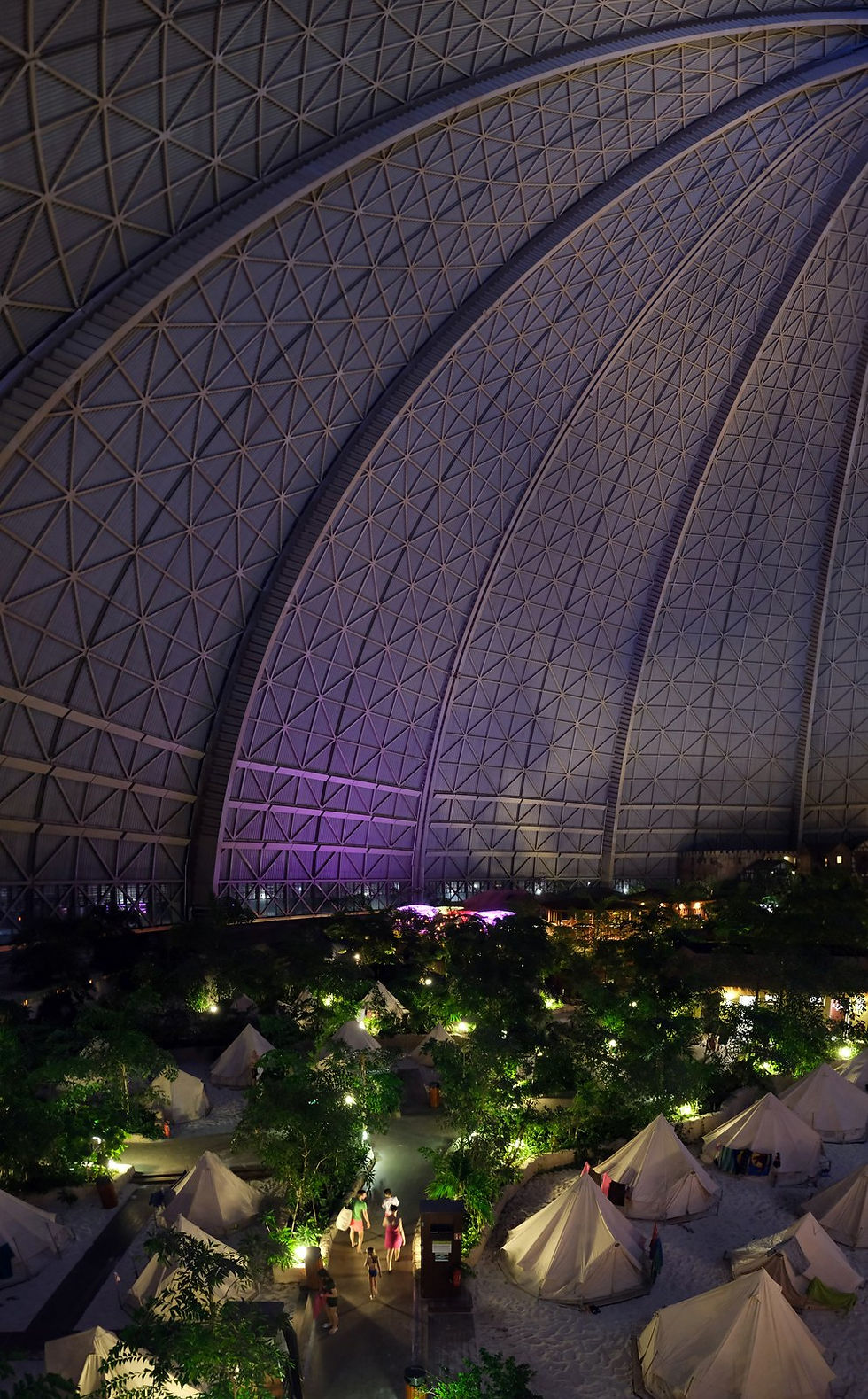
The overnight camp after dark. Day guests leave at 23:30; these tents do not have to.
How I would plan it
My advice: do not put Tropical Islands on your Berlin plan as a fixed day. Hold it as your weather insurance. If you are in the city for three or four days and the forecast breaks one of them, that broken day is the dome day: book the ticket online the evening before, take the S-Bahn to Ostkreuz after breakfast, and catch the next RE2. I have watched a rained-out Berlin day turn into the best day of a family's trip exactly this way.
Keep the clear days for the city itself. Spend a morning with me on my free walking tour through the historic centre, about two hours from Alexanderplatz, and you will have the Berlin context that makes even a bankrupt airship hangar make sense. If the weather holds all week, the dome loses to the other day trips: Potsdam, the Spreewald and Dresden are stronger uses of good sky. And if you are travelling with children in winter, ignore all of this hedging and just go; my Berlin with kids guide has the city-side half of that plan.
Image credits
Source and licence details for the 7 photographs used in this article.
Aerial view of the Tropical Islands dome: Ralf Roletschek, CC BY-SA 1.0 FI, via Wikimedia Commons.
View across the Tropical Sea under the dome: Tropical Islands Resort, CC BY-SA 3.0, via Wikimedia Commons.
Indoor rainforest walkway: Tropical Islands Resort, CC BY-SA 3.0, via Wikimedia Commons.
Waterslide tower at night: kallerna, CC BY-SA 4.0, via Wikimedia Commons.
Bali pavilion in the tropical village: Tropical Islands Resort, CC BY-SA 3.0, via Wikimedia Commons.
CargoLifter test airship inside the hangar, 2002: Stefan Kühn, CC BY-SA 3.0, via Wikimedia Commons.
Overnight tents under the dome at night: kallerna, CC BY-SA 4.0, via Wikimedia Commons.