The Totentanz: A 700-Year-Old Dance of Death Inside Berlin's Oldest Parish Church
- Yusuf Ucuz
- Mar 3
- 7 min read
Updated: 4 days ago
Most visitors to Alexanderplatz walk right past St. Mary's Church without a second glance.
It is easy to understand why. The TV Tower dominates the skyline. The square is loud. Trams slide past, shopping bags swing, phones point upward, and the medieval brick church nearby can look like a quiet leftover from another city.
But inside that church, in the entrance hall, is one of the most haunting things you can still see in Berlin: the Totentanz, the Dance of Death.
It is faint now. It sits behind glass. You do not get the dramatic impact of a restored museum fresco. You get something more powerful in a different way: a late-medieval warning that has survived war, moisture, renovation, neglect and more than five centuries of Berlin changing around it.
I love showing this story on my tour because it does something Berlin often does. It takes a place people nearly miss and turns it into a doorway into the whole city.
What Is the Totentanz?
Totentanz means Dance of Death.
It was one of the great visual ideas of late-medieval Europe. Death appears as a figure, often skeletal or corpse-like, and leads living people away in a dance. The people come from every rank of society: religious leaders, rulers, soldiers, merchants, women, children, workers and the poor.
The message is simple and brutal.
Nobody escapes.
The point was not only horror. It was moral instruction. A Dance of Death image reminded viewers that wealth, power, beauty, learning and status all end in the same place. In a world shaped by plague, short lives, religious fear and public death, this was not abstract philosophy. It was everyday reality painted on a wall.
That is why the image worked so well in churches. It spoke to everyone.
You did not need to read Latin. You did not need a university education. You only needed to recognise the social order in the figures, then notice that Death was leading all of them away.
Where Is Berlin's Dance of Death?
Berlin's Totentanz is inside St. Mary's Church, the Marienkirche, near Alexanderplatz.
VisitBerlin calls the Marienkirche the oldest parish church in Berlin still in religious use. That wording matters. The Nikolaikirche is also medieval and older in the city's origin story, but it is now a museum. St. Mary's is still a working church.
The Totentanz sits in the Turmhalle, the tower hall or entrance hall of the church. If you enter from the main door, do not walk straight through without looking. The fresco is in the entrance area, protected behind glass.
The official Marienkirche Totentanz page describes it as an over 22-metre-long late-medieval wall painting from the end of the 15th century. VisitBerlin gives the height as about 2 metres and notes that various sources date it to around 1484, a year associated with a plague epidemic.
That means the painting is not just "old".
It belongs to the oldest surviving layer of Berlin you can still stand in.

What the Fresco Shows
The Berlin Totentanz is badly faded, but the structure still comes through.
The living figures are arranged by social rank. The official church description notes that spiritual and worldly representatives form pairs, each held and led by a dancing figure of Death. Death is not simply standing beside them. Death is moving them.
That motion is the whole idea.
The image does not say death waits somewhere far away. It says death is already in the dance.
The figures traditionally associated with this kind of scene include:
Religious authority: pope, bishop, preacher or cleric figures.
Political and military power: emperor, king, nobleman, knight or armed figure.
Urban society: merchant, craftsman, innkeeper or townspeople.
Ordinary human life: young women, old people, children and poorer figures.
The order matters because the medieval viewer understood hierarchy. Society had ranks, clothes, roles, privileges and obligations. The Dance of Death walks through that hierarchy and cancels it.
The bishop cannot preach his way out.
The knight cannot fight his way out.
The merchant cannot pay his way out.
The poor person is not spared either.
That is why the image is both democratic and terrifying. It tells the most powerful person in the room and the least powerful person in the room the same thing.
Your time is limited.
Was It Really Painted During the Plague?
The common date given for the Berlin Totentanz is around 1484.
VisitBerlin connects that dating with a plague epidemic that cost many lives. The broader Dance of Death tradition had already spread through Europe in the centuries after devastating plague outbreaks, so the idea would have been familiar: death is unpredictable, public and universal.
Still, it is worth being careful. Medieval artworks rarely come with the kind of documentary file modern historians would love. The exact circumstances of the Berlin fresco are not fully preserved.
What is clear is enough.
This was a late-15th-century image painted in a city where death, disease, religion and social order were not background themes. They were central facts of life.
Standing in front of it today, you are looking at a message created for people who lived before the Reformation, before Prussia, before the TV Tower, before Brandenburg Gate became the tourist symbol everyone knows.
Berlin did not begin with the Wall.
It did not begin with the Nazis.
It did not even begin with Prussia.
It begins down here, in brick, church walls, market streets and medieval fear.
How It Survived
The Totentanz survived, but not cleanly.
The fresco is fragmentary. It has been damaged by time, moisture, repainting, restoration attempts and the simple fact that more than 500 years is a long time for pigment on a wall.
Atlas Obscura notes that the fresco had been painted over and was rediscovered during 19th-century renovations. Today, the remaining painting is shown behind protective glass.
That glass can disappoint people at first. It separates you from the artwork. It catches reflections. It reminds you that this is not a clean museum object.
But that is also the point.
The Totentanz is not impressive because it looks perfect. It is impressive because it is still there.
Berlin has lost so much of its medieval centre that any surviving fragment becomes precious. Around St. Mary's Church, almost the entire old Marienviertel disappeared through war damage, postwar clearance and GDR urban planning. The church now stands in open space beside modern roads and socialist-era scale.
The painting inside survived inside a city that kept erasing and remaking the outside.
Its survival is still active work, not a finished story. The church's own English visitor information explains that donations from a Dance of Death model mosaic help preserve the church's art treasures, especially the Totentanz fresco. The model needs 70,000 tiles to be completed.
That detail is easy to miss, but it says something important. Medieval art does not survive because history is kind. It survives because people keep choosing, generation after generation, to protect something fragile.
Why St. Mary's Church Feels So Strange Today
St. Mary's Church is one of the best places in Berlin to feel how much of the old city vanished.
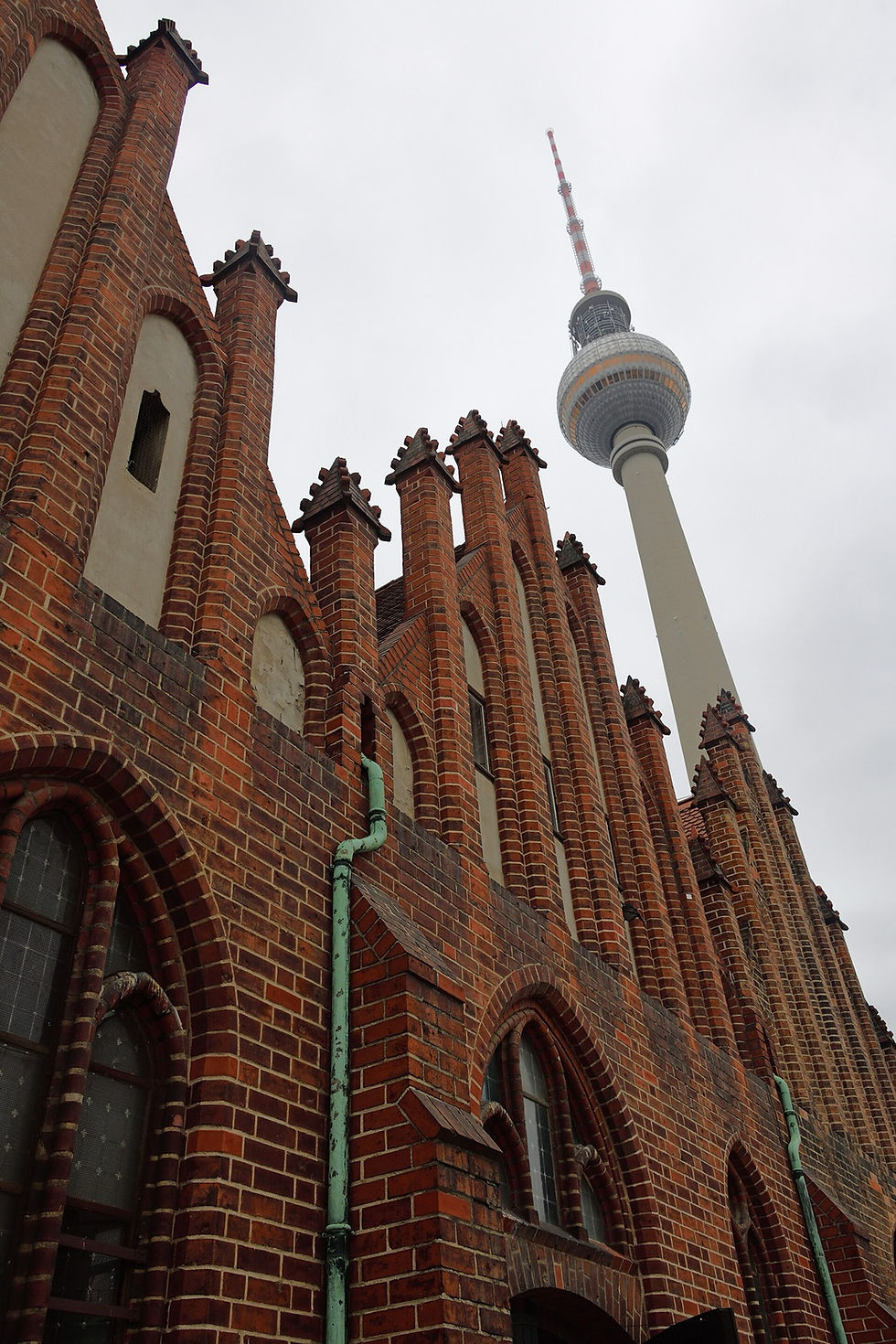
The church should be surrounded by narrow streets, houses, courtyards and the dense life of a medieval and early-modern town. Instead, it stands in a wide, exposed landscape near the TV Tower, Rotes Rathaus and Alexanderplatz.
That contrast is not accidental.
The area around today's Alexanderplatz was reshaped again and again: wartime destruction, postwar rubble clearance, GDR planning, and later reunified Berlin development. The medieval church remained, but the neighbourhood around it changed almost beyond recognition.
That is why the Totentanz matters beyond art history.
It gives the area a memory older than the skyline.
When you stand outside, you see the TV Tower rising behind the brick church. When you step inside, you see a 15th-century death image. Between those two views, you get about 700 years of Berlin compressed into a few metres.
For more of that context, read my guide to St. Mary's Church in the shadow of the TV Tower, or the wider story of Alexanderplatz then and now.
The same contrast also appears in the story of the TV Tower's construction. To make space for the GDR's new centre, much of the old urban fabric around the church was cleared or remade. St. Mary's stayed, but the city around it became almost unrecognisable.
That is why Berlin's missing old town can feel confusing. The medieval traces are real, but they sit inside a landscape that has been broken, cleared and rebuilt many times. I explain that broader pattern in my guide to why Berlin does not have a beautiful old town.
How to Find the Totentanz When You Visit
The practical part is easy, but many people still miss it.
St. Mary's Church stands near Alexanderplatz, close to the TV Tower and Rotes Rathaus. The address listed by VisitBerlin is Karl-Liebknecht-Straße 8.
When you enter the church, stay in the entrance area for a moment. The Totentanz is not deep inside the nave. It is in the tower hall, behind glass.
Look slowly.
The fresco is pale, and your eyes need time. At first you may see fragments, outlines and colour patches. Then the figures begin to appear: bodies, robes, gestures, the rhythm of the line. The painting asks for patience, which is fitting. It is not designed for a quick selfie.
A few practical notes:
Entry is usually free, but churches can close for services, events or restoration work.
Check current opening times on the official Marienkirche site or VisitBerlin before making a special trip.
Be respectful inside. It is a church first, not only a tourist stop.
Avoid harsh flash photography. The fresco is fragile and protected for a reason.
If you visit in winter, the church also gives you one of the best quiet pauses around Alexanderplatz. It is a rare place in that area where the city noise drops.
Why It Still Matters
The Totentanz is easy to reduce to a spooky medieval curiosity.
That is too small.
The fresco matters because it shows Berlin before Berlin became the modern symbol city of the 20th century. Before Cold War maps. Before Nazi rallies. Before Prussian boulevards. Before imperial domes. Before GDR concrete.
It shows a community afraid of death and trying to make sense of it in public.
That is a deeply human thing.
Every age creates its own way of looking at mortality. Medieval Berlin painted Death into the entrance of a church. Modern Berlin builds memorials, preserves ruins, marks former borders, argues about reconstruction and tries to decide what should be remembered in public space.
The questions are different, but the instinct is related.
How do you live with the past?
How do you make fear visible?
How do you teach the living what they would rather forget?
The Totentanz is one of Berlin's oldest answers.
See the Totentanz on My Walking Tour
St. Mary's Church is one of the quietest stops near Alexanderplatz, and one of the most useful.
On my free, tip-based walking tour, I use it to show the city beneath the modern square: medieval Berlin, the vanished Marienviertel, the TV Tower's GDR layer, and the strange survival of a church that should not still feel so hidden.
If you want to understand Berlin through details most visitors miss, you can book your spot on the free walking tour here. The walk takes about 2 hours, starts at Alexanderplatz and ends at Hackescher Markt.