The Oldest Restaurants in Berlin: Where the Room Is Actually Old

There is a green sign on a quiet street behind Alexanderplatz that reads Zur letzten Instanz, anno 1621. Around the corner, a piece of Berlin's medieval city wall stands in a small park, and inside, the menu leans on a tiled stove that supposedly warmed Napoleon. Ten minutes away, most of the city is younger than your grandparents.
That contrast is the whole story of eating out in old Berlin. This city lost so much of its fabric to the war that a genuinely old dining room is rarer here than in almost any other European capital. The places that claim centuries are worth knowing, but the claims come in very different flavours, and the sign over the door rarely tells you which one you are getting.
Three kinds of old
Once you look closely, every "oldest" place in Berlin falls into one of three groups, and knowing the difference changes what you are paying for.
The room itself is old. The panelling, the bar, the mirrors survived the war and the Wall. You sit where the regulars of 1900 sat. Berlin has only a handful of these.
The spot is old, the room is rebuilt. The business is real and the address is real, but the house was wrecked in the war and rebuilt afterwards, usually in the 1960s.
The name is old, the walls are new. A famous historic brand revived decades later, sometimes in a different building entirely.
None of these is a scam. A rebuilt room can still serve the best pork knuckle of your trip. But if what you want is to drink a beer inside actual Berlin history, you need to know which group you are standing in, and the honest answer is often surprising.
The oldest restaurant in Berlin, and what is actually old in it
Zur letzten Instanz on Waisenstraße is the standard answer to the oldest restaurants in Berlin question, and the tradition is real: the house records a first documented mention in 1561 and dates its run as a drinking establishment to 1621, when a former groom of the elector opened an inn here. The current name arrived only in 1924, borrowed from the courthouse on nearby Littenstraße, where legal disputes found their last instance, and supposedly their true resolution, at these tables.

Zur letzten Instanz on Waisenstraße, with the drinker reliefs between the first-floor windows and the anno 1621 sign over the door.
Here is the honest part: the building was badly damaged in the Second World War and the room you eat in dates from the 1963 reconstruction. The 200-year-old tiled stove survived, the story survived, and the medieval city wall still runs along the little park next door, which is the oldest thing on the street by about four centuries. The Napoleon story, that he sat and warmed himself by that stove, is a house legend with no document behind it, and the staff tell it accordingly.
Practical side: closed on Sunday, open Monday from 17:30 and Tuesday to Saturday for lunch from 12:00 to 15:00 and dinner from 17:30. It fills with tour groups at dinner, so reserve, and take the lunch sitting if you want the room quiet. Order the Eisbein, eat it near the stove, and walk the wall before you sit down. You can check hours and book on the restaurant's own site.
Old stories in new walls
Two of Berlin's most famous "old" addresses belong to the third group, and both are still worth your time as long as you know what you are looking at.

The original Zum Nußbaum in 1903, photographed at Fischerstraße 21 on the Fischerinsel, two streets from where its replica stands today.
Zum Nußbaum in the Nikolaiviertel carries a date of 1571, which would make it the oldest inn in the city by half a century. The 1571 tavern genuinely existed, but it stood on Fischerstraße on the other side of the Mühlendamm, and it burned out in the bombing of 1943. What you visit today is a faithful replica built in 1987, when East Berlin reconstructed the whole Nikolaiviertel for the city's 750th birthday. I cover that strange, wonderful quarter in my guide to the rebuilt old town around the Nikolaikirche, and the wider habit behind it in Berlin's rebuilt buildings.

The 1987 replica of Zum Nußbaum on Am Nußbaum in the Nikolaiviertel, open daily from noon.
Lutter & Wegner am Gendarmenmarkt plays the same game at a higher price point. The original 1811 wine house was a legend, the place where the writer E.T.A. Hoffmann drank and where the word Sekt for German sparkling wine was supposedly coined. It was destroyed in the war, and after a break of roughly fifty years the name returned in 1997, a few doors from the original site, in a handsome but entirely modern room. The wine cellar and the Schnitzel are excellent, the walls are younger than the internet. Open daily from 12:00 with no closing day, and lunch is far easier to walk into than dinner.
The rooms that are genuinely old
If you want the first group, the real survivors, Berlin still has them. They are just not in the postcard centre.
E. & M. Leydicke, Schöneberg, since 1877. A distillery pub run by the fourth generation of the same family, with an interior essentially unchanged since the Kaiser years. They still make their own fruit wines and liqueurs to the house recipes. Evenings from about 18:00, and the hours can be moody, so it suits the start of a Schöneberg night rather than a pilgrimage.
Wilhelm Hoeck 1892, Charlottenburg. The oldest pub in the old West, with the original carved wood and mirrored bar room intact. The liqueur factory behind it burned in the war, the tasting room survived, and the beer is drawn at the same counter as in 1892. Open Monday to Saturday from noon until 01:00, Sunday from 14:00.
Max & Moritz, Kreuzberg, since 1902. A listed Jugendstil Wirtshaus on Oranienstraße whose painted rooms survived everything the century threw at them, went dark for a few years, and reopened in October 2001. Wednesday to Monday from 18:00, Tuesday closed, and the Königsberger Klopse deserve their reputation.
Henne, Kreuzberg, since 1908. One wood-panelled room, one dish that matters, the milk-fed half chicken, and a framed 1963 apology letter from John F. Kennedy, who was invited and could not come. The Wall once ran directly outside the windows. Tuesday to Sunday from 17:00, and it books out, so call a day or two ahead.

The Leydicke shopfront on Mansteinstraße has advertised the family distillery in the same lettering for generations.
What these four share is atmosphere that no designer can fake: low light on old wood, regulars who have their table, and the sense that the city outside changed a hundred times while the room did not. Most of them run on cash-first habits too, so read my note on cash-only restaurants in Berlin before you go out with only a card.
A dance hall, a beer garden and a sausage stand
Three more institutions round out the list, each a different kind of old.

Clärchens Ballhaus on Auguststraße. The bare brick and bullet scars on the facade are kept deliberately visible.
Clärchens Ballhaus opened on Auguststraße in September 1913 and has been dancing more or less ever since, through two wars, the DDR and a careful renovation under new owners. The restaurant runs daily from 17:00, the garden opens weekend afternoons in good weather, and the mirrored hall upstairs is one of the loveliest rooms in the city. Come for dinner around 19:00 and stay when the music starts. Leaving before the dancing is the classic first-timer mistake. Details and reservations are on the Ballhaus site.
Prater Garten in Prenzlauer Berg has poured beer in the same courtyard on Kastanienallee since 1837, which makes it Berlin's oldest beer garden by a comfortable margin. It is seasonal: daily from noon, roughly April to September, weather deciding, and the benches go quiet for winter. If the summer is ending while you read this, go this week. My full round-up of the city's gardens is in the Berlin beer gardens guide.
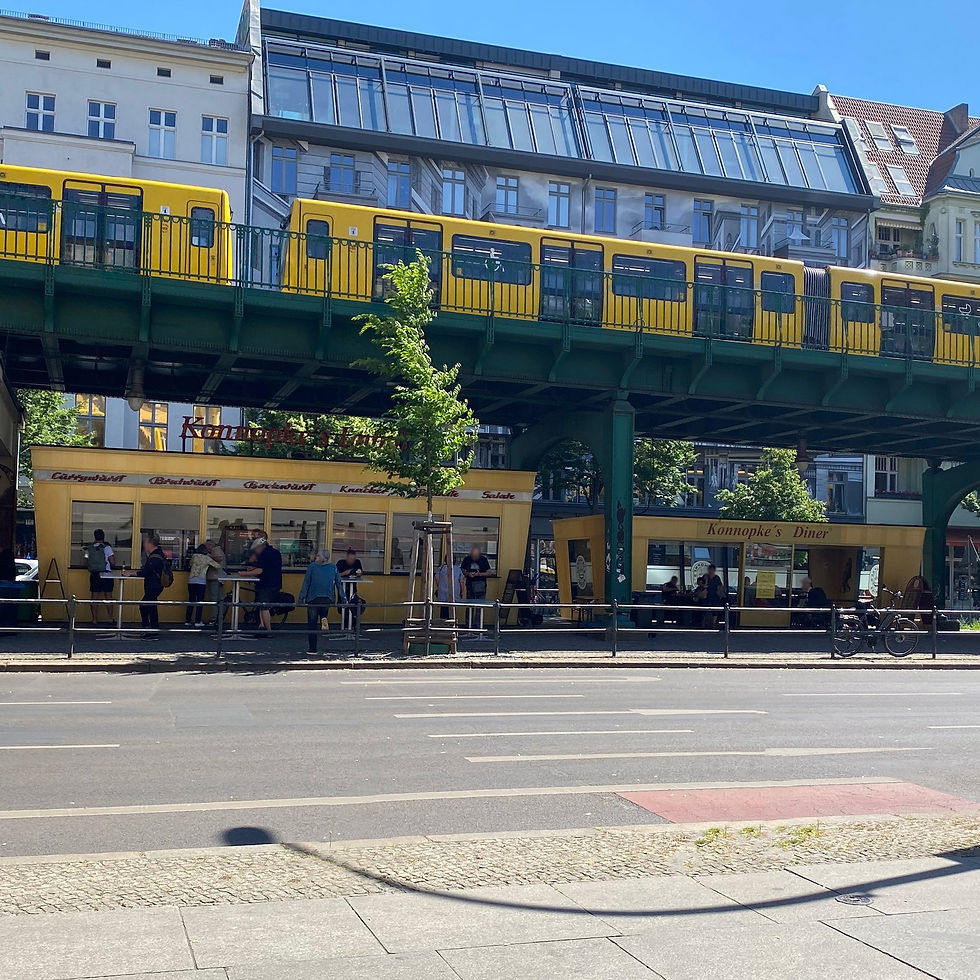
Konnopke's Imbiß under the U2 viaduct on Schönhauser Allee, where the family has sold sausage since October 1930.
Konnopke's Imbiß is the youngest entry and maybe the most stubborn. One family, the same spot under the U2 viaduct since October 1930, and a currywurst recipe served since 1960 that East Berliners will defend with real feeling. The kiosk is modern, the institution is not. Tuesday to Friday 11:00 to 18:00, Saturday 12:00 to 19:00, closed Sunday and Monday, and the correct order is mit Darm. Where it ranks in the city's eternal sausage argument is a question for the currywurst guide.
Rank them by story or by room
The tool below draws all ten on one timeline. The dotted line is the story each house tells, the solid bar is how long the room you would actually sit in has existed, and the red band explains most of the gaps. Flip the ranking to age of the room and watch the famous names fall down the list: the oldest restaurant in Berlin drops to eighth, and a Charlottenburg corner pub nobody photographs climbs to third.
How to eat your way through this list
My advice: treat these as evenings, one at a time, and match them to where you already are. Crossing the city twice for a historic pub turns a good night into a transfer plan. I have made that mistake before, on a rainy Tuesday, for a Kneipe that turned out to be closed.
Near the historic centre: Zur letzten Instanz for dinner, Zum Nußbaum for the beer before it. Remember the Instanz is closed on Sunday.
A Kreuzberg evening: Henne or Max & Moritz, both reserve-first, both a short walk from Moritzplatz U8.
West Berlin afternoon: Wilhelm Hoeck for a slow beer at the 1892 bar, no booking needed.
North side: Prater Garten while the season lasts, Konnopke for the lunch stop, Clärchens when you want the night to end with music.
Booking rule of thumb: the restaurants want a reservation, the pubs want you to walk in, and Konnopke wants you in a queue that moves fast.
A last thought on why this list is so short. Most cities keep their oldest rooms by accident. Berlin had to choose, over and over, what to rebuild and what to let go, which is why a 1571 date can hang on a 1987 wall and both things are true at once. The city the 1621 sign remembers, the walled medieval town of Cölln and Berlin, is the ground my work covers every day: the free 2 hour walking tour crosses that vanished old city between Alexanderplatz and Hackescher Markt, and my Medieval Berlin audio tour walks the traces of it that survive, including the same city wall that shelters the beer garden at Zur letzten Instanz. Eat in the old rooms in the evening, walk the old city in the morning, and the sign over the door will mean far more.
Opening hours and details checked on 29 August 2026 against each house's own pages. Berlin kitchens change their days without ceremony, so glance at the current hours before a special trip.
Image credits
Source and licence details for the credited images used in this article.
Zur letzten Instanz facade on Waisenstraße (also used as the cover image): Jörg Zägel, CC BY-SA 3.0, via Wikimedia Commons.
Zum Nußbaum in the Nikolaiviertel: Hajotthu, CC BY 3.0, via Wikimedia Commons.
Clärchens Ballhaus courtyard facade: Clärchens Ballhaus, CC BY-SA 4.0, via Wikimedia Commons.
E. & M. Leydicke shopfront on Mansteinstraße: Sir James, CC BY-SA 3.0, via Wikimedia Commons.