Hidden Places in Central Berlin: Anhalter Bahnhof to Alexanderplatz

Central Berlin is full of famous buildings, but some of its strongest history sits in the gaps between them. Visitors cross Potsdamer Platz, Friedrichstrasse and Alexanderplatz every day without noticing the ruined station wall, the round border tower, the old departure hall or the medieval brickwork built into a university block.
My advice: do not treat hidden Berlin as a hunt for secret doors. Most of these places are in plain sight. The useful trick is knowing where to stop and what to look at. This walk starts at Anhalter Bahnhof, finishes at Alexanderplatz and follows a real line through Berlin's railway age, dictatorship, division and reconstruction.
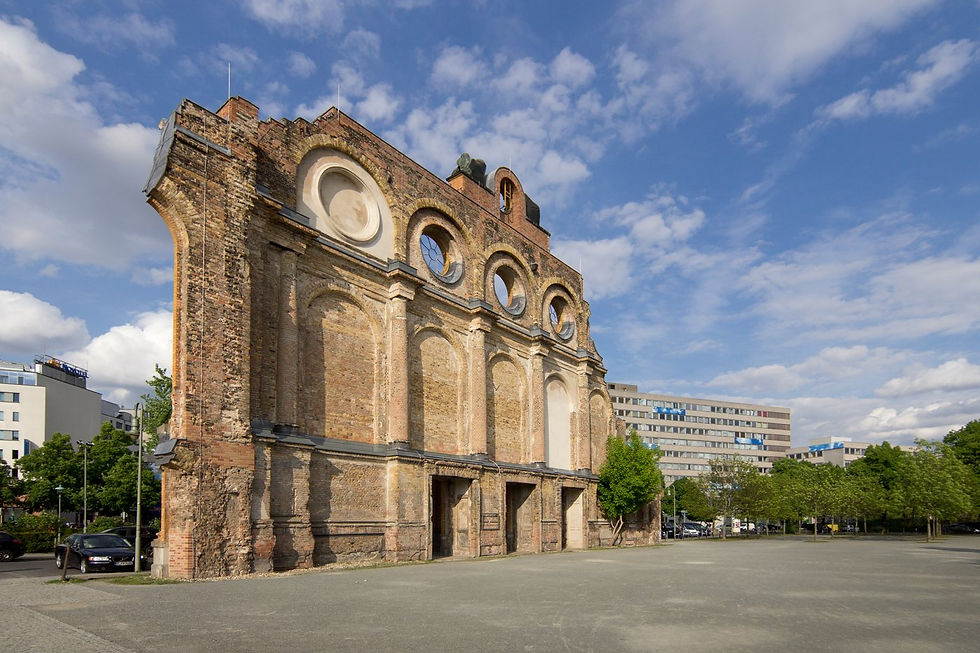
Anhalter Bahnhof once filled the space behind this portal. Today the surviving wall is the first clue on the route.
Hidden places in central Berlin: the route at a glance
This is a 5.3 kilometre walk from S Anhalter Bahnhof to Alexanderplatz. Allow 90 to 120 minutes if you only stop outside, or longer if you enter the free Tränenpalast exhibition.
The route is not a loop. That is an advantage: both ends have excellent public transport, so you do not need to walk back to the start. Most of the route uses normal city pavements, but there are busy crossings, patches of cobblestone and occasional construction. Check the live route on the day rather than assuming every pavement will look exactly as it did last week.
The places below are the visible framework. They tell you where to stand and what to notice without giving away every story in my audio route.
1. Anhalter Bahnhof: the station reduced to one wall
Leave S Anhalter Bahnhof and walk to Askanischer Platz. The large brick portal with the clock is impossible to miss once you face it, but it is easy to mistake for a decorative ruin if you do not know what stood behind it.
The station building opened in 1880. Its train hall stretched far beyond the surviving entrance, and the station became one of Berlin's major gateways to southern Germany and Europe. Long-distance service ended in 1952. Most of the damaged building was demolished between 1959 and 1961, leaving the portico as a deliberate fragment.
Stand several metres back and look through the three lower openings. The empty ground behind them is part of the experience: you are not looking at a small building but at the front edge of something that has disappeared. The Berlin State Monuments Office has a useful timeline and explains what survived.
From the portal, walk north on Stresemannstrasse and turn right into Erna-Berger-Strasse.
2. Erna-Berger-Strasse: a border tower behind office blocks
The next stop looks almost misplaced. A round concrete tower stands between modern office buildings close to Potsdamer Platz. It is a BT-6 observation tower from the former Berlin Wall border system.
This is why I like the stop: the tower is not arranged in a large memorial landscape. You find it at street level, surrounded by ordinary working Berlin. Berlin.de describes it as the last surviving tower of this round type.
Look at the narrow shaft and the wider observation cabin above it. Do not assume the interior is open. The exterior can be seen from the public street, while access arrangements can change. The safe move is to treat the tower as an outside stop unless a current notice at the site says otherwise.
Continue toward Potsdamer Platz. The small green, five-sided tower on the square is your next clue.
3. Potsdamer Platz: look for the small survivors
Potsdamer Platz is designed to make you look up at glass and steel. The more interesting move is to look for two much smaller survivors.
First, find the green Verkehrsturm. Berlin's first traffic signal tower began operating here in December 1924, when a police officer inside changed the lights by hand. The object on the square today is a later reconstruction, not the original. That distinction matters. It is evidence of how Berlin remembers an innovation, rather than an untouched object from 1924. The Berlin transport authority's centenary note explains the original system.
Then walk into the Center am Potsdamer Platz, the complex many people still call the Sony Center, and look for the preserved Kaisersaal from the former Hotel Esplanade. The room was moved about 75 metres and incorporated into the new complex. If an event or temporary barrier limits the view, do not force the stop. The point is to see how a fragment of old Berlin was physically carried into the new development.
From here, the route has its longest plain walking section. Head north toward Friedrichstrasse and the river. This stretch is about 1.4 kilometres, so save your phone battery and do not expect a historical object every two minutes.
4. Tränenpalast: do not hurry past the low glass hall
Beside Friedrichstrasse station, the Tränenpalast looks modest compared with the trains and offices around it. During the division of Berlin, this was the departure hall where people leaving East Berlin for the West went through border controls and said goodbye.
The building now holds a permanent exhibition about German division. Admission is free. As checked on 14 July 2026, the official opening hours are Tuesday to Friday from 9:00 to 18:00 and Saturday and Sunday from 10:00 to 18:00; Monday is closed. Check the official Tränenpalast visitor page before making the exhibition part of a fixed plan, because holiday hours can differ.
If you only have time for the walk, pause outside and look at the scale of the hall. It was not a grand station building. Its ordinary size is what makes the separation feel personal.

The Tränenpalast is easy to pass as part of Friedrichstrasse station. Stop outside even if the exhibition is closed.
5. Weidendammer Brücke and Rosenstrasse: two kinds of evidence
Walk east along Reichstagufer to Weidendammer Brücke. Most people use it as a quick crossing of the Spree. Pause near the centre and look at the ornamental ironwork and imperial eagles instead. The bridge is a working piece of the city, not an object behind glass, and the Berlin monument database records its protected structure.
Continue east toward Rosenstrasse, behind the busy streets around Hackescher Markt. In the small park, the reddish stone figures of Block der Frauen remember the protest by relatives, mostly non-Jewish women, after Jewish men were detained at Rosenstrasse 2–4 during the Nazi regime in 1943.
This is a memorial, not a photo prop. Read the information panel and leave space for other visitors. The historical question of exactly why some detainees were released is still discussed, and Berlin's own commemoration page is careful about that uncertainty. A good visit does not need a simplified victory story.
6. Hackescher Markt station: read the building, not the timetable
Walk north to S Hackescher Markt and stand where you can see the station facade. The trains are useful, but the building deserves attention on its own.
The station was built between 1878 and 1882 as part of Berlin's elevated Stadtbahn. Its brick facade, terracotta decoration and arches survived changes of name and use. It opened as Börse, later became Marx-Engels-Platz and received the name Hackescher Markt in 1992. Berlin.de's station history is worth opening while you stand there.
My simple move: ignore the shop signs for one minute and follow the brickwork upward. The building is doing more historical work than most people give it credit for.
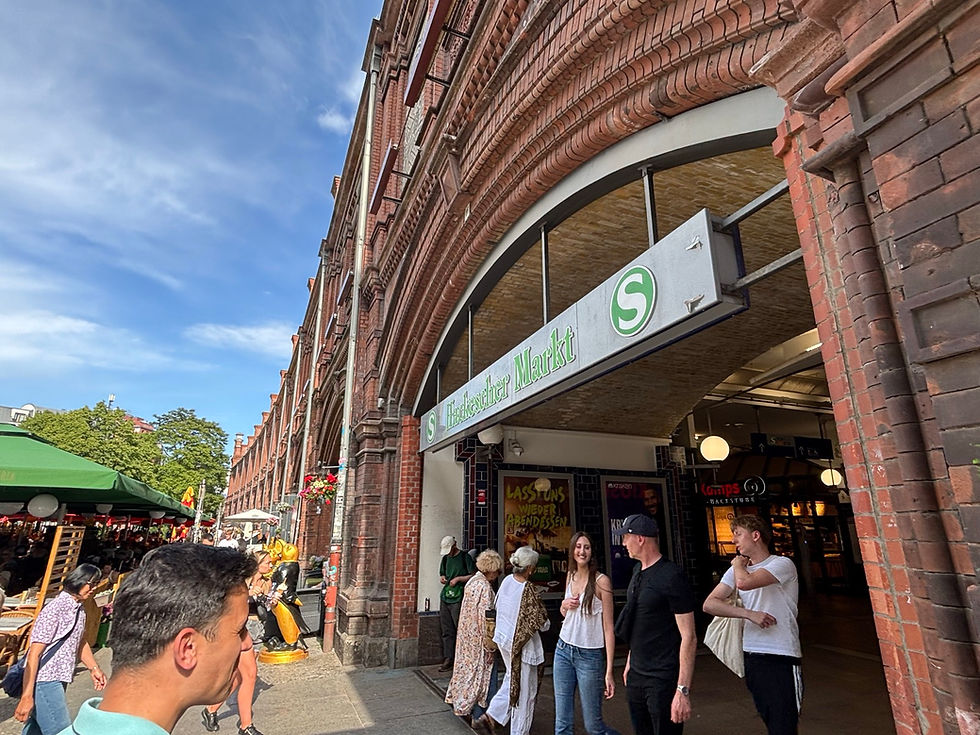
Hackescher Markt is not only a transport stop. Its brick and terracotta facade is part of the nineteenth-century Stadtbahn.
7. Heilig-Geist-Kapelle: medieval brick inside a university block
From Hackescher Markt, walk south on Spandauer Strasse. Near number 1, look for medieval red brick emerging from a much larger university building. This is the Heilig-Geist-Kapelle, the chapel of the former Hospital of the Holy Spirit.
The important practical point is that this is normally an outside observation stop, not a church you can assume will be open. Humboldt University uses the chapel for selected events and guided visits. If you want to see inside, check the university's current events information rather than trying a locked door.
Stand on the public pavement, find the change in brickwork and imagine the older building before the university block grew around it. Then continue toward Alexanderplatz with the TV Tower on your left.
8. Alexanderplatz: finish with the Berlin that vanished
End at Berolinahaus, the corner building marked with its name on Alexanderplatz. Peter Behrens designed it, and the building was completed in 1932. It survived war damage and later reconstruction of the square; the Berlin monument record identifies it as one of the older structures framing today's pedestrian space.
The name points to Berolina, the female personification of Berlin. A large Berolina statue once stood on Alexanderplatz, but it is gone. The historic photograph below shows how confidently she occupied the square. Finish by comparing that image with the open space around you now.
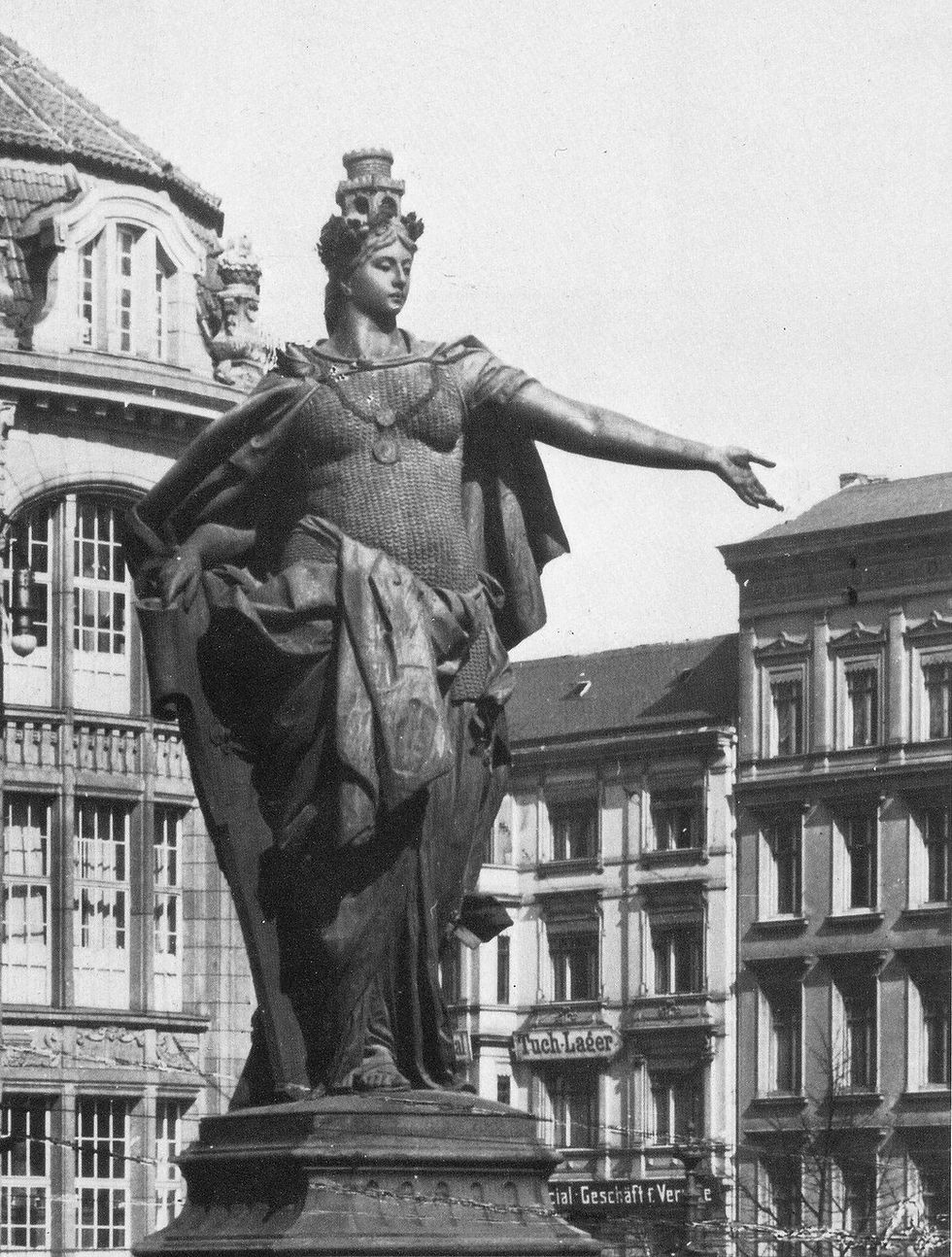
Berolina once stood over Alexanderplatz. Berolinahaus keeps the name even though the statue has disappeared.
Use the Hidden Berlin evidence trail
The tool below does not replace the walk. It trains your eye before you start. Move through four pieces of visible evidence and switch between what you see and what it tells you about the city.
Free guide or audio route: which one should you use?
Use this article if you want the route shape, practical stops and enough context to walk independently. It is deliberately selective.
Use my Hidden Berlin Audio Route if you want the full sequence on your phone. It includes 12 short tracks across 10 stops, a route card and offline MP3 downloads for €4.99. You start at Anhalter Bahnhof and finish at Alexanderplatz, but the audio adds the stories and transitions that I have not reproduced here.
If this route is not your theme, compare all BerlinWalk audio guides by starting point, duration and subject before buying anything.
The plan I would use
Start at Anhalter Bahnhof in daylight and keep two hours free. Do not schedule a timed museum entry immediately after the walk. Friedrichstrasse and Potsdamer Platz can both slow you down, and Tränenpalast is worth entering when it is open.
Bring headphones only if you are using the audio route. Keep one ear free at crossings, especially around Stresemannstrasse and Potsdamer Platz. At memorials, stop the audio before reading site text and give other visitors space.
At Alexanderplatz, do not rush straight into the station. Stand by Berolinahaus, look once at the historic Berolina photograph and then look back at the square. That final comparison is the whole point of this walk: Berlin does not hide its past perfectly. It leaves fragments, names and empty spaces for you to connect.
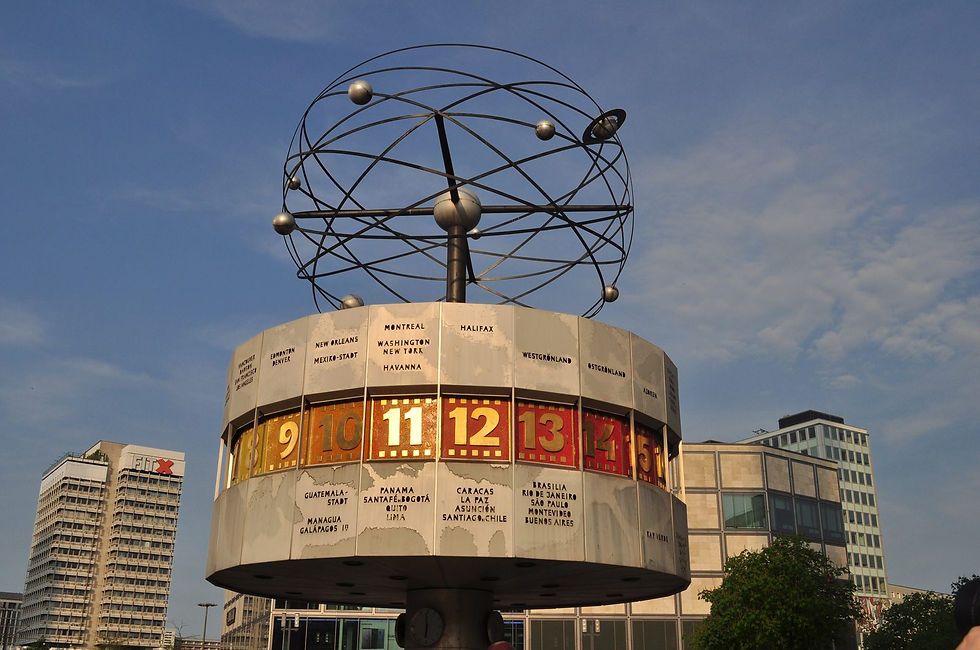
The walk ends at Alexanderplatz, where surviving buildings and missing monuments occupy the same square.
Photo attribution is available from the compact Image credits disclosure inside the evidence-trail tool above.