How to See a Football Match in Berlin: Union, Hertha and the Tickets You Can Actually Get (2026/27)

Updated: Aug 16
Most visitors who want to see a football match in Berlin start in the wrong place. They search for Bundesliga tickets, land on Hertha BSC because Hertha is the name they half remember, and assume the rest is a formality. Then they find out that Hertha are in the second division, that the Bundesliga club is the one out in the woods in Köpenick, and that its tickets sold out before they ever opened a browser.
My advice: work out which of the two games you actually want before you look at a single ticket page. Berlin has one club you can almost always get into and one club you basically cannot, and knowing which is which saves you the whole frustrating loop.

The Olympiastadion holds around 74,000. In the second division you can usually still buy a ticket for it in the week of the game.
The two Berlin clubs, and why the difference matters
For the 2026/27 season the split is simple and it is the opposite of what most people expect.
1. FC Union Berlin play in the Bundesliga, at Stadion An der Alten Försterei in Köpenick, in the far south east of the city. The ground holds 22,012 people. That is small for a top-flight club, and it is the root of every ticket problem below.
Hertha BSC play in the 2. Bundesliga, at the Olympiastadion out west, a stadium built for around 74,000. A second-division club in an Olympic bowl means a lot of empty seats, and for you that means availability.
So the equation is not "which club is better known". It is: 22,012 places against demand from a whole Bundesliga city, versus 74,000 places against second-division demand. Everything else follows from that.
One more thing worth knowing before you plan around dates. Both German leagues start late in 2026 because of the World Cup summer. The 2. Bundesliga begins on 7 August 2026 and the Bundesliga only on 28 August, so an early-August trip can catch Hertha but no Union league football at all.
Union Berlin: the hardest ticket in the city, and the last season at the old ground
Union sell tickets online through their own shop, union-zeughaus.de. Club members get an exclusive window of a few days first. There is then a second member phase. Only what survives both reaches a general public sale, and for the bigger fixtures very little survives.

Stadion An der Alten Försterei sits in the woods at Köpenick. Four low stands, 22,012 places, and no room to grow without rebuilding it.
Two rules matter more than anything else here, and getting them wrong means being turned away at the turnstile:
Union tickets are personalised and cannot be passed on. The name on the ticket is expected to match the person using it.
Anything bought on a resale marketplace is void. The club states plainly that tickets bought through platforms like Viagogo lose their validity. You will not get in, and you will not get your money back.
If you want an official resale ticket, the club's own Ticketbörse is the only route. Standing tickets start at around 15 EUR, which is remarkable value for Bundesliga football, and that is exactly why they go.

A full Union terrace. Twenty two thousand places against Bundesliga demand is the whole reason these tickets are hard.
There is a reason to try harder than usual this season. 2026/27 is the last season at the Alte Försterei in its current form. After it ends, the ground is rebuilt and enlarged, and Union spend 2027/28 at the Olympiastadion while the work happens. The plan is to come back to a 34,500-capacity ground.
That matters because of what the current ground is. 18,395 of its 22,012 places are standing places, an enormous proportion for a top-flight stadium anywhere in Europe. And the terraces are not a heritage accident. In 2008 and 2009 the fans rebuilt the stadium themselves: more than 2,300 volunteers put in over 140,000 unpaid working hours laying the terraces, the stairs and the roofing.
If standing on that is the thing you want from a trip to Berlin, this season is the last one where it exists.

Most of this ground is terrace. It is also the part that disappears when the rebuild starts after this season.
Hertha BSC: the game you can actually walk up to
Hertha is the honest answer for most visitors, and I do not mean that as a consolation prize.
Tickets go through a member presale and then a normal general sale on the Hertha BSC ticket pages. For most fixtures you can still buy in the days before the game, and sometimes on the day. Prices change with the opponent and the section. For the home opener against Heidenheim on 15 August 2026, Hertha lists tickets from 30 to 75 EUR, with general sale starting on 24 July. Kids4Free applies to that match, but check the individual sale notice rather than assuming the same offer and price for every fixture.
The football is second division. The building is not. You are watching a league game in the stadium that hosted the 1936 Olympics, the 2006 World Cup final and the Euro 2024 final, and on a normal matchday you can have a standing place in it for less than a museum ticket.
One honest warning about the view. The Olympiastadion has a running track between the stands and the pitch, so you sit further from the game than at a purpose-built football ground. It is a trade: scale and history for proximity.
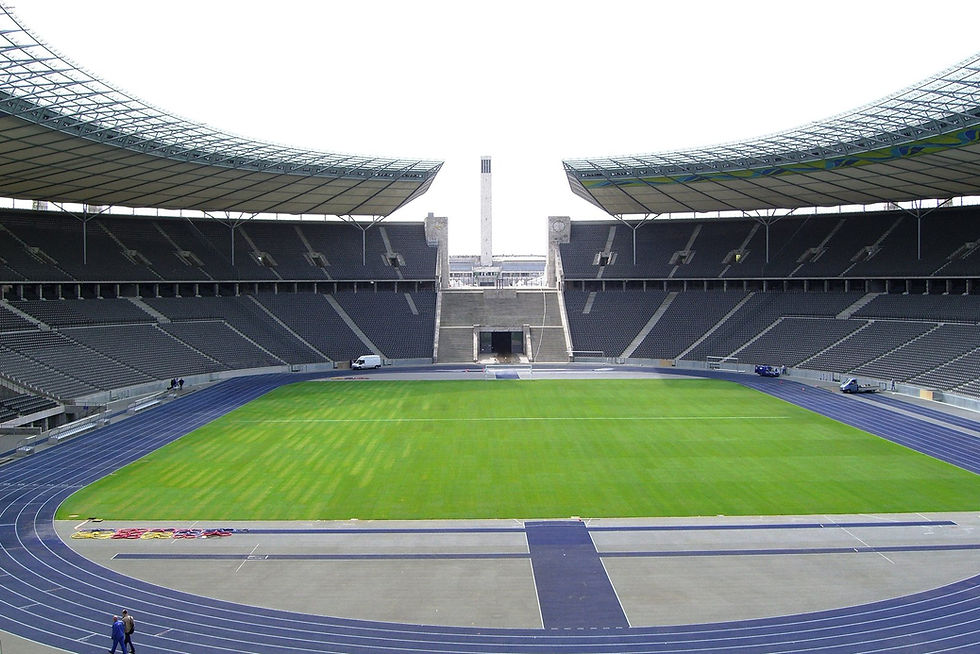
The running track is why the Olympiastadion feels vast and why you are never as close to the play as at Köpenick.
If you are visiting the stadium as a sight rather than for a game, that is a different trip with different rules, and I have written it up separately in my guide to the Olympiastadion in Berlin. Worth reading before you go, because the walk-in visitor centre closes on matchdays.
The one nobody tells you about: Union Berlin Frauen
Here is the tip I give people whose dates do not line up with anything else.
Union Berlin's women's team play in the Frauen-Bundesliga, and they play at the Alte Försterei. Same ground, same terraces, top-flight football, and nothing like the same scramble for a ticket.
Their 2026/27 season opens at home against Bayern Munich on Friday 21 August 2026 at 18:20, which makes it Berlin's first top-flight league match of the season, a week before the men's Bundesliga starts. If you are in Berlin in late August and you want to stand on that terrace, this is the easiest way to do it.
Why you cannot pin a Berlin matchday down months in advance
This is the part that trips up people planning a trip, so it is worth being precise about it.
The German leagues published their full 2026/27 fixture lists on 2 July 2026. What that gives you is the weekend of every match, not the kickoff time. Exact times are fixed later, usually a few weeks ahead, because television selects the matches it wants in the Friday night, Saturday afternoon, Saturday evening and Sunday slots.
In practice that means a fixture you find in July says something like "9 to 11 October". It could be a Friday at 20:30, a Saturday at 15:30 or a Sunday at 17:30. A Friday night kickoff and a Sunday evening kickoff are a completely different weekend for a short trip.
My advice: if a game is the reason for your dates, book flexible accommodation and check the club site again about four weeks out, when the exact time appears. If the game is a bonus rather than the reason, just pick your dates and look at what falls inside them.
The board above does this the honest way. It shows you the weekend the league has fixed, and it only shows a kickoff time where the club has actually confirmed one.
Getting to a football match in Berlin: the two routes
Neither stadium is central, and both are straightforward if you know the line.
Alte Försterei, Köpenick. Take the S3 from Alexanderplatz towards Erkner and get off at S Köpenick, then walk about 15 minutes to the ground at An der Wuhlheide 263. The club publishes its own directions to the stadium if you want the exact route. Allow around 40 minutes door to gate from the middle of town. Coming straight from BER airport, take the S85 or S9 to Schöneweide and change to tram 60 or 67, which stops right by the stadium.

Köpenick has its own small transport world of trams and buses. On matchday the crowd walking from the S-Bahn is easy enough to follow.
Olympiastadion, Westend. Take the U2 from Alexanderplatz towards Ruhleben to Olympia-Stadion, then walk about 5 minutes. The S3 and S9 also stop at Olympiastadion, slightly closer to the east gate. Again, around 40 minutes from the centre.

U-Bahnhof Olympia-Stadion on the U2. The platform was built for stadium crowds, which is why it is this long.
Both grounds sit inside the normal Berlin fare area, so a standard AB ticket covers the journey. If you are not sure which zone you need, my guide to Berlin's AB and ABC ticket zones explains it, and the general Berlin public transport guide covers how the U-Bahn and S-Bahn fit together.
One thing I will not tell you is that your match ticket doubles as a free transport ticket. Some German clubs do include travel and some do not, the information for Berlin is inconsistent, and a wrong assumption here costs you a 60 EUR fine for riding without a valid ticket. Check what your specific ticket says, and if it does not say clearly that travel is included, buy a normal BVG ticket. Fares and ticket types are on the BVG site.
What to know at the gate
The practical rules are similar at both grounds and stricter than most visitors expect.
Bags. Nothing bigger than A4 at either stadium. Union do not allow backpacks at all. Hertha allow up to A4 with a depth of 15 cm. Both have a left-luggage service, 4 EUR at Union and 5 EUR at Hertha.
Payment. Both take cash and normal cards, and Hertha take Apple Pay and Google Pay. Neither uses a closed-loop stadium card, so you do not need to load credit onto anything first.
Bottles. Hertha do not allow plastic or glass bottles inside. Tetrapaks up to one litre are fine.
Gates. Union open 120 minutes before kickoff, Hertha 90 minutes. Going in early is the right move at Union, where the terrace fills from the back.
Away fans. The away section at Union is sector 5, and at Hertha it is reached through the south gate. Buy a home ticket and stand in the home end, whoever you are quietly supporting.

The sign at the entrance. If you have a ticket for Köpenick, give yourself the full two hours the gates are open.
23 December: the night the ground fills without a match
If your trip lands at Christmas, there is one more thing at the Alte Försterei that has nothing to do with football.
Every 23 December, the stadium hosts the Weihnachtssingen, a Christmas carol singing evening. It began in 2003 with 89 members of a Union fan club meeting in the stands. In 2025 it drew 28,500 people. Choirs and brass start in the late afternoon, and at 19:00 the floodlights go off and the whole ground sings by candlelight.
It is one of the few genuinely unusual things you can do in Berlin in December that is not a Christmas market, and you do not need to care about football to be moved by it.
If you are already walking the city with me
A match is an evening or an afternoon. It is not a Berlin plan on its own, and both grounds are a long way from the historic centre.
If you are building a day around one, the sensible shape is history in the middle of the city first and football later. My free walking tour runs about 2 hours through the medieval core around Alexanderplatz, Marienkirche and Museum Island, and ends at Hackescher Markt, which puts you on the S-Bahn with plenty of time to get out to Köpenick or Westend afterwards.
If you want to see how the rest of your days could fit together, my guide to what to book in advance in Berlin covers the things that genuinely sell out, and a match ticket belongs on that list only if it is a Union home game.

One floodlight, a small scoreboard and four low stands. Union's ground is the opposite of a modern arena, which is most of the point.
Image credits
Source and licence details for the 9 photographs used in this article.
Olympiastadion supporters' display: Frankinho, CC BY 2.0, via Wikimedia Commons.
Alte Försterei aerial view: Arne Müseler, CC BY-SA 3.0 DE, via Wikimedia Commons.
Alte Försterei stadium sign: Berlinschneid, CC BY-SA 4.0, via Wikimedia Commons.
Alte Försterei floodlight and fence: Z thomas, CC BY-SA 3.0, via Wikimedia Commons.
Alte Försterei terrace: Z thomas, CC BY-SA 3.0, via Wikimedia Commons.
Olympiastadion interior: Times, CC BY-SA 3.0, via Wikimedia Commons.
Olympia-Stadion U-Bahn platform: Alexrk2, CC BY-SA 3.0, via Wikimedia Commons.
Union supporters display: Chivista, CC BY-SA 4.0, via Wikimedia Commons.
Rathaus Köpenick departure board: GodeNehler, CC BY-SA 4.0, via Wikimedia Commons.