The Brandenburg Gate, Before and After: One Landmark, Berlin’s Whole Century

Most people photograph the Brandenburg Gate in about fifteen seconds and walk on. I understand the instinct. It sits there on Pariser Platz looking calm, floodlit and permanent, like it has always been exactly this. The truth is almost the opposite. This is the survivor. Napoleon stole its statue, bombs left it standing alone in a field of rubble, and for nearly thirty years it was locked inside no-man's-land where nobody could reach it. Learning the Brandenburg Gate before and after those moments is what turns a quick photo stop into the one place in Berlin where you can actually feel the whole century in your feet.

The Gate today: a free, open square you can walk straight through. It has not always looked this settled.
Before: a grand gate for a small kingdom
The Gate you see was built between 1788 and 1791 for King Friedrich Wilhelm II, designed by Carl Gotthard Langhans and modelled on the gateway to the Acropolis in Athens. Berlin once had eighteen city gates in its customs wall. This is the only one left standing, which is part of why it carries so much weight now.
Two years later the sculptor Johann Gottfried Schadow added the Quadriga on top: a chariot pulled by four horses and driven by a winged goddess. Look up and notice which way she faces. She looks east, down Unter den Linden into the old heart of the city, not out toward the Tiergarten. That small detail tells you the Gate was always meant to be an entrance into Berlin, not an exit from it. One more thing worth knowing as you pass through: the wide central passage was originally reserved for the royal family. Ordinary Berliners used the side arches.

Around 1900 the Gate opened onto a busy imperial square. Everything you see around it here would later be flattened.
The Quadriga's round trip to Paris
In 1806 Napoleon marched into Berlin, and he liked the Quadriga enough to take it. The whole chariot was crated up and carried off to Paris as a war trophy. For eight years the Gate stood bare-topped, a public reminder that Prussia had lost.
When the Prussians reached Paris in 1814 they took it straight back. On its return the architect Karl Friedrich Schinkel added an iron cross and a Prussian eagle to the goddess's staff, quietly turning her into a figure of victory. That is the version standing up there today, which means the statue you are looking at has already done a return trip across Europe and come home.
After the war: a landmark left among the ruins
Skip forward to 1945. The bombing raids and the final Battle of Berlin turned Pariser Platz into rubble. The hotels, the embassies, the Adlon, all of it gone or gutted. The Brandenburg Gate was badly damaged and shell-pocked, but it stayed up as one of the few recognisable structures in the ruined square. Soviet and Allied soldiers posed under it. The Quadriga was wrecked, and only a single horse's head survived. That original fragment belongs to the Stadtmuseum Berlin collection and is currently shown in the BerlinZEIT exhibition at Museum Ephraim-Palais, not in the closed Märkisches Museum.
What happened next is a small miracle of a divided city cooperating. In 1956 to 1958, East and West Berlin restored the Gate together and recast the Quadriga from old moulds, even though the Cold War was already freezing everything else between them.

1945: the Gate scarred but upright in a flattened square. Drag the slider in the tool below to fade this exact scene into the Gate today.
Walled off: thirty years in the death strip
Then came the hardest chapter. When the Berlin Wall went up in 1961, the border ran right past the Gate, and it ended up stranded inside the death strip, the closed no-man's-land between East and West. For nearly thirty years it belonged to neither side and nobody could walk up to it. It became the single clearest image of a divided Germany, which is exactly why US President Ronald Reagan chose to stand near it in 1987 and say the line, "tear down this wall."

1982, from the eastern side: a barrier, empty ground, and a sign warning that beyond it lay a prohibited zone.
The Wall fell on the night of 9 November 1989, but the Gate itself stayed shut a little longer. It finally reopened on 22 December 1989, when the two German leaders walked through it together in front of an enormous crowd. If you have seen one photo of German reunification, it is probably this spot. For the wider route of what divided the city and what is left of it, the Berlin Wall trail guide is a good next read.
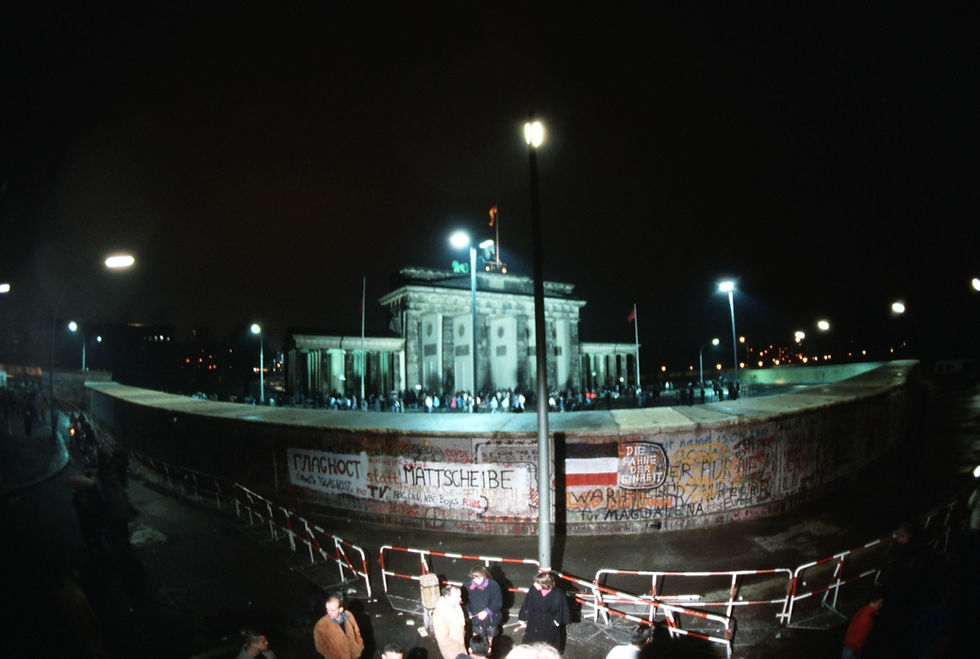
22 December 1989: the Gate reopens and a divided city walks through it again.
What you can still read on the Gate today
This is the part I care about most as a guide, because the whole story is written into the stone if you slow down for five minutes.
The columns. Look closely at the sandstone on the Pariser Platz side. Some of it still carries filled and patched scars from shrapnel and gunfire in 1945.
The cobblestone line. A double row of cobblestones set into the road near the Gate marks the exact line the Berlin Wall once followed across the city. Stand with one foot on each side and you are standing where East met West.
The Room of Silence. Inside the northern gatehouse there is a small, free Raum der Stille, a quiet room open to anyone who wants a moment out of the crowd.
The Gate itself is a free, open public square with no ticket and no queue, accessible at any hour. That is unusual for a landmark this famous, so there is no reason to rush it. For opening details and the surrounding square, visitBerlin and the official Berlin.de page both keep current information. If you want the practical visiting angle rather than the history, my Brandenburg Gate visitors guide covers timing, crowds and photos.

The Quadriga up close: recast after the war and still facing east into the city, iron cross and eagle in place.
Where it fits on a Berlin walk
Getting here is easy. Brandenburger Tor station sits directly underneath, served by the S-Bahn and the U5, and on foot the Gate is simply the far end of Unter den Linden, a straight walk down from Museum Island and the TV Tower. Come from that direction and the Gate is the last thing before the green of the Tiergarten opens up.
My own tour starts a little east of here, at Alexanderplatz, for reasons I explain in why the tour starts at Alexanderplatz. The Gate is one of the sights I point guests toward rather than where I begin, partly because it makes far more sense once you already understand the divided city that ran through it. If you like reading a single building as a whole century, the Reichstag before and after sits a five-minute walk to the north and tells a similar story.
My honest advice: do not treat the Brandenburg Gate as a fifteen-second photo. Walk through the side arch the way an ordinary Berliner once had to, find the cobblestone line, look up at a goddess who has already been to Paris and back, and give the survivor of Pariser Platz the couple of minutes it has earned.
Image credits
Source and licence details for the 6 photographs used in this article.
The Brandenburg Gate at dusk, seen from Pariser Platz: Thomas Wolf, www.foto-tw.de, CC BY-SA 3.0, via Wikimedia Commons.
Pariser Platz and the Brandenburg Gate around 1900: Unknown (period photograph), Public domain, via Wikimedia Commons.
The damaged Brandenburg Gate photographed from the east in 1945: AIP Emilio Segrè Visual Archives, CC0 1.0, via Wikimedia Commons.
The Brandenburg Gate closed off behind the barrier from the eastern side in 1982: Zika, Public domain, via Wikimedia Commons.
Crowds at the Brandenburg Gate the day it reopened, 22 December 1989: U.S. Department of Defense, Public domain, via Wikimedia Commons.
The restored Quadriga on top of the Brandenburg Gate: Karl-Ludwig Poggemann, CC BY 2.0, via Wikimedia Commons.