Berlin Public Transport Ferries: The Cheap Boat Ride Tourists Miss
- Yusuf Ucuz

- Jun 25
- 6 min read
Berlin public transport ferries are one of the easiest ways to put water into a Berlin trip without paying for a full sightseeing cruise. They are not hidden in the romantic sense. They are real BVG ferry lines, with timetables, commuters, bikes, lake wind and the occasional tourist who has worked out the trick.
The trick is simple: if you already have a valid Berlin public transport ticket for the right zone, most BVG ferries work like another transit leg. That does not make them a replacement for a narrated Spree cruise through the historic centre, but it does make them a very good cheap boat ride if you choose the right route.
Here is the honest version I would give a visitor before they lose half a day chasing the wrong dock.
Berlin public transport ferries: the short answer

Caption: Berlin public transport ferries are real transit lines, but the right one can still feel like a small boat trip.
Berlin public transport ferries are useful, scenic and easy to misunderstand.
For most first-time visitors, the best choice is the F10 ferry from S Wannsee to Alt-Kladow. It crosses the Havel in about 20 minutes, feels like a small lake trip, and works well as a slower west-Berlin afternoon.
The southeast ferries are more local. F11 and F12 are practical short crossings. F21, F23 and F24 are better for a Müggelsee or Rahnsdorf nature day, especially if you already want forest paths, water, beer garden energy or a slower edge-of-Berlin plan.
Before you go, check the current BVG timetable. Ferry seasons, Monday service and bike rules matter more here than they do on the U-Bahn.
The F10 ferry: the easiest cheap boat ride

Caption: F10 works best as a slower west-Berlin plan, not as a quick central sightseeing detour.
If you only remember one line, remember F10.
The F10 runs between S Wannsee and Alt-Kladow. BVG lists the crossing at about 20 minutes, and it is the ferry that most naturally fits a visitor's Berlin itinerary. You take the S-Bahn to Wannsee, walk down to the pier, cross the water, stroll in Kladow, then return the same way or continue by bus.
This is not a quick add-on from Alexanderplatz. Wannsee is in Berlin's west, and the whole plan feels best when you give it a half day. That is also why it works after a morning in the centre: do the museums, Reichstag area or my Berlin walking tour first, then use the afternoon for water and open sky.
The important ticket detail is that BVG's current F10 timetable says the short-trip fare does not apply on this line. Use a normal valid ticket or day ticket for the right fare zone, and check whether your pass covers the trip before boarding.
If what you actually want is commentary past Museum Island, the Reichstag area and the central bridges, use my separate guide to Berlin boat tours and Spree cruises. If you want a quiet, cheap water crossing inside the public transport system, F10 is the better first pick.
Which BVG ferry should you choose?
The right ferry depends on your starting point, season and tolerance for slow travel. A tourist with one afternoon should not make the same choice as someone spending a full summer day around Müggelsee.
Use the tool above as a first filter, then check the official timetable before leaving. Ferry lines are more weather-sensitive than trains: fog, ice, high water and local operating changes can stop service.
The practical crossings tourists can skip

Caption: Some BVG ferries are practical local crossings first and tourist sights second.
F11 and F12 are real Berlin, but they are not usually the reason to cross the city.
F11 links Wilhelmstrand with Baumschulenstraße/Fähre in about 2 minutes. It is useful if you are already around Oberschöneweide, Treptow or nearby bike routes. As a pure sightseeing detour, it is too short.
F12 links Wendenschloß/Müggelbergallee with Grünau/Wassersportallee, also in about 2 minutes. It is a good local connector if you are moving through southeast Berlin, especially around the water, but I would not sell it to a first-time visitor as the big Berlin boat moment.
That distinction matters. Berlin rewards curiosity, but it also punishes scattered planning. If your day is mostly Mitte, Prenzlauer Berg, Kreuzberg or Charlottenburg, F10 is usually cleaner. If your day is already southeast, F11 or F12 can become a nice local detail.
The Müggelsee ferries are for a slow nature day
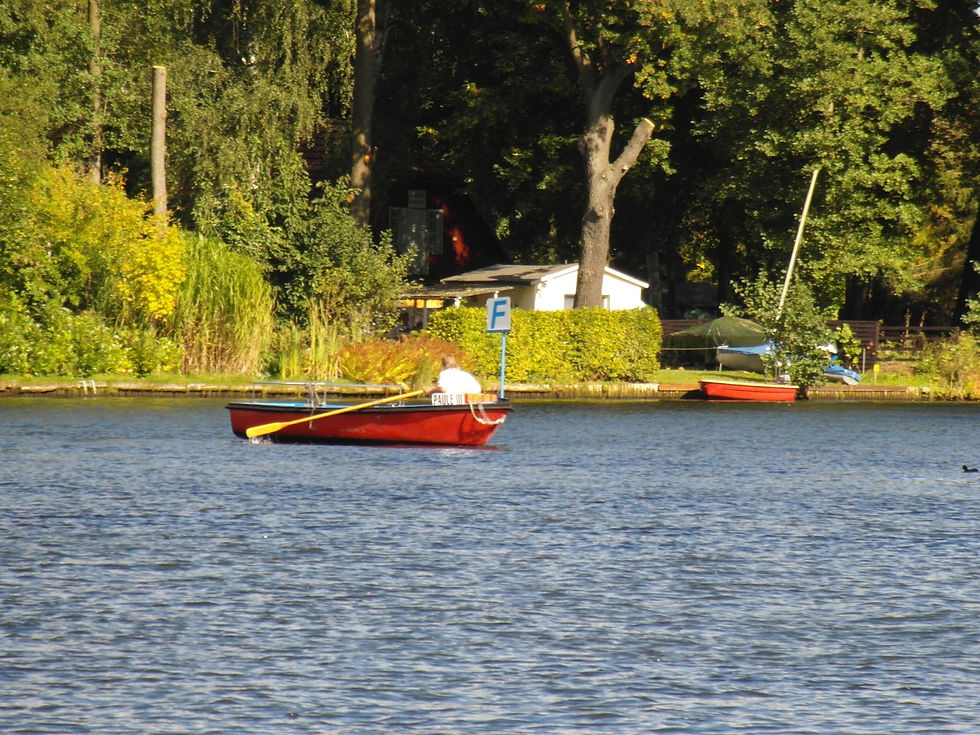
Caption: F24 is memorable because it feels unlike a normal city transit line, but its season and days matter.
The southeast ferry trio is where Berlin starts to feel less like a capital and more like a lake district.
F21 crosses between Krampenburg and Schmöckwitz/Zum Seeblick. F23 runs around Rahnsdorf and Müggelhort/Neu Helgoland. F24 is the small rowboat ferry between Spreewiesen and Kruggasse, and it is the one people talk about because it feels so unlike a normal city transit line.
For 2026, BVG's current PDFs list F21 and F23 from 03 April to 01 November, generally without Monday service. F24 is listed from 01 May to 04 October 2026, on weekends and public holidays. Treat those as planning facts, not promises: always recheck the BVG page on the day you travel.
I would choose this area only if you are comfortable giving Berlin a slower day. Bring patience, watch the last return options, and do not build the plan around squeezing five landmarks into the same afternoon.
Ticket and bike mistakes to avoid

Caption: The southeast ferries reward slow planning. Check the route, season and bike rules before leaving.
The most common mistake is assuming every ferry behaves like every train.
A normal valid Berlin public transport ticket works on BVG ferry lines inside the right fare zone, but ticket type still matters. BVG currently lists an adult Berlin AB single ticket from EUR 4.00 and a 24-hour ticket from EUR 11.20. If you are already taking several rides, the day ticket can be calmer than buying separate tickets.
Bike rules need extra care. BVG says bicycles need a bicycle fare unless you are exempt, and carriage depends on available space and staff decisions. The F10 timetable also notes that bike carriage depends on space. In plain tourist terms: do not assume your bike will automatically get on a small ferry, and do not build a tight connection around it.
Also watch the short-trip rule. It is tempting to treat a ferry crossing like a small hop, but F10 is not covered by the short-trip fare according to the current BVG timetable.
For a broader ticket decision, use the Berlin Transport Ticket Calculator before you buy. For the basics of trains, trams and buses, start with my Berlin public transport guide for tourists.
BVG ferry or tourist boat tour?
Choose a BVG ferry if you want a cheap, local-feeling water crossing and you do not need commentary.
Choose a tourist boat tour if you want central landmarks, a guide or audio commentary, and a route designed around sightseeing. The Spree cruises are better for first-time landmark orientation. The ferries are better when you want Berlin to feel spacious.
That is why I would not frame the ferry as a "hack" that replaces everything. It replaces one thing very well: the desire to sit on water for a while without turning the day into a ticketed attraction.
A simple first plan
For most visitors, I would do this:
Start with a central morning. If you join my walking tour, keep the ferry as an easy afternoon idea after the 2 hours are done. Have lunch, take the S-Bahn to Wannsee, ride F10 to Alt-Kladow, walk by the water, and return before the evening rush of decisions begins.
If you already have a lake day in mind, use F23 or F24 instead. That is a different Berlin: slower, greener and less concerned with ticking off famous sights.
Common ferry mistakes
Do not go to Wannsee expecting a central Spree cruise. It is a lake-and-Havel plan, not a Museum Island plan.
Do not arrive on a Monday for the seasonal southeast ferries without checking the timetable. Several tourist-interesting lines are not daily.
Do not count on bike space as guaranteed. Ferries are small, and staff decisions matter.
Do not use an old blog post or map screenshot as your only source. Ferry seasons and operating notes change. Use the official BVG ferry overview or the current line pages before you leave.
And do not confuse BVG public transport ferries with private lake ferries or tourist boats. Berlin has several kinds of boats. This guide is specifically about the BVG public transport ferries that fit into the city's transit system.
Image Credits
Images via Wikimedia Commons: BVG F12 ferry in Berlin.jpg) by Andre_de, CC BY-SA 4.0; BVG F10 pier context in Kladow by Lothar Weber, CC BY-SA 4.0; BVG F11 ferry by Jcornelius, CC BY-SA 3.0; Rahnsdorf BVG ferry stop.jpg) by Sludge G, CC BY-SA 2.0; BVG F24 rowboat ferry.jpg) by Ingolf from Berlin, CC BY-SA 2.0.
FAQ