Berlin Club Dress Codes: What Tresor, Sisyphos and RSO Actually Read
Somebody spends the afternoon of their Berlin trip reading about what to wear, buys a black t-shirt near Hackescher Markt, and gets turned away at 01:30 with five friends, all talking, one of them filming the queue. The shirt was never the problem. Nothing they read told them what the actual problem was.
The Berlin club dress code is the most searched thing about this city's nightlife and almost the least useful, because at nearly every door worth queueing for there is no published dress code at all. Berghain does not print one. Tresor does not print one. Sisyphos, ://about blank, RSO, Kater and Renate do not print one. The rule people repeat, wear black, is a description of what the room happens to wear, not an instruction anyone gave.
So this is a venue-by-venue read of twelve Berlin doors: what each one is actually looking at, when it is open, and what happens if it says no. My advice: spend less time on the outfit and more on the two things that genuinely move the odds, which are how many of you arrive and what hour you pick.

The Sisyphos gate on Hauptstrasse in Rummelsburg. There is no dress code written anywhere on it, and there never has been.
Why the Berlin club dress code is almost never published
Berlin nightlife grew out of buildings nobody wanted: a power station, a dog biscuit factory, a brewery, the space under a railway viaduct. Those rooms were never products, and the culture that formed in them was recognised in March 2024, when the German UNESCO Commission added Berlin techno culture to the national list of intangible cultural heritage.
A published rule would turn the door into a checkout. What the door is really doing is protecting the room for the people already dancing in it, and that job cannot be written down as a clothing list.
Which means the door is reading almost everything except your clothes:
How many of you there are. Four is already a lot. Six is a group, and groups get split or refused.
How loud you are. A quiet queue with one loud conversation in it is not a subtle thing.
How drunk you look. This ends more attempts than any outfit.
Whether your phone is out. Filming the queue is read as filming the room.
Whether you can name the night. Not the club, the night. Being able to say who is playing is the shortest possible proof you came for the music.
None of that costs money and none of it is a secret. It is simply not what the search results tell people to fix.
Tresor Berlin dress code: there is no dress code, but there are two real rules
Tresor is the one people search for most after Berghain, and the honest answer is short. There is no official Tresor dress code. You do not need black, you do not need designer clothes, and you certainly do not need fetish wear. Dark and plain is common because that is what the room wears.
What Tresor does publish is more useful than any outfit advice. Its own guest information states that there is strictly no filming or photography inside the club, and any guest found doing it is removed from the premises. It also says the cloakroom is now self-service and that you should bring a charged phone with NFC switched on, which is a genuine trap at 04:00 with a dead battery.
The club sits inside the old Kraftwerk power station on Köpenicker Strasse, a few minutes from U Heinrich-Heine-Strasse, and runs Friday and Saturday nights from around midnight. The door is easier than Berghain's and still turns people away, mostly for the group-and-noise reasons above.
The doors that are genuinely hard, and why
Four venues on the map run the reads that actually reject people.
Berghain on Am Wriezener Bahnhof is the hardest door in the city and the one where an outfit helps you least. Panorama Bar opens Friday around midnight, the Klubnacht starts Saturday around midnight and runs until Monday morning, and both phone lenses get a sticker at the door. The queue at peak can be an hour or three. It is also the venue people most reliably overdress for.
Sisyphos in Rummelsburg is a former dog biscuit factory that behaves like a small festival, open from Friday night straight through to Monday. In summer the queue is the filter long before the person at the front is. Plan for a long wait, or come on Sunday when the same party is still running.
://about blank on Markgrafendamm by Ostkreuz is a political collective with a garden attached, and it is loud about that. Read the door as a question about whether you understand where you are. Alone or in a pair, quiet, it is one of the friendlier doors in this list. As a stag group, it is one of the harder ones.
RSO is the furthest out, in the derelict Bärenquell brewery halls in Niederschöneweide, roughly forty minutes from Mitte. It grew out of Griessmühle after that club lost its site, and the door protects that inheritance. Turning up there in holiday clothes at 01:00 with a group is the most predictable rejection on this map.

://about blank sits a two minute walk from S Ostkreuz. From the street it does not look like a club, which is roughly the point.
The doors that are easy, and the one that is the opposite
The other half of the map is far less dramatic than the internet suggests.
Kater, on Holzmarktstrasse by the Spree, is wooden shacks and circus tents and a relaxed door. Tickets are usually bought on arrival, around 20 to 25 euro, and phone cameras get a sticker. It was called Kater Blau until August 2025, which is still the name most people type into a search box.
Ritter Butzke in Kreuzberg, near U Moritzplatz, has a fair door and four floors, so what it usually costs you is an hour of queueing.
Salon zur Wilden Renate in Alt-Stralau is an old flat full of small rooms. The door asks, in effect, whether you will treat it like someone's home.
Club der Visionäre and Else, both on the water in Treptow, have effectively no door at all. They start in the afternoon, they run on summer weather, and they are shut completely through the winter.
Matrix, under the U-Bahn arches at Warschauer Platz, is the exception in the other direction. It runs an ordinary commercial smart-casual door and turns people away for sportswear. If you want a Berlin club where the outfit really is the whole test, it is this one, and it plays chart music.
And then there is KitKatClub on Brückenstrasse, the one venue here with a published, enforced dress rule, where street clothes are refused outright. It is the exception that proves the pattern: when a Berlin door does care about clothes, it tells you, in detail, in advance. Everything else is a guess. There is a full breakdown of that one in my guide to the KitKatClub dress code.

Holzmarkt 25 on the Spree, home of Kater. Twenty minutes on foot from Berghain and a completely different door.
Pick the hour before you pick the outfit
This is the part that changes results and nobody optimises for it.
Berlin club nights are not evenings, they are weekends. Berghain, Sisyphos, Kater and ://about blank all run from Friday or Saturday night into Monday. So the crush, and the hardest reads, sit roughly between midnight and 04:00 on Saturday and Sunday. That is exactly when most visitors arrive, because it is when a night out happens everywhere else.
Move a few hours and the whole map changes:
Friday 23:00. Doors are opening, queues are short, and the rooms are half empty. Easy, and a little flat.
Saturday 02:00. Everything is open and everything is hardest. This is the hour that produces the rejection stories.
Sunday afternoon. The most underrated arrival in Berlin. Berghain, Sisyphos and Kater are still inside the same party, the queue has thinned, and the water venues in Treptow are open in daylight.
Monday 08:00. Still going at two or three of them, and nobody is being selective any more.
My advice: if this is your one night, arrive before midnight on Friday or at some point on Sunday, and go in a pair. I have watched groups of six spend two hours in a queue for an outcome that was decided when they walked up.

The Bärenquell brewery site in Niederschöneweide, where RSO runs. Forty minutes from Mitte, which is part of what the door is filtering for.
Two practical things nobody mentions
The phone sticker is not theatre. Berghain, Tresor, Sisyphos, ://about blank, Kater and Renate all cover your camera lenses at the door. The no-photo rule is what lets people behave freely inside, and peeling the sticker off is one of the few offences that gets you removed and banned rather than warned. If you want pictures of your night in Berlin, take them outside.
Bring cash. Berlin nightlife is one of the last corners of this city where card is not guaranteed, entry usually runs 15 to 30 euro, and the cloakroom is a separate charge almost everywhere. Hunting for a cash machine in Schöneweide at 02:00 is a bad end to an evening. My guide to cash and cards in Berlin covers where this bites during the day too.
The map is also out of date, and that matters
Two things have changed recently enough that older guides still get them wrong.
Watergate is gone. After 22 years on the Spree next to the Oberbaumbrücke, it closed permanently at the end of 2024, with its founder citing inflation, energy costs and the rent on that riverside site. The label continues. The room does not. People still walk to that address.
Renate nearly went the same way and did not. It announced its own closure for the end of 2025, played what was meant to be a final New Year's party, and then secured its lease in December 2025 and stayed open. In a city that keeps losing these rooms, that is worth knowing before you write it off.
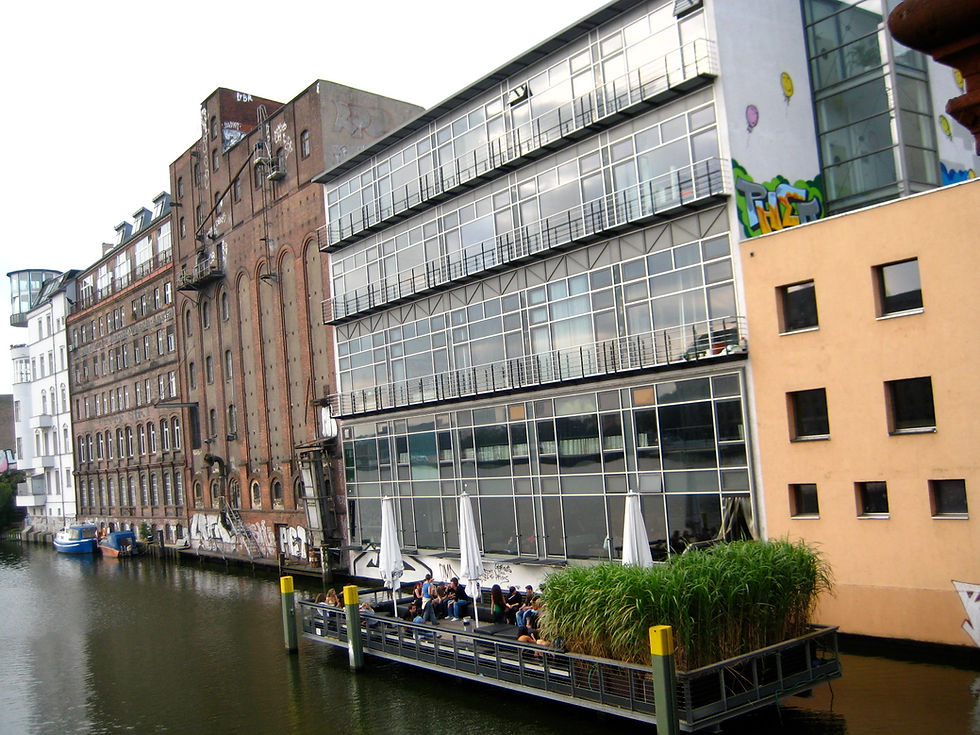
Watergate from the Oberbaumbrücke. It ran for 22 years and closed for good at the end of 2024.
What I would actually do
If you have one night and you want it to work, the plan is boring and it works.
1. Pick the night, not the club. Look at what is on and be able to say a name at the door. 2. Go in a pair, or alone. Split a bigger group before you join the queue, not in it. 3. Arrive off-peak. Before midnight on Friday, or Sunday from midday onward. 4. Wear something dark, comfortable and unremarkable, and then stop thinking about it. 5. Bring cash, keep the phone in your pocket, and have a second door in mind before you need one.
That last point is the one the map above is really for. A no at one door is a normal Berlin evening, not a verdict on you, and there is almost always something open within a twenty minute walk.
If you are also spending the daylight hours here, my free walking tour covers eleven stops and sixteen places across the historic centre in about two hours, and it starts late enough in the morning to survive a proper Berlin night. There is also a guide to what to wear to Berlin clubs if you still want the clothes answer, and one on how to get into Berghain for the single hardest door.
Image credits
Source and licence details for the 4 photographs used in this article.
The entrance gate of the Sisyphos nightclub on Hauptstrasse, Berlin: Marcus Grbac, CC BY 2.0, via Wikimedia Commons.
The Holzmarkt site on the bank of the Spree, Berlin: Felix Winkelnkemper, CC BY 2.0, via Wikimedia Commons.
The Bärenquell brewery halls on Schnellerstrasse in Niederschöneweide, Berlin: Neuköllner, CC BY-SA 4.0, via Wikimedia Commons.
The approach to Berghain and Panorama Bar, Berlin: Darkroomduck, CC BY-SA 4.0, via Wikimedia Commons.