Berlin Bike Lanes: What Tourists Must Know Before Walking or Riding
- Yusuf Ucuz

- Jun 28
- 7 min read
Berlin bike lanes can surprise visitors because they often look like extra pavement. They are not. Some are red, some are painted, some are separated by plastic kerbs, some run beside tram stops, and some appear exactly where a tired tourist wants to stand with a suitcase.
The useful rule is simple: treat every marked bike lane as live traffic space, not as spare sidewalk. That is true whether you are walking, renting a bike, stepping out of a taxi, or trying an e-scooter for three minutes.
This guide is not written for commuters. It is for tourists who need the reflexes fast: where to stand, where to ride, where not to park, and how to avoid the classic Berlin moment where a cyclist rings at you because you are blocking the lane without realizing it.
Berlin bike lanes: the short answer
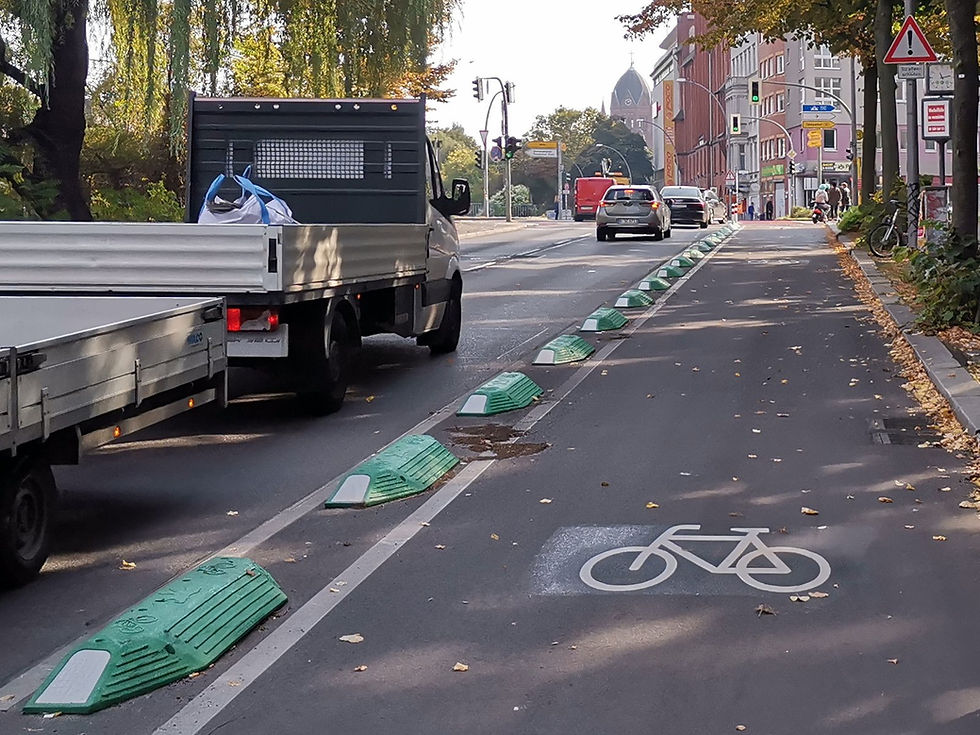
Caption: The safest tourist reflex is to treat a marked bike lane as active traffic space, not as spare pavement.
If you are walking, stay out of marked bike lanes. If you are cycling, use the road or bike infrastructure, not the sidewalk. If you are on an e-scooter, use cycle infrastructure where it exists and do not ride on pavements.
Berlin is not Copenhagen, but bikes are part of daily traffic here. The official visitBerlin safe-cycling advice tells riders to cycle on the right, watch car doors, avoid red lights, and never ride on the pavement. The legal baseline is in the German Road Traffic Regulations: StVO section 2 says bicycle paths are mandatory only when signed with the right blue signs, but it also makes clear that bikes belong in traffic space, not randomly on sidewalks.
For tourists, the law matters less than the reflex. Look down before you stop. Look both ways before crossing a bike lane. Do not stand in the red strip for a photo, a map check, or a suitcase regroup.
Use this Berlin bike lane reflex checker
The hardest part is not memorizing German traffic law. It is recognizing the situation quickly. Use the checker below for the moment you are actually in: walking, riding, scooting, crossing, parking, or carrying a bike onto public transport.
The checker is deliberately practical. It gives you the move first, then the reason, because in Berlin bike lanes you often have two seconds to make the polite choice.
Why Berlin bike lanes confuse tourists

Caption: Red or painted lanes are often exactly where visitors are tempted to stand. Step out before checking your phone.
Berlin bike lanes are not one single design. On the same day you might see:
a red lane painted beside the curb
a narrow lane between parked cars and traffic
a protected lane with small kerbs or bollards
a shared pedestrian-and-bike path marked by blue signs
a bicycle street, or Fahrradstrasse, where bikes have priority
a normal road where cyclists simply ride with traffic
That variety is why visitors guess wrong. A red lane can look like a clean walking strip. A protected lane can look like a quiet place to drag luggage. A bike-priority street can look like a backstreet where walking in the middle is harmless.
The safest tourist habit is this: if there is a bicycle symbol, a red strip, a blue bike sign, or a line separating pavement from bike traffic, step out of it before you stop.
Use this Berlin cycleway network map before you choose a rental
Berlin bike lanes make more sense when you can see the actual network. The map below loads mapped OpenStreetMap cycle infrastructure for the visible area: dedicated cycle paths, painted bike lanes, bicycle streets, and shared or designated bike paths.
Use it like a practical pre-rental check. Jump to the part of Berlin you are considering, zoom in around your route, then load the visible area. Dense lines are useful, but they do not automatically mean the ride is calm. Junctions, tram tracks, construction, crowds, and station exits still matter.
If the map shows a connected route and the street layout looks readable, a rental bike may fit your day. If the first stretch already looks busy, broken, or luggage-heavy, Berlin public transport may be the calmer first move.
If you are walking: the lane is not a waiting room
Most visitor conflicts happen when pedestrians stop without noticing the ground. You look at Google Maps, wait for friends, take a photo, or step around a cafe table. Suddenly you are in the bike lane.
Do not stand in a Berlin bike lane for:
map checks
photos
hotel regrouping with luggage
stroller pauses
taxi pickup confusion
traffic-light waiting if the bike lane runs beside the crossing
The polite move is boring and effective: move fully onto the pedestrian pavement first, then stop. If the pavement is narrow, stop beside a building wall, tree pit, bench, or shopfront instead of halfway across the bike strip.
At crossings, look for bikes before you step. Cyclists can come faster than you expect, especially on long straight lanes such as Karl-Marx-Allee, Tempelhofer Damm, Hasenheide, or the approaches around larger stations.
If you rent a bike: sidewalks are the trap
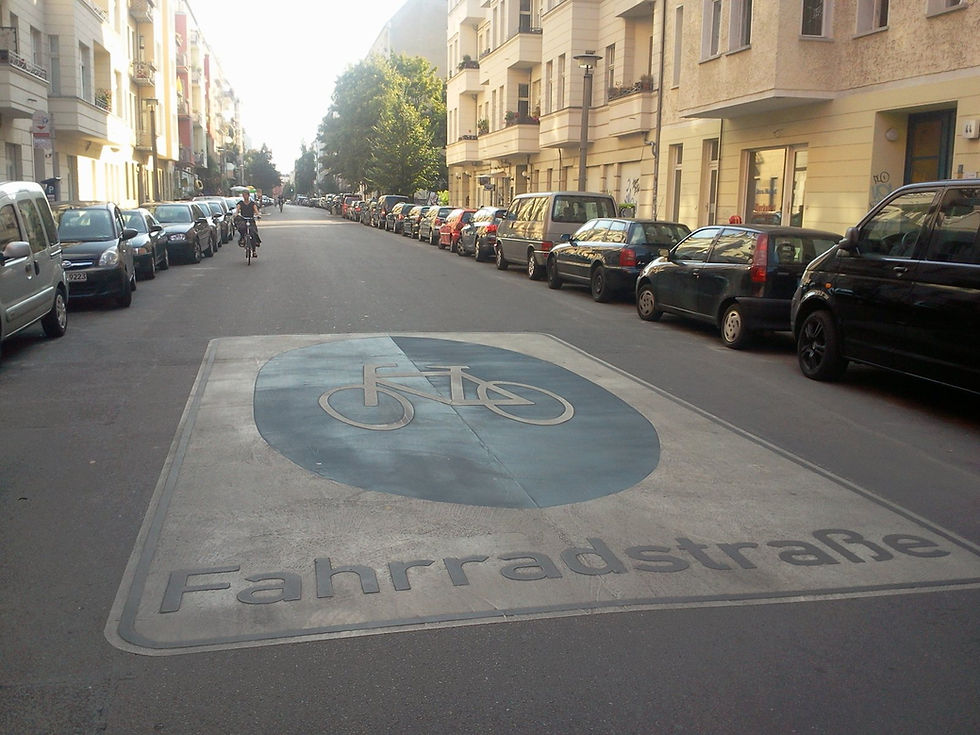
Caption: A Fahrradstrasse is bike-priority street space. It is different from a normal pedestrian pavement.
Berlin is a good city to cycle in, but it is not a theme-park path system. If you rent a bike, the default is not "ride wherever feels calm." The default is: use the road or proper bike infrastructure.
The official visitBerlin advice is blunt: do not cycle on the pavement. That one rule prevents many tourist mistakes. Sidewalk riding feels safer for the rider, but it pushes the risk onto pedestrians, children, wheelchairs, dog walkers, and people stepping out of doorways.
There are important child exceptions in StVO section 2: children up to 8 must use the sidewalk, children up to 10 may use it, and an accompanying adult may use the sidewalk while accompanying a child up to 8. Even then, pedestrians must not be endangered or obstructed, and riders must dismount before crossing the road.
For adult visitors, the working rule is easier: do not ride on the sidewalk unless a sign specifically allows it.
Red lights, doors and tram tracks
Berlin cycling looks relaxed until it suddenly is not. The three places tourists get into trouble are red lights, parked cars, and tram tracks.
Red lights: do not copy a local rider who jumps one. You do not know the timing, the junction shape, or whether police are nearby.
Car doors: keep space from parked cars. The door zone is one of the least obvious risks for visitors because a quiet parked row can become a sudden obstacle.
Tram tracks: cross tracks as close to a right angle as you safely can. A shallow angle can catch a wheel, especially when the road is wet.
Add one more Berlin habit: watch for delivery vans and turning cars. A protected lane helps, but it does not make every junction simple.
E-scooters: use bike space, not the pavement

Caption: E-scooters should not turn sidewalks into obstacle courses. Ride and park them with pedestrian space in mind.
E-scooters are where many visitors misunderstand the rules. They feel like toys. Legally and practically, they belong much closer to bike traffic.
The federal eKFV section 10 says electric micro-vehicles inside built-up areas must use cycle paths, shared or separated cycle-and-foot paths, cycle lanes, or bicycle streets when those exist. If they do not exist, riders use the road or traffic-calmed areas. Berlin.de's e-scooter guidance also says electric scooters may not be ridden on sidewalks or pedestrian zones, and violations may lead to a fine.
Parking matters too. Do not leave a scooter across the pavement, in front of a ramp, at a crossing, in a doorway, or in the middle of a bike lane. Put it where a wheelchair, stroller, cyclist, and blind pedestrian can still move without a zigzag.
If the route feels too busy for a scooter, that is useful information. Park it properly and walk.
Bikes on public transport
You can take bicycles on parts of Berlin public transport, but it is not a magic escape button. Berlin.de explains that bicycles can travel on regional trains, S-Bahn, U-Bahn and trams in marked carriages when space is available. Wheelchairs and strollers have priority, and a bicycle ticket is required.
For tourists, this means:
do not force a bike into a packed train
use marked doors and carriages
let wheelchairs and strollers take priority
buy the correct bicycle ticket before boarding
avoid rush-hour bike transfers if your timing is flexible
If your hotel is far from the center, compare cycling with normal public transport first. My Berlin public transport guide is the better starting point for most first days, and the alternative transport guide helps when you are choosing between bikes, scooters, car share, taxi, and walking.
Five tourist mistakes with Berlin bike lanes
1. Treating red paint as decoration. Red paint usually means "pay attention," not "walk here."
2. Waiting in the lane at crossings. Stand behind the pedestrian line or on the pavement, not inside the cycle path.
3. Riding on the sidewalk because traffic feels scary. If the road feels too stressful, return the bike and walk or take transit.
4. Parking scooters where the trip ends instead of where people can pass. Convenience for you can become an obstacle for everyone else.
5. Assuming every blue sign means the same thing. Some signs create mandatory cycle paths, some mark shared paths, and some separate bikes and pedestrians. If you are unsure, slow down and choose the least intrusive move.
Where this matters on a first Berlin day

Caption: Berlin bike lanes change shape from street to street. The reflex stays the same: look down before you stop.
Bike-lane awareness matters most when you are tired, carrying luggage, or walking in a group. The dangerous moment is not usually a dramatic intersection. It is the small pause: someone checks the map, one person steps sideways, the group expands, and the bike lane disappears under your feet.
On my BerlinWalk route, I point out practical city habits as they appear: how crossings work, why Berlin pavements change suddenly, where traffic feels calm but is not, and how to move through the historic center without drifting into local commuter space. The tour lasts 2 hours, and it is on foot, but the same rule helps all day: pause where Berlin expects pedestrians to pause.
If you want that first orientation before renting anything, book the BerlinWalk tip-based walking tour first, then decide whether a bike or scooter actually fits your day.
The calm tourist rule
You do not need to fear Berlin bike lanes. You just need to notice them.
Before you stop, look down. Before you cross, look both ways. Before you ride, check whether you belong on a lane, a road, or a shared signed path. Before you park, ask whether someone with wheels, a stroller, or a cane can pass without moving around your choice.
That is the whole reflex. It is small, but it makes Berlin feel much easier.
Image Credits
Cover image and protected-lane images: SupapleX, via Wikimedia Commons, CC BY-SA 4.0. E-scooter image: Geoprofi Lars, via Wikimedia Commons, CC BY-SA 4.0. Fahrradstrasse image: Berlinschneid, via Wikimedia Commons, CC BY-SA 3.0.