Baltic Sea Day Trip from Berlin: Which Beach to Pick and How the Trains Work

Every July the same scene repeats at Schlachtensee and Wannsee: towels edge to edge, queues for ice cream, and someone next to you saying there is no real escape from the heat in Berlin. There is. Berlin is a landlocked city with a sea problem nobody talks about: the Baltic coast starts less than three hours north by train, with proper sand, proper waves and a lighthouse instead of a lifeguard hut. I take that train a few times every summer, and the difference between a great sea day and a wasted one is never the beach. It is the plan.
My advice: do not try to "see the Baltic" in one day. Pick one beach town, take the earliest train you can face, and treat the return timetable as the law. I have made the other mistake before, three towns in one day on paper, and it turns a sea day into a regional-train marathon with twenty minutes of actual sand. Here is how the three realistic options compare, and the exact train logic for each.

Warnemünde beach with its 1898 lighthouse and the curved Teepott roof. This is the closest real sea to Berlin.
The honest math of a Baltic Sea day trip from Berlin
The Baltic Sea day trip from Berlin is an hours problem before it is anything else. The three towns worth the trip sit between two and a half and four hours from Berlin Hauptbahnhof, so you will spend five to eight hours of the day on trains. That sounds brutal, but German regional trains do the route directly, the ride through Mecklenburg is calm and green, and if you leave early you can still bank six hours by the water.
Three destinations cover almost every version of this trip:
Warnemünde is the fastest sand: change once in Rostock, and the beach starts 400 metres from the platform.
The Usedom imperial resorts, Heringsdorf and Ahlbeck, are the prettiest seaside architecture in Germany, at the cost of a longer ride.
Binz on Rügen is the grandest of all, and it sits right at the edge of what a sane day trip allows.
One reassurance for summer travellers who have read about Berlin's big 2026 rail closure: the east-west Stadtbahn is closed for regional trains until December, but the Baltic routes are not affected in the same way. The trains north leave from the low-level platforms at Hauptbahnhof and stop at Gesundbrunnen, so you board in the city centre as normal. My guide to leaving Berlin by train explains the closure in full.
Warnemünde: the fastest way to real sand
If you just want the sea with the least logistics, this is the answer. Take the RE5 from Berlin Hauptbahnhof towards Rostock, change onto the local S-Bahn, and 21 minutes later you are in Warnemünde, a fishing village that grew into Rostock's beach suburb. On the typical summer timetable the 06:46 RE5 puts you on the sand just after 10:00, and the whole trip runs on a Deutschlandticket.

The Rostock S-Bahn at Warnemünde station. From this platform you can be barefoot in the sand within ten minutes.
The beach is the widest I know on the German Baltic, a huge apron of pale sand backed by the old lighthouse from 1898 and the Teepott, a curved GDR-era shell roof that looks like a seagull mid-landing. Climb the lighthouse for 3 euros if it is open, daily 10:00 to 18:30 in season; the view sorts the whole coastline out for you in five minutes.
Between station and beach runs the Alter Strom, the old harbour channel, and this is where the food plan writes itself: fishing boats and kiosks sell Fischbrötchen, the north German fish roll, and eating one on the harbour edge is the whole ritual. A beach chair, the hooded wicker Strandkorb, rents for about 15 euros a day and is worth every cent on a windy day, which on the Baltic is most days. Warnemünde also charges day visitors a small beach fee of 2.25 euros, collected at machines and kiosks along the promenade.

The Alter Strom, Warnemünde's old harbour channel. Buy the fish roll here, then walk the two minutes to the sand.
One honest warning: on cruise-ship days the town centre gets crowded around midday. The fix is simple, walk ten minutes north along the beach and the crowd thins to locals with dogs and kites.

The Baltic wind is free entertainment. Warnemünde's beach is wide enough that even a busy day leaves room.
Usedom: piers, emperors and a walk to Poland
The second option trades speed for beauty. Usedom's Kaiserbäder, the imperial resorts of Heringsdorf, Ahlbeck and Bansin, are where Berlin's rich built their white seaside villas over a century ago, and the whole strip still looks the part. From Berlin the RE3 runs to Züssow, where a small local train, the RB23 of the Usedom resort railway, carries you through the pines to the coast. Plan on roughly four hours door to sand; the early train out of Hauptbahnhof around 05:22 reaches Heringsdorf by 09:25, all on the Deutschlandticket.

The Ahlbeck pier, standing in the Baltic since 1898. It is the oldest pier in Germany and the emblem of Usedom.
Two piers anchor the day. The Ahlbeck Seebrücke from 1898 is the oldest in Germany, a white pavilion on stilts that you have seen on postcards even if you never knew its name. Twenty minutes along the promenade, the Heringsdorf Seebrücke stretches 508 metres into the sea, the longest in the country. Walking one, then the other, with a swim in between, is already a complete day.
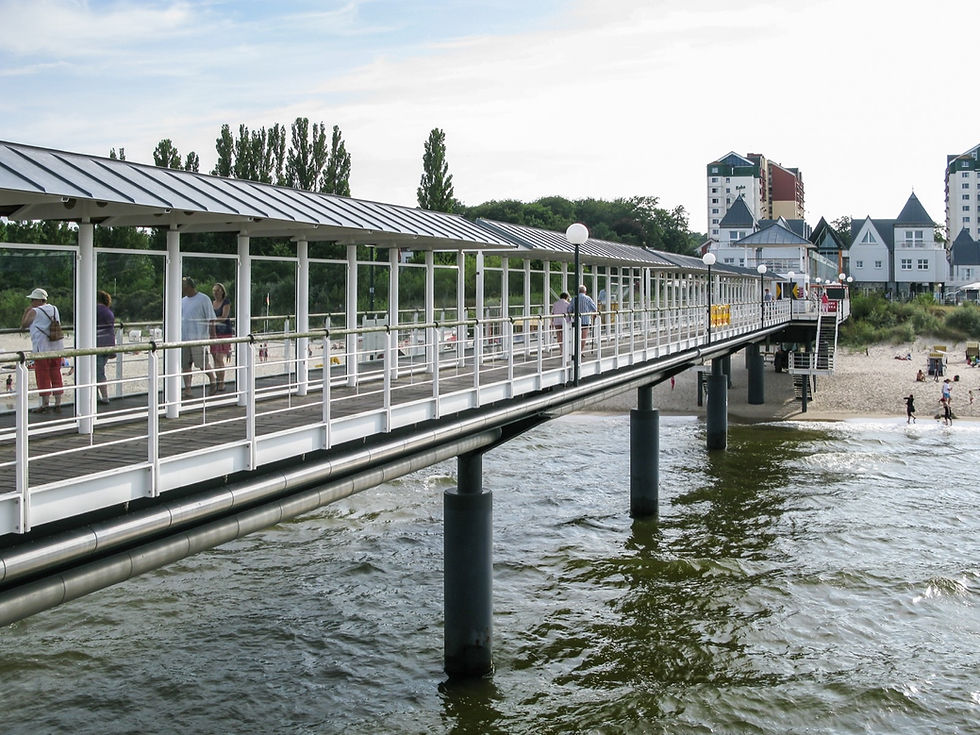
The Heringsdorf pier runs 508 metres out into the water. The sea air here was once prescribed as medicine.
The bonus nobody expects: keep walking east from Ahlbeck along the beach promenade and in about half an hour you cross into Świnoujście, Poland, on foot, mid-beach, with nothing but a marker stone to announce it. A sea day that includes strolling into another country is a very Usedom trick. Day visitors in the Kaiserbäder pay a spa fee too: 3.70 euros in the 2026 main season.
Binz on Rügen: the grand one, at the limit
Binz is the postcard: a long white beach, the huge Kurhaus hotel, streets of carved resort villas, and the chalk-cliff island of Rügen behind it. It is also the hardest to justify in one day. The fastest regional connections need around four hours with changes. The 2026 summer timetable also has direct ICE services from Berlin, including a morning train that can reach Binz around 12:42; those need a separate ticket on top of any Deutschlandticket.

Binz on Rügen, with the Kurhaus above the beach. Gorgeous, and honestly better as an overnight than a day trip.
My honest verdict: do Binz as a day trip only if the day is long, the forecast is perfect and you like trains. Arriving at noon and leaving by early evening gives you five hours of a place that deserves two days. If Rügen is calling, make it an overnight; if you have exactly one free day, Warnemünde or Usedom will treat you better. For more one-day escapes in every direction, my day trips from Berlin guide ranks the field.
Trains, tickets and the return you must not miss
The ticket logic is simple once you see it. Every regional connection above runs on the Deutschlandticket, 63 euros a month in 2026, which is why it is the default answer for Baltic days; my Deutschlandticket guide for tourists covers where to buy it and when it pays off. InterCity and ICE trains need a normal DB ticket instead, and an advance Sparpreis fare often costs less than people expect. Check exact times for your specific day in the DB journey planner, because summer weekends and construction can shift individual trains.
The return train is where day trips die, so I plan it before I leave. The pattern worth memorising on the current summer timetable:
From Warnemünde, regional returns run into the evening, roughly hourly until about 21:00, with the last realistic connection arriving in Berlin after midnight.
From Heringsdorf, the last comfortable connection leaves around 19:33 and reaches Berlin around 23:33.
From Binz, aim for the trains between 16:00 and 18:00; later options exist but arrive well past midnight.
Give yourself a fifteen-minute buffer at the station, buy water before boarding, and remember that the last train north of Berlin is not a theory you want to test. Arriving back at Berlin Hauptbahnhof at 23:00 with sand in your shoes is the good ending.
I built the planner below to make the trade-off visible. Pick when you can leave Berlin, whether you are travelling on a Deutschlandticket, and when you need to be back: it races all three coasts against each other and shows how much actual beach time each one pays out, leg by leg.
Small print for a smooth sea day
The water is honest Baltic: in high summer it usually sits between 17 and 20 degrees. Swimmable, refreshing, never Mediterranean.
Wind is part of the deal. A light jacket earns its place in the bag even in July, and the Strandkorb exists for a reason.
Bring a card and some coins: beach fees and Strandkorb rentals are small amounts, and kiosks on the promenade do not all take cards.
Sundays and Saturdays fill the trains on perfect-forecast days. Board early at Hauptbahnhof for a window seat, or start from Gesundbrunnen.
One last planning thought. If you have only two or three days in Berlin, do not spend one of them on the coast; the city's own lakes deliver ninety percent of the swim for ten percent of the travel. The Baltic day is for trips of four days and more, when one day by the sea resets you for the rest. And if the city part of your trip is just starting, join my free Berlin walking tour first: two hours through the historic centre, and I am happy to talk beach logistics at the end.
Image credits
Source and licence details for the 7 photographs used in this article.
Warnemünde beach with lighthouse and Teepott: W. Bulach, CC BY-SA 4.0, via Wikimedia Commons.
Rostock S-Bahn at Warnemünde station: Lukas Beck, CC BY-SA 4.0, via Wikimedia Commons.
Alter Strom harbour channel in Warnemünde: Bahnfrend, CC BY-SA 4.0, via Wikimedia Commons.
Kites over Warnemünde beach: Dirk Vorderstraße, CC BY 3.0, via Wikimedia Commons.
Ahlbeck pier from above: Zeppelubil / Th. Haft, CC BY-SA 3.0, via Wikimedia Commons.
Heringsdorf pier walkway: Dietmar Rabich, CC BY-SA 4.0, via Wikimedia Commons.
Binz beach and Kurhaus on Rügen: Dirk Schmidt (Celsius auf Wikivoyage), CC BY-SA 3.0, via Wikimedia Commons.