Air Conditioning in Berlin: Do Hotels Have It, and How to Stay Cool
- Yusuf Ucuz

- Jul 10
- 7 min read
Updated: Jul 22
Most people who book a Berlin summer trip assume the room will be cool. Then they arrive in the last week of June, walk into a beautiful old apartment on the third floor, and realise the windows only open onto still, warm air and there is no air conditioning anywhere in the building. That exact scene played out across the city this year, when the late-June heat pushed Germany to a preliminary national record of about 41.8°C before things settled back down for early July. If you are coming in high summer, the room you sleep in matters more than most guides admit.
This is a practical guide to air conditioning in Berlin: why so few places have it, how to check before you book, and the very ordinary tricks Berliners use to keep an apartment liveable in a heatwave without any AC at all. I have spent enough hot Julys in Berlin flats to know the difference a fan and a closed shutter can make.

A very normal Berlin flat in July: tall old windows thrown open, a fan on the floor, and not an air-conditioning unit in sight.
Do Berlin hotels have air conditioning?
Some do, many do not, and the honest answer is that you cannot assume it. Big international chains, newer builds and business hotels usually have proper AC. Motel One, Adina, the larger Steigenberger and similar mid-to-upper chains are the safer bets if a cool room is non-negotiable. Small family-run hotels, guesthouses, hostels and most apartment rentals in Berlin's classic old buildings often have no air conditioning at all.
This is not laziness on the hosts' part. It reflects how the country lives: fewer than one in twelve German homes has any form of active air conditioning, and even after several hot summers a 2025 survey put ownership at around 18 percent, up from 13 percent two years earlier. Berlin was built for cold winters, not tropical Augusts, so cooling was simply never standard.
The practical rule: if you are travelling in July or August and heat bothers you, treat air conditioning as a feature to search for, not a default to expect. On booking sites, use the "air conditioning" filter, then read recent summer reviews, because a listing can tick the box while only the lobby or the renovated wing is actually cooled. If it really matters, send the hotel a one-line email and ask them to confirm the room you booked has working AC. I have seen guests arrive sure they were covered, only to find the cool rooms were on the other side of the building.
Why so much of Berlin has no AC
Walk into any classic Berlin Altbau, one of the tall pre-1914 apartment buildings that fill neighbourhoods like Prenzlauer Berg, Kreuzberg and Neukölln, and you will see the reason. Thick masonry walls, high ceilings and deep courtyards were designed to hold winter heat in and let summer heat rise away from you. For most of the year that logic still works, and for the two or three genuinely brutal weeks it does not, Germans reach for shading and airflow instead of a compressor.

The heat outside is exactly why the room you sleep in matters. A cloudless summer afternoon at Alexanderplatz can push well past 30°C.
There is also a cultural and legal side. Retrofitting AC into a protected old building is expensive and often not allowed, electricity is costly, and there is a strong environmental reluctance to install energy-hungry cooling. Renters rarely get to make that call anyway. The result is a city that mostly keeps cool the old way.
The German method: shutters by day, air by night
The single most useful habit to steal is how Germans use shade. Many buildings have external roller shutters, called Rollladen, that pull down over the outside of the window. Closing them on the sunny side during the day blocks the sunlight before it ever hits the glass, and studies of exterior shading put the cooling effect at roughly a quarter to a third of the heat load, far better than any interior curtain. If your room has them, the move is simple: shutters or curtains down and windows shut through the hot afternoon, then everything thrown open once the outside air finally drops in the evening.
That night airing has a name too, Stoßlüften, short bursts of wide-open cross-ventilation rather than a permanently tilted window. Open windows on opposite sides of the flat for ten or fifteen minutes and you pull the day's trapped heat straight out.
How to keep your Berlin room cool without AC
If you land in a hot spell and your room has no air conditioning, you are not stuck. Here is what actually works, roughly in order of how much difference it makes.
Block the sun early. Close shutters, blinds or curtains on the sunlight side before the room heats up in the late morning, not after. Keeping the sun out is far easier than cooling a room that has already baked.
Get the timing of your windows right. Keep windows closed while the outside air is hotter than the room, usually from late morning to early evening, then open them wide once the evening cools. Berlin nights in summer often drop to a comfortable 13-18°C, which is your best free source of cooling.
Get a fan on day one. A cheap floor or tower fan changes everything, and pointing it across an open window at night moves cool air through the room. Buy one early from a drugstore or electronics shop, because they genuinely sell out during a heatwave. Many hotels will also lend you one from reception if you ask, so ask before you assume they cannot help.
Aim lower if you are still choosing a room. Top-floor and attic rooms bake hardest under the roof; a lower floor or a room facing a shaded courtyard rather than the afternoon sun stays noticeably cooler.
Small tricks add up. A damp towel or a bowl of cold water in the fan's airflow, a cool shower before bed, and light bedding all help you sleep through a warm night.
The tool below turns all of that into one quick check. Tell it your room type, floor, which way the windows face and how hot the forecast is, and it gives you a plain heat-risk read plus the two or three moves that matter most for your exact room.
Where to escape the heat during the day
The other half of staying comfortable is not being in your room during the worst of it. Berlin is unusually good at this, because so much of what you would want to see is either cool inside or built around water.
For a cool indoor block, the big museums are your friends: Museum Island and the Humboldt Forum have thick walls, calm interiors and long exhibitions that happily eat the hottest hours of the afternoon. Large stations and shopping centres like Berlin Hauptbahnhof or the malls at Alexanderplatz are cool, free and easy to duck into, even if you are just passing through.

Big stations and malls like Hauptbahnhof are some of the easiest free places to cool down in the middle of a Berlin heatwave.

The Humboldt Forum and the Museum Island buildings hold their cool, which makes the middle of the day the right time to be inside them.
One warning that surprises visitors: do not count on the U-Bahn to cool you down. BVG states plainly on its own air-conditioning page that the underground trains are not air conditioned and rely on ventilation instead. Buses and most trams do have cooling, but only by a few degrees. On a 35°C afternoon, an underground platform is one of the hottest places in the city.
When the buildings are not enough, do what locals do and go to the water. Berlin is ringed with lakes and dotted with pools, and switching your afternoon to a swim is often the smartest heat plan there is. My guides to the best Berlin lakes and the city's swimming pools cover where to go and how to get there.
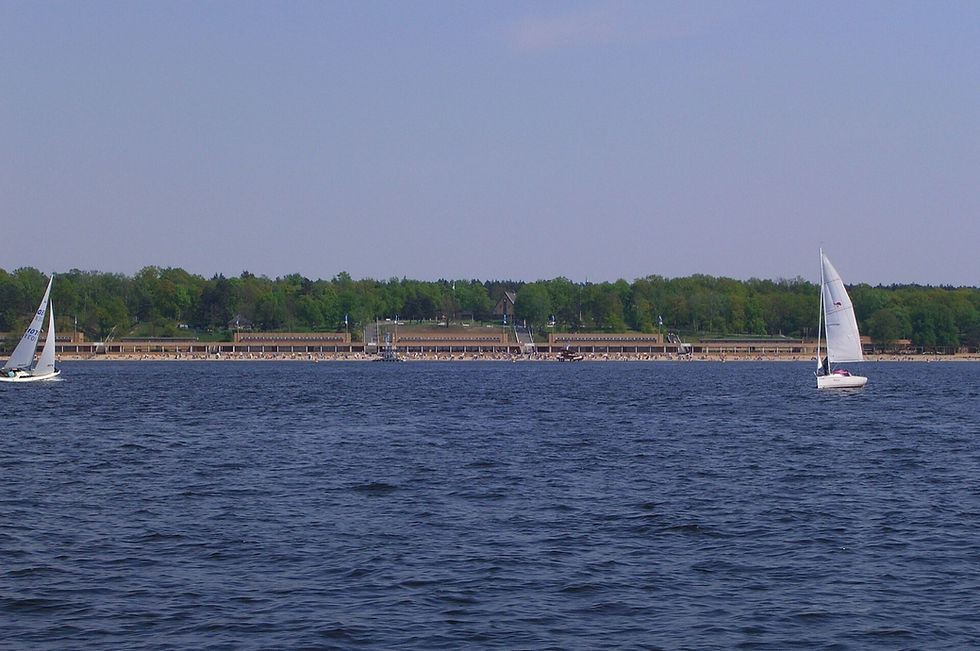
When your room is too warm and the museums are full, Berliners just leave for the water. Strandbad Wannsee is the classic version.
Booking and planning around a Berlin heatwave
If you already know you are coming in peak summer, a little planning removes most of the risk. Book a room with confirmed AC if you sleep badly in heat, or at least a lower-floor, courtyard-facing room in a solid old building. Berlin heat comes in short, sharp episodes rather than a steady tropical season, so it helps to check the forecast a few days out; the official German warning portal at warnung.bund.de carries the national heat warnings.
It is also worth understanding what a normal Berlin summer actually looks like, because the record-breaking days are the exception. My month-by-month Berlin temperature guide and the detailed Berlin in July guide lay out the real highs and lows, and my Berlin heatwave day plan goes deeper on structuring a single very hot day. If you are still deciding where to base yourself, where to stay in Berlin covers the neighbourhoods.
My own free walking tour runs in the late morning through the historic centre between Alexanderplatz and Hackescher Markt, which is deliberately the cooler, shaded part of a summer day, before the heat peaks in the afternoon. If you want the evenings sorted too, the free Berlin trip planner can shape your days around the weather and leave the hottest hours for a museum or a lake. Berlin does summer differently from a Mediterranean city. Once you stop expecting a cold hotel room and start using shade, timing and water the way locals do, a heatwave here becomes very manageable.
Image credits
Berlin Hauptbahnhof interior by Daderot (CC0 1.0, via Wikimedia Commons). Humboldt Forum courtyard by Derbrauni (Creative Commons, via Wikimedia Commons). Other images are BerlinWalk assets.